


JEE Mains · Chemistry · STD 12 - 5. Co-ordination chemistry
The spin only magnetic moment of \(\left[ Mn \left( H _2 O \right)_6\right]^{2+}\) complexes is \(........B.M.\) (Nearest integer)(Given : Atomic no. of \(Mn\) is \(25\) )
- A \(3\)
- B \(6\)
- C \(9\)
- D \(12\)
Answer & Solution
Correct Answer
(B) \(6\)
Step-by-step Solution
Detailed explanation
\(\left(\left[ Mn \left( H _2 O \right)_6\right]^{2+}\right.\) \(Mn ^{2+}=3 d ^5\) \(\mu=\sqrt{5(5+2)}=5.91\,BM\)
See the Complete Solution
Get step-by-step explanations for this and 2.5 Lakh+ more JEE, NEET & CET questions.
- Unlock all solutions
- Practice the full chapter
- Track accuracy across PYQs
4.8 rated on Google Play · 14,000+ reviews
More questions from Chemistry
- Match List - I with List - II.
Choose the correct answer from the options given below :List - I (Reaction) List - II (Type of redox reaction) (A) Li (I) 589.2 (B) Na (II) 455.5 (C) Rb (III) 670.8 (D) Cs (IV) 780.0 JEE Mains 2024 Medium - Consider the following compound (X).
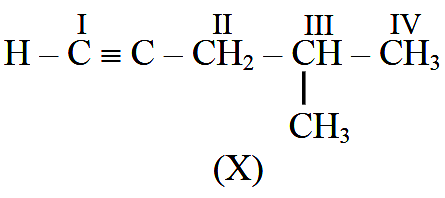
The most stable and least stable carbon radicals, respectively, produced by homolytic cleavage of corresponding \(\mathrm{C}-\mathrm{H}\) bond are :JEE Mains 2025 Medium - The following ligand is
 JEE Mains 2019 Hard
 - Identify the incorrect statements about group \(15\) elements : \((A)\) Dinitrogen is a diatomic gas which acts like an inert gas at room temperature. \((B)\) The common oxidation states of these elements are \(-3,+3\) and +5 . \((C)\) Nitrogen has unique ability to form \(\mathrm{p} \pi-\mathrm{p} \pi\) multiple bonds. \((D)\) The stability of +\(5\) oxidation states increases down the group. \((E)\) Nitrogen shows a maximum covalency of \(6\). Choose the correct answer from the options given below.JEE Mains 2024 Medium
- For the given cell ; \(Cu ( s )\left| Cu ^{2+}\left( C _{1} M \right) \| Cu ^{2+}\left( C _{2} M \right)\right| Cu ( s )\) change in Gibbs energy \((\Delta G )\) is negative, if :JEE Mains 2020 Medium
- For the following reactions, equilibrium constants are given \(S\left( s \right) + {O_2}\left( g \right) \rightleftharpoons S{O_2}\left( g \right);{K_1} = {10^{52}}\) \(2S\left( s \right) + 3{O_2}\left( g \right) \rightleftharpoons 2S{O_3}\left( g \right);{K_2} = {10^{129}}\) The equilibrium constant for the reaction \(2S{O_2}\left( g \right) + {O_2}\left( g \right) \rightleftharpoons 2S{O_3}\left( g \right)\) isJEE Mains 2019 Medium
More PYQs from JEE Mains
- Observe the following equilibrium in a 1 L flask.
\(A(g) \rightleftharpoons B(g)\)
At T(K), the equilibrium concentrations of A and B are 0.5 M and 0.375 M respectively. 0.1 moles of A is added into the flask and heated to T(K) to establish the equilibrium again. The new equilibrium concentrations (in M) of A and B are respectively.JEE Mains 2026 Medium - Consider the following half cell reaction
\(\mathrm{Cr}_2 \mathrm{O}_7^{2-}(\mathrm{aq})+6 \mathrm{e}^{-}+14 \mathrm{H}^{+}(\mathrm{aq})\) \(\rightarrow 2 \mathrm{Cr}^{3+}(\mathrm{aq})+7 \mathrm{H}_2 \mathrm{O}(\mathrm{l})\)
The reaction was conducted with the ratio of \(\frac{\left[\mathrm{Cr}^{3+}\right]^2}{\left[\mathrm{Cr}_2 \mathrm{O}_7^{2-}\right]}=10^{-6}\). The pH value at which the EMF of the half cell will become zero is ________. (nearest integer value)
[Given : standard half cell reduction potential
\(\left.\mathrm{E}_{\mathrm{Cr}_2 \mathrm{O}_7^{2-}, \mathrm{H}^{+} / \mathrm{Cr}^{3+}}^{\mathrm{o}}=1.33 \mathrm{~V}, \frac{2.303 \mathrm{RT}}{\mathrm{~F}}=0.059 \mathrm{~V}\right]\)JEE Mains 2025 Hard - The maximum number of possible oxidation states of actinoids are shown byJEE Mains 2019 Medium
- The area enclosed by the curves \(y=\log _{ t }\left( x + e ^{2}\right)\), \(x=\log _{ e }\left(\frac{2}{ y }\right)\) and \(x =\log _{ e } 2\), above the line \(y =1\) is.JEE Mains 2022 Hard
- Two billiard balls of mass \(0.05\,kg\) each moving in opposite directions with \(10\,ms ^{-1}\) collide and rebound with the same speed. If the time duration of contact is \(t=0.005\,s\), then \(\dots N\)is the force exerted on the ball due to each other.JEE Mains 2022 Medium
- If the two lines \(l_{1}: \frac{ x -2}{3}=\frac{ y +1}{-2}, z =2\) and \(l_{2}: \frac{x-1}{1}=\frac{2 y+3}{\alpha}=\frac{z+5}{2}\) perpendicular, then an angle between the lines \(l_{2}\) and \(l_{3}: \frac{1- x }{3}=\frac{2 y -1}{-4}=\frac{ z }{4}\) isJEE Mains 2022 Medium