


JEE Mains · Chemistry · STD 12 - Co-ordination chemistry
- JEE Mains 2026
- Medium
- MCQ
Which of the following complexes will show coordination isomerism?
A. \([Ag(NH_3)_2][Ag(CN)_2]\)
B. \([Co(NH_3)_6][Cr(CN)_6]\)
C. \([Co(NH_3)_6][Co(CN)_6]\)
D. \([Fe(NH_3)_6][Co(CN)_6]\)
E. \([Co(NH_3)_6][Fe(CN)_6]\)
Choose the correct answer from the options given below:
Pick an option to check your answer.
Answer & Solution
Correct Answer
(B) B, D and E Only
Step-by-step Solution
Detailed explanation
Coordination isomerism arises from the interchange of ligands between cationic and anionic entities of different metal ions present in a complex.
A. \([Ag(NH_3)_2][Ag(CN)_2]\): Both the complex cation and anion contain the same metal ion (\(Ag^+\)). Interchanging one ligand produces a neutral molecule \([Ag(NH_3)(CN)]\), and interchanging both ligands yields the identical compound. Thus, it does not show coordination isomerism.
B. \([Co(NH_3)_6][Cr(CN)_6]\): The complex contains different metal ions (\(Co^{3+}\) and \(Cr^{3+}\)). Interchange of ligands gives the coordination isomer \([Cr(NH_3)_6][Co(CN)_6]\). Thus, it shows coordination isomerism.
C. \([Co(NH_3)_6][Co(CN)_6]\): Both the complex cation and anion contain the same metal ion (\(Co^{3+}\)). According to the strict definition requiring different metal ions, this is generally excluded from being a primary example of coordination isomerism in standard contexts.
D. \([Fe(NH_3)_6][Co(CN)_6]\): The complex contains different metal ions (\(Fe^{3+}\) and \(Co^{3+}\)). Interchange of ligands gives the coordination isomer \([Co(NH_3)_6][Fe(CN)_6]\). Thus, it shows coordination isomerism.
E. \([Co(NH_3)_6][Fe(CN)_6]\): This is the coordination isomer of complex D. Since it contains different metal ions, it also shows coordination isomerism by interchanging ligands to form \([Fe(NH_3)_6][Co(CN)_6]\).
Since complexes D and E are coordination isomers of each other, they must both be included together. Therefore, the complexes that show coordination isomerism are B, D, and E.
Answer: B, D and E Only
More questions from Chemistry
- Given below are two statements: Statement \((I)\) : Both metal and non-metal exist in \(\mathrm{p}\) and \(d\)-block elements. Statement \((II)\) : Non-metals have higher ionisation enthalpy and higher electronegativity than the metals. In the light of the above statements, choose the most appropriate answer from the option given below:JEE Mains 2024 Hard
- \(1\) Faraday electricity was passed through \(\mathrm{Cu}^{2+}(1.5\) \(\mathrm{M}, 1 \mathrm{~L}) / \mathrm{Cu}\) and \(0.1\) Faraday was passed through \(\mathrm{Ag}^{+}(0.2 \mathrm{M}, 1 \mathrm{~L}) / \mathrm{Ag}\) electrolytic cells. After this the two cells were connected as shown below to make an electrochemical cell. The emf of the cell thus formed at 298 K is-
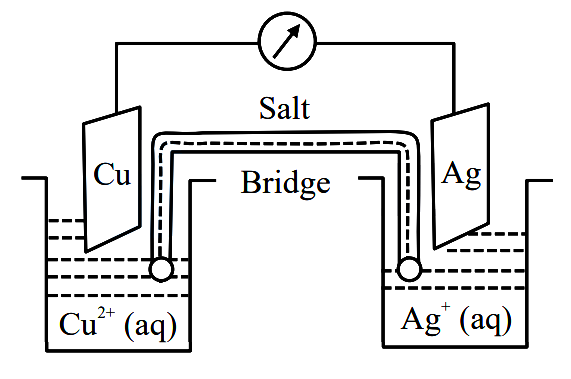
Given: \(\mathrm{E}_{\mathrm{Cu}^{2+} / \mathrm{Cu}}^{\mathrm{o}}=0.34 \mathrm{~V}\)
\(\mathrm{E}_{\mathrm{Ag}^{+} / \mathrm{Ag}}^0=0.8 \mathrm{~V}\)
\(\frac{2.303 \mathrm{RT}}{\mathrm{F}}=0.06 \mathrm{~V}\)JEE Mains 2025 Easy - A flask is filled with equal moles of \(A\) and \(B\). The half lives of \(A\) and \(B\) are \(100\, s\) and \(50 \,s\) respectively and are independent of the initial concentration. The time required for the concentration of \(A\) to be four times that of \(B\) is \(....\,s.\) (Given : \(\ln 2=0.693\) )JEE Mains 2022 Medium
- \(IUPAC\) name of following compound \((\mathrm{P})\) is
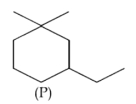 JEE Mains 2024 Hard
- Which one of the following statements is not true about enzymes ?JEE Mains 2021 Medium
- In an estimation of sulphur by Carius method \(0.2\) g of the substance gave \(0.6\) g of BaSO\(_4\). The percentage of sulphur in the substance is _____ %.
(Given molar mass in g mol\(^{-1}\) S : \(32\), BaSO\(_4\) : \(233\))JEE Mains 2026 Easy
More PYQs from JEE Mains
- A circular coil has moment of inertia \(0.8 \,kg m ^{2}\) around any diameter and is carrying current to roduce a magnetic moment of \(20\, Am ^{2}\). The coil is kept initially in a vertical position and it can rotate freely around a horizontal diameter. When a uniform magnetic field of \(4\, T\) is applied along the vertical, it starts rotating around its horizontal diameter. The angular speed the coil acquires after rotating by \(60^{\circ}\) will beJEE Mains 2020 Hard
- \(\frac{x}{x+4}\) is the ratio of energies of photons produced due to transition of an electron of hydrogen atom from its \((i)\) third permitted energy level to the second level and \((ii)\) the highest permitted energy level to the second permitted level. The value of \(x\) will be.JEE Mains 2022 Medium
- 10 mole of oxygen is heated at constant volume from \(30^{\circ} C\) to \(40^{\circ} C\). The change in the internal energy of the gas is _________ cal. (The molecular specific heat of oxygen at constant pressure, \(C _{ p }=7 cal . / mol ^{\circ} C\) and \(\left.R =2 cal . / mol ^{\circ} C .\right)\)JEE Mains 2026 Medium
- A magnet of total magnetic moment \({10\,^{ - 2}}\hat i\,A - {m^2}\) is placed in a time varying magnetic field, \(B\,\hat i\,\left( {\cos \,\omega t} \right)\) where \(B = 1\, Tesla\) and \(\omega = 0.125\, rad/s\). The work done for reversing the direction of the magnetic moment at \(t = 1\, second\), isJEE Mains 2019 Medium
- A transformer has an efficiency of \(80 \%\) and works at \(10 \mathrm{~V}\) and \(4 \mathrm{~kW}\). If the secondary voltage is \(240 \mathrm{~V}\), then the current in the secondary coil is _______.JEE Mains 2024 Hard
- A body of mass \(m\) is moving in a circular orbit of radius \(R\) about a planet of mass \(M\). At some instant, it splits into two equal masses. The first mass moves in a circular orbit of radius \(\frac{R}{2}\) , and the other mass, in a circular orbit of radius \(\frac{3R}{2}\). The difference between the final and initial total energies isJEE Mains 2018 Hard