


JEE Mains · Chemistry · STD 12 - Co-ordination chemistry
- JEE Mains 2026
- Medium
- MCQ
Which of the following sequences of hybridisation, geometry and magnetic nature are correct for the given coordination compounds ?
A. \([\text{NiCl}_4]^{2-}\) \(-\) sp\(^3\), tetrahedral, paramagnetic
B. \([\text{Ni(NH}_3)_6]^{2+}\) \(-\) sp\(^3\)d\(^2\), octahedral, paramagnetic
C. \([\text{Ni(CO)}_4]\) \(-\) sp\(^3\), tetrahedral, paramagnetic
D. \([\text{Ni(CN)}_4]^{2-}\) \(-\) dsp\(^2\), square planar, diamagnetic
Choose the correct answer from the options given below :
Pick an option to check your answer.
Answer & Solution
Correct Answer
(D) A, B and D only
Step-by-step Solution
Detailed explanation
In \([\text{NiCl}_4]^{2-}\), Ni is in \(+2\) oxidation state with a \(3d^8\) configuration. Since \(\text{Cl}^-\) is a weak field ligand, no pairing of electrons takes place. The hybridisation is \(sp^3\), the geometry is tetrahedral, and the presence of two unpaired electrons makes it paramagnetic. Thus, statement A is correct.
In \([\text{Ni(NH}_3)_6]^{2+}\), Ni is in \(+2\) oxidation state with a \(3d^8\) configuration. In an octahedral field, a \(d^8\) ion cannot form inner orbital complexes. It undergoes \(sp^3d^2\) hybridisation, forming an octahedral geometry. It has two unpaired electrons, making it paramagnetic. Thus, statement B is correct.
In \([\text{Ni(CO)}_4]\), Ni is in \(0\) oxidation state with a \(3d^8 4s^2\) configuration. Since \(\text{CO}\) is a strong field ligand, the \(4s\) electrons are forced to pair up in the \(3d\) orbitals, resulting in a \(3d^{10}\) configuration. The hybridisation is \(sp^3\), the geometry is tetrahedral, and since there are no unpaired electrons, it is diamagnetic. Statement C incorrectly lists it as paramagnetic.
In \([\text{Ni(CN)}_4]^{2-}\), Ni is in \(+2\) oxidation state with a \(3d^8\) configuration. Since \(\text{CN}^-\) is a strong field ligand, it causes the pairing of \(3d\) electrons, leaving one \(3d\) orbital empty. The hybridisation is \(dsp^2\), the geometry is square planar, and the absence of unpaired electrons makes it diamagnetic. Thus, statement D is correct.
Therefore, only statements A, B, and D are correct.
Answer: A, B and D only
More questions from Chemistry
- The photoelectric current from Na (work function, \(\left. w _{0}=2.3\, eV \right)\) is stopped by the output voltage of the cell \(Pt ( s )\left| H _{2}( g , 1 bar )\right| HCl ( aq \cdot, pH =1)| AgCl ( s )| Ag ( s )\) The \(pH\) of aq. HCl required to stop the photoelectric current from \(K \left( w _{0}=2.25 eV \right),\) all other conditions remaining the same, is..........\(\times 10^{-2}\) (to the nearest integer). Given, \(2.303 \frac{ RT }{ F }=0.06 V ; E _{ AgC1|Ag|C ^{-}}^{0}=0.22\, V\)JEE Mains 2020 Hard
- When \(800\,mL\) of \(0.5\,M\) nitric acid is heated in a beaker, its volume is reduced to half and \(11.5\,g\) of nitric acid is evaporated. The molarity of the remaining nitric acid solution is \(x \times 10^{-2}\,M\).(Nearest Integer)(Molar mass of nitric acid is \(63\,g\,mol ^{-1}\) )JEE Mains 2022 Hard
- If enthalpy of atomisation for \(\mathrm{Br}_{2(l)}\) is \(\mathrm{x}\; \mathrm{kJ} / \mathrm{mol}\) and bond enthalpy for \(\mathrm{Br}_{2}\) is \(y \;\mathrm{kJ} / \mathrm{mol}\), the relation between themJEE Mains 2020 Hard
- The increasing order of the \(pK_b\) of the following compound is
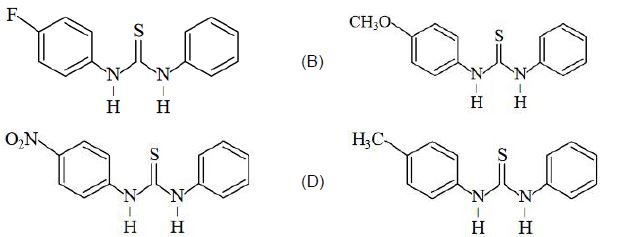 JEE Mains 2019 Hard
- The difference in the oxidation state of \(Xe\) between the oxidised product of \(Xe\) formed on complete hydrolysis of \(XeF _4\) and \(XeF _4\) isJEE Mains 2023 Medium
- Given below are two statements:
Statement (I): Methylcyclopentane and hex-3-ene are isomeric compounds.
Statement (II): Pentan-1-amine and N-methylbutan-1-amine are functional group isomers.JEE Mains 2025 Easy
More PYQs from JEE Mains
- A galvanometer ( \(G\) ) of \(2 \Omega\) resistance is connected in the given circuit. The ratio of charge stored in \(C_1\) and \(C_2\) is _______.
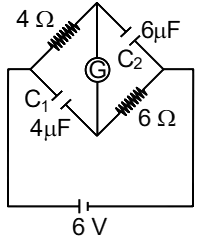 JEE Mains 2024 Medium
- Which of the following options are correct for the reaction \(2\left[ Au ( CN )_2\right]_{( aq )}^{-}+ Zn ( s ) \rightarrow 2 Au ( s )+\left[ Zn ( CN )_4\right]_{( aq )}^{2-}\) \(A.\) Redox reaction \(B.\) Displacement reaction \(C.\) Decomposition reaction \(D.\) Combination reaction Choose the correct answer from the options given below:JEE Mains 2023 Medium
- A conductor lies along the \(z-\)axis \(a\) \(-1.5\)\( \le Z < 1.5\,m\) carries a fixed current of \(10.0\ A\) in \( - {\hat a_z}\) direction (see figure). For a field \(\vec B\) \(=\) \(3.0 \times 10^{-4}\) \(e^{-0.2x}\) \({\hat a_y}\,T\) find the power required to move the conductor at constant speed to \(x = 2.0\ m, y = 0\ m\) in \(5 \times 10^{-3}\ s\). Assume parallel motion along the \(x-\)axis........\( W\)
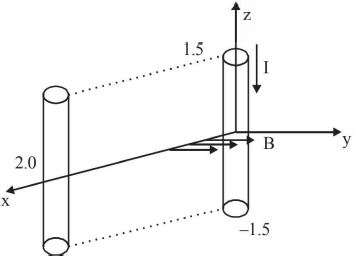 JEE Mains 2014 Hard
- Arrange the following Cobalt complexes in the order of increasing Crystal Field Stabilization Energy \((CFSE)\) value. Complexes : \(\left[\mathrm{CoF}_{6}\right]^{3-},\left[\mathrm{Co}\left(\mathrm{H}_{2} \mathrm{O}\right)_{6}\right]^{2+},\left[\mathrm{Co}\left(\mathrm{NH}_{3}\right)_{6}\right]^{3+}\) and \(\left[\mathrm{Co}(\mathrm{en})_{3}\right]^{3+}\) \(\quad\quad\quad\quad\quad\quad A\quad\quad\quad\quad \quad B\quad\quad\quad\quad\quad\quad C\quad\quad\quad\quad\quad\quad D\) Choose the correct option:JEE Mains 2021 Medium
- A mass \(m\) is attached to two springs as shown in figure. The spring constants of two springs are \(K _1\) and \(K _2\). For the frictionless surface, the time period of oscillation of mass \(m\) is
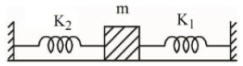 JEE Mains 2023 Medium
- Two radioactive substances \(X\) and \(Y\) originally have \(N _{1}\) and \(N _{2}\) nuclei respectively. Half life of \(X\) is half of the half life of \(Y\). After three half lives of \(Y\), number of nuclei of both are equal. The ratio \(\frac{ N _{1}}{ N _{2}}\) will be equal toJEE Mains 2021 Hard