


JEE Mains · Chemistry · STD 12 - 3. Chemical kinetics
Consider the two different first order reactions given below \(\mathrm{A}+\mathrm{B} \rightarrow \mathrm{C}\) (Reaction 1\()\) \(\mathrm{P} \rightarrow \mathrm{Q}\) (Reaction \(2\)) The ratio of the half life of Reaction \(1\) : Reaction \(2\) is \(5: 2\). If \(t_1\) and \(t_2\) represent the time taken to complete \(2 / 3^{\text {dd }}\) and \(4 / 5^{\text {dd }}\) of Reaction \(1\) and Reaction \(2\), respectively, then the value of the ratio \(\mathrm{t}_1: \mathrm{t}_2\) is _______ \(\times 10^{-1}\) (nearest integer). [Given: \(\log _{10}(3)=0.477\) and \(\log _{10}(5)=0.699\) ]
- A \(15\)
- B \(18\)
- C \(20\)
- D \(17\)
Answer & Solution
Correct Answer
(D) \(17\)
Step-by-step Solution
Detailed explanation
\(\frac{\left(\mathrm{t}_{1 / 2}\right)_{\mathrm{I}}}{\left(\mathrm{t}_{1 / 2}\right)_{\mathrm{II}}}=\frac{\mathrm{K}_2}{\mathrm{~K}_1}=\frac{5}{2}\) \(\therefore \mathrm{K}_1 \mathrm{t}_1=\ln \frac{1}{1-\frac{2}{3}}=\ln 3\)…
See the Complete Solution
Get step-by-step explanations for this and 2.5 Lakh+ more JEE, NEET & CET questions.
- Unlock all solutions
- Practice the full chapter
- Track accuracy across PYQs
4.8 rated on Google Play · 14,000+ reviews
More questions from Chemistry
- In the given compound, the number of \(2^{\circ}\) carbon atom is _______.
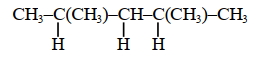 JEE Mains 2024 Medium
 - CORRECT order of stability for the following is
\( CH_{2}=CH^{-}, CH_{3}-CH_{2}^{-}, CH\equiv C^{-} \)JEE Mains 2026 Hard - Total number of molecules/species from following which will be paramagnetic is
\(\mathrm{O}_2, \mathrm{O}_2^{+}, \mathrm{O}_2^{-}, \mathrm{NO}, \mathrm{NO}_2, \mathrm{CO}, \mathrm{K}_2[\mathrm{NiCl}_4],[\mathrm{Co}(\mathrm{NH}_3)_6] \mathrm{Cl}_3,\)\(\mathrm{~K}_2[\mathrm{Ni}(\mathrm{CN})_4]\)JEE Mains 2025 Medium - A current of \(10.0\, A\) flows for \(2 .00\, h\) through an electrolytic cell containing a molten salt of metal \(X\). This results in the decomposition of \(0 .250\, mol\) of metal \(X\) at the cathode. The oxidation state of \(X\) in the molten salt is \((F = 96,500\, C\))JEE Mains 2014 Hard
- The octahedral diamagnetic low spin complex among the following isJEE Mains 2023 Medium
- Given :
\(\begin{aligned}
& \Delta \mathrm{H}_{\text {sub }}^{\ominus}[\mathrm{C}(\text { graphite })]=710 \mathrm{~kJ} \mathrm{~mol}^{-1} \\
& \Delta_{\mathrm{C}-\mathrm{H}} \mathrm{H}^{\ominus}=414 \mathrm{~kJ} \mathrm{~mol}^{-1} \\
& \Delta_{\mathrm{H}-\mathrm{H}} \mathrm{H}^{\Theta}=436 \mathrm{~kJ} \mathrm{~mol}^{-1} \\
& \Delta_{\mathrm{C}=\mathrm{C}} \mathrm{H}^{\Theta}=611 \mathrm{~kJ} \mathrm{~mol}^{-1}
\end{aligned}\)
The \(\Delta \mathrm{H}_{\mathrm{f}}^{\ominus}\) for \(\mathrm{CH}_2=\mathrm{CH}_2\) is _____ \(\mathrm{kJ} \mathrm{mol}^{-1}\) (nearest integer value)JEE Mains 2025 Medium
More PYQs from JEE Mains
- \(\frac{x}{x+4}\) is the ratio of energies of photons produced due to transition of an electron of hydrogen atom from its \((i)\) third permitted energy level to the second level and \((ii)\) the highest permitted energy level to the second permitted level. The value of \(x\) will be.JEE Mains 2022 Medium
- Let \(y=y(x)\) be the solution of the differential equation \(x \tan \left(\frac{y}{x}\right) d y=\left(y \tan \left(\frac{y}{x}\right)-x\right) d x,-1 \leq x \leq 1, y\left(\frac{1}{2}\right)=\frac{\pi}{6}\) Then the area of the region bounded by the curves \(x=0, x=\frac{1}{\sqrt{2}}\) and \(y=y(x)\) in the upper half plane is :JEE Mains 2021 Hard
- If \(z\) is a complex number such that \(|z| \geq 1\), then the minimum value of \(\left|z+\frac{1}{2}(3+4 i)\right|\) is :JEE Mains 2024 Medium
- The percentage errors in quantities \(P, Q, R\) and \(S\) are \(0.5\%,\,1\%,\,3\%\) and \(1 .5\%\) respectively in the measurement of a physical quantity \(A\, = \,\frac{{{P^3}{Q^2}}}{{\sqrt {R}\,S }}\) . the maximum percentage error in the value of \(A\) will be ........... \(\%\)JEE Mains 2018 Hard
- The maximum value of \(f(x)=\left|\begin{array}{ccc} \sin ^{2} x & 1+\cos ^{2} x & \cos 2 x \\ 1+\sin ^{2} x & \cos ^{2} x & \cos 2 x \\ \sin ^{2} x & \cos ^{2} x & \sin 2 x \end{array}\right|, x \in R \text { is }\)JEE Mains 2021 Medium
- A linearly polarized electromagnetic wave in vacuum is \(E=3.1 \cos \left[(1.8) z-\left(5.4 \times 10^{6}\right) {t}\right] \hat{\text { i }}\, {N} / {C}\) is incident normally on a perfectly reflecting wall at \(z=a\). Choose the correct optionJEE Mains 2021 Medium