


JEE Mains · Chemistry · STD 11 - Structure of atom
- JEE Mains 2024
- Medium
- MCQ
Match List \(I\) with List \(II\).
| List \(-I\)(Element) | List \(-II\) (Electronic Configuration) |
| \(A.\) \(N\) | \(I.\) \([\mathrm{Ar}] 3 \mathrm{~d}^{10} 4 \mathrm{~s}^2 4 \mathrm{p}^5\) |
| \(B.\) \(S\) | \(II.\) \([\mathrm{Ne}] 3 \mathrm{~s}^2 3 \mathrm{p}^4\) |
| \(C.\) \(Br\) | \(III.\) \([\mathrm{He}] 2 \mathrm{~s}^2 2 \mathrm{p}^3\) |
| \(D.\) \(Kr\) | \(IV.\) \([\mathrm{Ar}] 3 \mathrm{~d}^{10} 4 \mathrm{~s}^2 4 \mathrm{p}^6\) |
Pick an option to check your answer.
Answer & Solution
Correct Answer
(B) \(A-III, B-II, C-I, D-IV\)
Step-by-step Solution
Detailed explanation
(\(A\)) \({ }_7 \mathrm{~N}:[\mathrm{He}] 2 \mathrm{~s}^2 2 \mathrm{p}^3\)
(\(B\)) \({ }_{16} \mathrm{~S}:[\mathrm{Ne}] 2 \mathrm{~s}^2 3 \mathrm{p}^4\)
(\(C\)) \({ }_{35} \mathrm{Br}:[\mathrm{Ar}] 3 \mathrm{~d}^{10} 4 \mathrm{~s}^2 4 \mathrm{p}^5\)
(\(D\)) \({ }_{36} \mathrm{Kr}:[\mathrm{Ar}] 3 \mathrm{~d}^{10} 4 \mathrm{~s}^2 4 \mathrm{p}^6\)
More questions from Chemistry
- Match List \(I\) with List \(II\)
Choose the correct answer from the options given below:List \(I\) Vitamin List \(II\) Deficiency disease \(A\) Vitamin \(A\) \(I.\) Beri-Beri \(B\) Thiamine \(II.\) Cheilosis \(C\) Ascorbic acid \(III.\) Xeropthalmia \(D\) Riboflavin \(IV.\) Scurvy JEE Mains 2023 Easy - Given below are two statements :
Statement \((I)\) : Aqueous solution of ammonium carbonate is basic.
Statement \((II)\) : Acidic/basic nature of salt solution of a salt of weak acid and weak base depends on \(\mathrm{K}_{\mathrm{a}}\) and \(K_b\) value of acid and the base forming it.
In the light of the above statements, choose the most appropriate answer from the options given below :JEE Mains 2024 Hard - For the reaction \(\mathrm{A}+\mathrm{B} \rightleftharpoons 2 \mathrm{C}\) the value of equilibrium constant is \(100\) at \(298\, \mathrm{~K}\). If the initial concentration of all the three species is \(1\, \mathrm{M}\) each, then the equilibrium concentration of \(\mathrm{C}\) is \(\mathrm{X} \times 10^{-1} \,\mathrm{M}\). The value of \(\mathrm{x}\) is \(.....\) (Nearest integer)JEE Mains 2021 Hard
- Butane reacts with oxygen to produce carbon dioxide and water following the equation given below
\(\mathrm{C}_4 \mathrm{H}_{10}(\mathrm{~g})+\frac{13}{2} \mathrm{O}_2(\mathrm{~g}) \rightarrow 4 \mathrm{CO}_2(\mathrm{~g})+5 \mathrm{H}_2 \mathrm{O}(\mathrm{l})\)
If 174.0 kg of butane is mixed with 320.0 kg of \(\mathrm{O}_2\), the volume of water formed in litres is ________.(Nearest integer)
[Given : (a) Molar mass of \(\mathrm{C}, \mathrm{H}, \mathrm{O}\) are 12, 1, \(16 \mathrm{~g} \mathrm{~mol}^{-1}\) respectively, (b) Density of water \(\left.=1 \mathrm{~g} \mathrm{~mL}^{-1}\right]\)JEE Mains 2025 Medium - Compound with molecular formula \(C _{3} H _{6} O\) can showJEE Mains 2021 Medium
- In which of the following pairs, electron gain enthalpies of constituent elements are nearly the same or identical ? \((A)\) \(Rb\) and \(Cs\) \((B)\) \(Na\) and \(K\) \((C)\) \(Ar\) and \(Kr\) \((D)\) \(I\) and \(At\) Choose the correct answer from the options given below.JEE Mains 2022 Easy
More PYQs from JEE Mains
- The reactions which cannot be applied to prepare an alkene by elimination, are
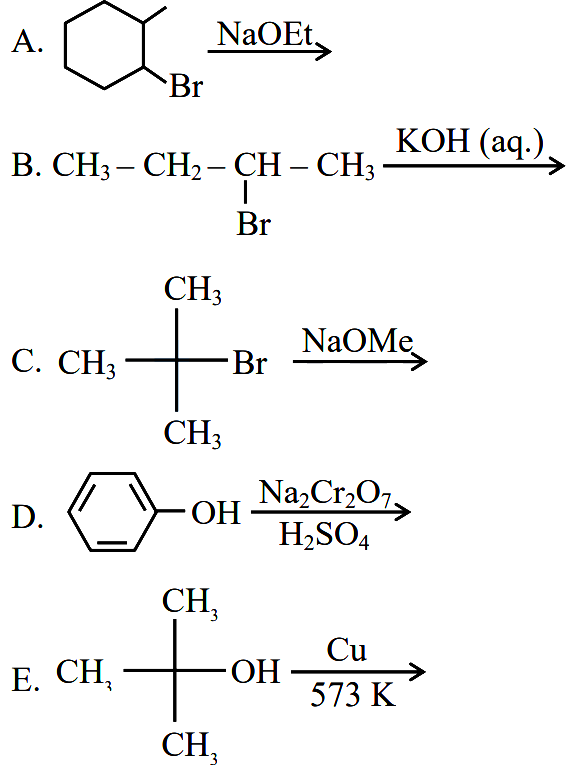
Choose the correct answer from the option given below :JEE Mains 2025 Easy - Elevation in the boiling point for \(1\) molal solution of glucose is \(2\, K\). The depression in the freezing point for \(2\) molal solution of glucose in the same solvent is \(2\, K\). The relation between \(K_b\) and \(K_f\) isJEE Mains 2019 Hard
- In the below circuit, \(C\, = \,\frac{{\sqrt 3 }}{2}\,\mu F,\,R = 20\,\,\Omega ,\,L = \frac{{\sqrt 3 }}{{10}}H\) and \({R_1} = 10\,\,\Omega .\) Current in \(L-R_1\) path is \(I_1\) and \(C-R_2\) path is \(I_2.\) The voltage of \(A.C\) source is given by, \(V\, = \,200\sqrt 2 \,\sin \,(100\,t)\,volts.\) The phase difference between \(I_1\) and \(I_2\) is
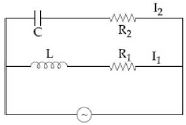 JEE Mains 2019 Hard
- The correct order of ionic size of \(N^{3-} , Na^+ ,F^- , Mg^{2+}\) and \(O^{2-}\) isJEE Mains 2022 Hard
- Which of the following reactions are disproportionation reactions? (A) \(\mathrm{Cu}^{+} \rightarrow \mathrm{Cu}^{2+}+\mathrm{Cu}\) (B) \(3 \mathrm{MnO}_4^{2-}+4 \mathrm{H}^{+} \rightarrow 2 \mathrm{MnO}_4^{-}+\mathrm{MnO}_2+2 \mathrm{H}_2 \mathrm{O}\) (C) \(2 \mathrm{KMnO}_4 \rightarrow \mathrm{K}_2 \mathrm{MnO}_4+\mathrm{MnO}_2+\mathrm{O}_2\) (D) \(2 \mathrm{MnO}_4^{-}+3 \mathrm{Mn}^{2+}+2 \mathrm{H}_2 \mathrm{O} \rightarrow 5 \mathrm{MnO}_2+4 \mathrm{H}^{+}\) Choose the correct answer from the options given below:JEE Mains 2024 Hard
- Observe structures of the following compounds \([Image]\) The total number of structures/compounds which possess asymmetric carbon atoms is \(....\)
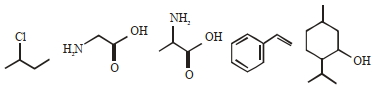 JEE Mains 2022 Medium