


JEE Mains · Chemistry · STD 11 - Structure of atom
- JEE Mains 2026
- Medium
- MCQ
Which of the following statement(s) is/are true ?
A. If two orbitals have the same value of \((n + l)\), the orbital with lower value of \(n\) will have lower energy.
B. Energies of the orbitals in the same subshell increase with increase in atomic number.
C. The size of \(2p_x\) orbital is less than the size of \(3p_x\) orbital.
D. Among \(5f\), \(6s\), \(4d\), \(5p\) and \(5d\) orbitals, none of the orbitals have \(2\) radial nodes.
Choose the correct answer from the options given below :
Pick an option to check your answer.
Answer & Solution
Correct Answer
(B) A and C only
Step-by-step Solution
Detailed explanation
Statement A: According to the \((n+l)\) rule, if two orbitals have the same \((n+l)\) value, the orbital with the lower value of \(n\) has lower energy. This statement is true.
Statement B: As the atomic number increases, the effective nuclear charge (\(Z_{eff}\)) increases. The energy of an orbital is proportional to \(-\dfrac{Z_{eff}^2}{n^2}\). Thus, the energy becomes more negative, meaning the energy of the orbitals in the same subshell decreases with an increase in atomic number. This statement is false.
Statement C: The size of an orbital increases with an increase in the principal quantum number \(n\). Therefore, the size of the \(2p_x\) orbital is less than the size of the \(3p_x\) orbital. This statement is true.
Statement D: The number of radial nodes is given by the formula \(n - l - 1\).
For \(5f\): \(5 - 3 - 1 = 1\)
For \(6s\): \(6 - 0 - 1 = 5\)
For \(4d\): \(4 - 2 - 1 = 1\)
For \(5p\): \(5 - 1 - 1 = 3\)
For \(5d\): \(5 - 2 - 1 = 2\)
Since the \(5d\) orbital has exactly \(2\) radial nodes, the statement that none of the orbitals have \(2\) radial nodes is false.
Therefore, only statements A and C are true.
Answer: A and C only
More questions from Chemistry
- Given below are two statements :
Statement I: The two cyclic forms of D-(+)-glucose (α and β anomers differing at C1 hydroxyl orientation) are two anomers of D-(+)-glucose.
Statement II: The open chain forms of D-glucose and D-fructose contain three similar chiral carbons at \(C_3\), \(C_4\) and \(C_5\).
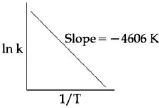
In the light of the above statements, choose the correct answer from the options given below :JEE Mains 2026 Medium - For a certain reaction consider the plot of \(lnk\) versus \(1/T\) given in the figure. If the rate constant of this reaction at \(400\,K\) is \(10^{-5}\,s^{-1},\) then the rate constant at \(500\,K\) is
 JEE Mains 2019 Hard
- The total number of amines among the following which can be synthesized by Gabriel synthesis is ..... .
 JEE Mains 2021 Medium
- Identify the incorrect statementJEE Mains 2013 Hard
- Choose the correct statement regarding the formation of carbocations \(A\) and \(B\) given :- \({C{H_3} - C{H_2} - CH = C{H_2} + HBr\\,\to \,CH _{3}- CH _{2}- CH _{2}- C^{+}H _{2}+ Br ^{-}} _{"A"}\) \({C{H_3} - C{H_2} - CH = C{H_2} + HBr\\, \to \,CH _{3}- CH _{2}- C^{+}H - CH _{3}+ Br ^{-}}_{"B"}\)JEE Mains 2021 Medium
- The average molar mass of chlorine is \(35.5\, g\) \(mol ^{-1}\). The ratio of \(35\, Cl\) to \(37 \,Cl\) in naturally occurring chlorine is close to :JEE Mains 2020 Hard
More PYQs from JEE Mains
- Gaseous cyclobutene isomerizes to butadiene in a first order process which has a \('k'\) value of \(3.3 \times 10^{-4} s ^{-1}\) at \(153^{\circ} C\). The time in minutes it takes for the isomerization to proceed \(40 \%\) to completion at this temperature is .......... (Rounded off to the nearest integer)JEE Mains 2021 Medium
- At a given point of time the value of displacement of a simple harmonic oscillator is given as \(y = A \cos \left(30^{\circ}\right)\). If amplitude is \(40\,cm\) and kinetic energy at that time is \(200\, J\), the value of force constant is \(1.0 \times 10^{ x }\,Nm ^{-1}\). The value of \(x\) is ......JEE Mains 2023 Hard
- A metal sample carrying a current along \(X-\) axis with density \(J_x\) is subjected to a magnetic field \(B_z\) ( along \(z-\) axis ). The electric field \(E_y\) developed along \(Y-\) axis is directly proportional io \(J_x\) as well as \(B_z\) . The constant of proportionality has \(SI\, unit\).JEE Mains 2013 Medium
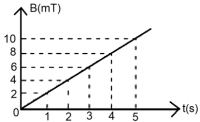
- The magnetic field \(B\) crossing normally a square metallic plate of area \(4\,m ^2\) is changing with time as shown in figure. The magnitude of induced \(emf\) in the plate during \(t=2\,s\) to \(t=4\,s\), is \(..........\,mV\)
 JEE Mains 2023 Hard
- A resistance of \(40 \,\Omega\) is connected to a source of alternating current rated \(220\, V , 50 Hz\). Find the time taken by the current to change from its maximum value to \(ms\) valueJEE Mains 2022 Hard
- The Total pressure observed by mixing two liquid \(A\) and \(B\) is \(350\,mm\,Hg\) when their mole fractions are \(0.7\) and \(0.3\) respectively.The Total pressure becomes \(410 \,mm\,Hg\) if the mole fractions are changed to \(0.2\) and \(0.8\) respectively for \(A\) and \(B\). The vapour pressure of pure \(A\) is \(...........\,mm\,Hg\). (Nearest integer) Consider the liquids and solutions behave ideally.JEE Mains 2023 Medium