


JEE Mains · Chemistry · STD 11 - Structure of atom
- JEE Mains 2025
- Medium
- MCQ
Correct statements for an element with atomic number 9 are
A. There can be 5 electrons for which \(\mathrm{m}_{\mathrm{s}}=+\frac{1}{2}\) and 4 electrons for which \(\mathrm{m}_{\mathrm{s}}=-\frac{1}{2}\)
B. There is only one electron in \(p_z\) orbital
C. The last electron goes to orbital with \(\mathrm{n}=2\) and \(l=1\)
4. The sum of angular nodes of all the atomic orbitals is 1.
Choose the correct answer from the options given below:
Pick an option to check your answer.
Answer & Solution
Correct Answer
(B) A and C Only
Step-by-step Solution
Detailed explanation
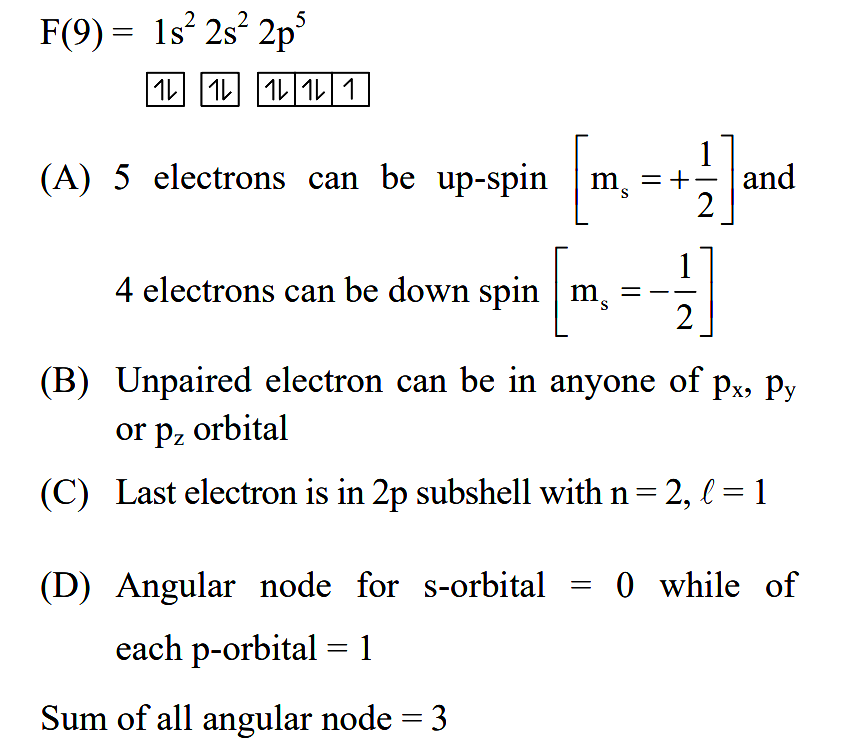
Explanation:
The element with atomic number 9 is Fluorine (\( \text{F} \)). Its ground-state electronic configuration is \( 1s^2 2s^2 2p^5 \). Let us analyze each statement:
1. Statement A is Correct: In the fully filled \( 1s^2 \) and \( 2s^2 \) subshells, there are 2 spin-up and 2 spin-down electrons. For the \( 2p^5 \) subshell, following Hund's rule, the distribution contains 3 spin-up and 2 spin-down electrons (or vice-versa). Therefore, a maximum of \( 2 + 3 = 5 \) electrons can have \( m_s = +\frac{1}{2} \) and \( 2 + 2 = 4 \) electrons can have \( m_s = -\frac{1}{2} \).
2. Statement B is Incorrect: The three \( 2p \) orbitals (\( 2p_x, 2p_y, 2p_z \)) are completely degenerate (equal in energy). The 5 valence electrons fill these orbitals such that two orbitals are completely paired and one remains unpaired. Because these orbitals are degenerate, the single unpaired electron can occupy any one of the three orbitals arbitrarily, not exclusively the \( p_z \) orbital.
3. Statement C is Correct: The last incoming electron enters the \( 2p \) subshell. For any electron occupying a \( 2p \) orbital, the principal quantum number is \( n = 2 \) and the azimuthal quantum number is \( l = 1 \).
4. Statement D is Incorrect: The number of angular nodes for any atomic orbital is given by its azimuthal quantum number (\( l \)). For Fluorine, the angular nodes for the occupied orbitals are: \( 1s \) has 0, \( 2s \) has 0, and each of the three active \( 2p \) orbitals (\( 2p_x, 2p_y, 2p_z \)) has 1 angular node. The total sum of angular nodes across all occupied atomic orbitals is \( 0 + 0 + 1 + 1 + 1 = 3 \).
Hence, Option B is the correct choice.
More questions from Chemistry
- The standard free energy change \(\left(\Delta G ^{\circ}\right)\) for \(50 \%\) dissociation of \(N _{2} O _{4}\) into \(NO _{2}\) at \(27^{\circ} C\) and \(1\, atm\) pressure is \(- x\, J \,mol ^{-1}\). The value of \(x\) is \(......\) (Nearest Integer) [Given \(: R =8.31 \,J \,K ^{-1} \,mol ^{-1}, \log 1.33=0.1239\) \(\ln 10=2.3]\)JEE Mains 2022 Easy
- The technique used for purification of steam volatile water immiscible substance is:JEE Mains 2024 Hard
- Decreasing order towards \(S_N 1\) reaction for the following compounds is:
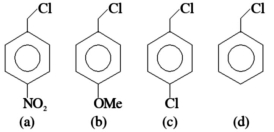 JEE Mains 2023 Medium
- In the following system, \(\mathrm{PCl}_5(\mathrm{~g}) \rightleftharpoons \mathrm{PCl}_3(\mathrm{~g})+\mathrm{Cl}_2(\mathrm{~g})\) at equilibrium, upon addition of xenon gas at constant \(\mathrm{T} \& \mathrm{p}\), the concentration of...JEE Mains 2025 Hard
- Match List \(I\) With List \(II\)
Choose the correct answer from the options given below:List \(I\) (compounds) List \(II\) (Value of \(Pk_a\)) \(A\). ethanol \(I\). \(10.0\) \(B\). phenol \(II\). \(15.9\) \(C\). \(m\)-nitrophenol \(III\). \(7.1\) \(D\). \(p\)-nitrophenol \(IV\). \(8.3\) JEE Mains 2024 Hard - The total number of species from the following in which one unpaired electron is present is _______.
[\(\mathrm{N}_2, \mathrm{O}_2, \mathrm{C}_2^{-}, \mathrm{O}_2^{-}, \mathrm{O}_2^{2-}, \mathrm{H}_2^{+}, \mathrm{CN}^{-}, \mathrm{He}_2^{+}\)]JEE Mains 2024 Medium
More PYQs from JEE Mains
- What volume of hydrogen gas at STP would be liberated by action of \(50\text{ mL}\) of \(H_2SO_4\) of \(50\%\) purity (density \(= 1.3\text{ g mL}^{-1}\)) on \(20\text{ g}\) of zinc ?
Given : Molar mass of H, O, S, Zn are \(1, 16, 32, 65\text{ g mol}^{-1}\) respectively.JEE Mains 2026 Medium - The successive 5 ionisation energies of an element are \(800,2427,3658,25024\) and \(32824 \mathrm{~kJ} / \mathrm{mol}\), respectively. By using the above values predict the group in which the above element is present :JEE Mains 2025 Easy
- What is the position and nature of image formed by lens combination shown in figure? (\(f_1, f_2\) are focal lengths)
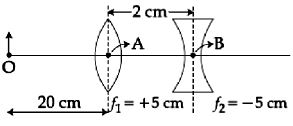 JEE Mains 2019 Hard
- Two ions of masses \(4 \,{amu}\) and \(16\, amu\) have charges \(+2 {e}\) and \(+3 {e}\) respectively. These ions pass through the region of constant perpendicular magnetic field. The kinetic energy of both ions is same. Then :JEE Mains 2021 Hard
- A satellite of \(10^3 \mathrm{~kg}\) mass is revolving in circular orbit of radius \(2 \mathrm{R}\). If \(\frac{10^4 \mathrm{R}}{6} \mathrm{~J}\) energy is supplied to the satellite, it would revolve in a new circular orbit of radius _______.
(use \(\mathrm{g}=10 \mathrm{~m} / \mathrm{s}^2, \mathrm{R}=\) radius of earth)JEE Mains 2024 Hard - In Chromyl chloride, the oxidation state of chromium is \((+)..........\)JEE Mains 2023 Medium