


JEE Mains · Chemistry · STD 11 - Structure of atom
- JEE Mains 2026
- Medium
- MCQ
Given,
(A) \(n = 5, m_l = -1\)
(B) \(n = 3, l = 2, m_l = -1, m_s = +\frac{1}{2}\)
The maximum number of electron(s) in an atom that can have the quantum numbers as given in (A) and (B) respectively are:
Pick an option to check your answer.
Answer & Solution
Correct Answer
(D) 8 and 1
Step-by-step Solution
Detailed explanation
Explanation:
Let us determine the maximum number of electrons for each set of quantum numbers step-by-step based on the rules governing quantum numbers from the Structure of Atom chapter in the NCERT Class 11 Chemistry textbook:
1. Analyzing Set (A): \(n = 5, m_l = -1\)
For a principal quantum number \(n = 5\), the possible values of the azimuthal quantum number (\(l\)) range from \(0\) to \((n-1)\), i.e., \(l = 0, 1, 2, 3, 4\).
Now let's find which subshells can host a magnetic quantum number value of \(m_l = -1\):
- For \(l = 0\) (\(s\)-subshell): \(m_l = 0\) (No \(m_l = -1\) orbital exists)
- For \(l = 1\) (\(p\)-subshell): \(m_l = -1, 0, +1\) → Contains 1 orbital with \(m_l = -1\)
- For \(l = 2\) (\(d\)-subshell): \(m_l = -2, -1, 0, +1, +2\) → Contains 1 orbital with \(m_l = -1\)
- For \(l = 3\) (\(f\)-subshell): \(m_l = -3, -2, -1, 0, +1, +2, +3\) → Contains 1 orbital with \(m_l = -1\)
- For \(l = 4\) (\(g\)-subshell): \(m_l = -4, -3, -2, -1, 0, +1, +2, +3, +4\) → Contains 1 orbital with \(m_l = -1\)
Thus, there are a total of \(1 + 1 + 1 + 1 = 4\) distinct orbitals in the \(n = 5\) shell that have \(m_l = -1\).
According to Pauli's Exclusion Principle, each orbital can hold a maximum of 2 electrons with opposite spins.
\(\text{Maximum electrons} = 4 \text{ orbitals} \times 2 \text{ electrons/orbital} = 8 \text{ electrons}\).
2. Analyzing Set (B): \(n = 3, l = 2, m_l = -1, m_s = +\frac{1}{2}\)
Here, all four quantum numbers are explicitly specified:
- \(n = 3, l = 2\) defines a unique subshell (\(3d\)).
- \(m_l = -1\) uniquely defines one specific orbital inside that subshell.
- \(m_s = +\frac{1}{2}\) defines a single, specific clockwise electron spin state inside that orbital.
According to Pauli's exclusion principle, no two electrons in an atom can have the exact same set of all 4 quantum numbers. Therefore, this fully specified combination can correspond to exactly 1 electron.
Combining the findings gives 8 and 1.
Hence, Option D is the correct choice.
More questions from Chemistry
- The mass of iron converted into \(Fe_3O_4\) by the action of \(18\) g of steam is :
(Given : Molar mass of H, O and Fe are \(1\), \(16\) and \(56\) g mol\(^{-1}\) respectively)
Assume iron is present in excess :JEE Mains 2026 Medium - The increasing order of \(pKa\) of following amino acids in aqueous solution is \(Gly, \,Asp,\, Lys,\, Arg\)JEE Mains 2019 Hard
- Given below are two statements:
Statement I: Sodium dichromate and potassium dichromate are classified as primary standards in titrimetric analysis.
Statement II: Phenolphthalein is a weak base, therefore it dissociates in acidic medium.
In the light of the above statements, choose the correct answer from the options given belowJEE Mains 2026 Medium - The number of \(4 f\) electrons in the ground state electronic configuration of \(\mathrm{Gd}^{2+}\) is ........ . [Atomic number of \(\mathrm{Gd}=64\) ]JEE Mains 2021 Medium
- The major product of the following reaction is \(C{H_3}C \equiv CH\xrightarrow[{(ii)\,Dl}]{{(i)\,DCl\,\,(1\,equiv)}}\)JEE Mains 2019 Hard
- An accelerated electron has a speed of \(5 \times 10^{6} \,\mathrm{~ms}^{-1}\) with an uncertainty of \(0.02\,\%\). The uncertainty in finding its location while in motion is \(x \times 10^{-9}\, \mathrm{~m}\). The value of \(x\) is \(......\) (Nearest integer) [Use mass of electron \(\left.=9.1 \times 10^{-31}\, \mathrm{~kg}, \mathrm{~h}=6.63 \times 10^{-34}\, \mathrm{~J} \mathrm{~s}, \)\(\pi=3.14\right]\)JEE Mains 2021 Hard
More PYQs from JEE Mains
- A point charge +q is placed at the origin. A second point charge +9 q is placed at \((\mathrm{d}, 0,0)\) in Cartesian coordinate system. The point in between them where the electric field vanishes is :JEE Mains 2025 Easy
- In the given circuit, the current \((I)\) through the battery will be \(..........\,A\)
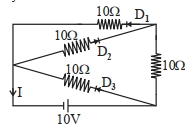 JEE Mains 2023 Medium
- A stationary source emits sound waves of frequency \(500\, Hz\). Two observers moving along a line passing through the source detect sound to be of frequencies \(480\, Hz\) and \(530\, Hz\). Their respective speeds are, in \(m\,s^{-1}\) (Given speed of sound \(= 300\, m/s\))JEE Mains 2019 Medium
- In a Young's double slit experiment, slits are separated by \(0.5\ mm\), and the screen is placed \(150\ cm\) away. A beam of light consisting of two wavelengths, \(650\ nm\) and \(520\ nm\), is used to obtain interference fringes on the screen. The least distance from the common central maximum to the point where the bright fringes due to both the wavelengths coincide is...... \(mm\)JEE Mains 2017 Medium
- The length of wire becomes \(l_1\) and \(l_2\) when \(100\,N\) and \(120\,N\) tensions are applied respectively. If \(10l_2=11l_1\), the natural length of wire will be \(\frac{1}{x} l_1\). Here the value of \(x\) is ........JEE Mains 2023 Medium
- A projectile is projected with velocity of \(25\, m / s\) at an angle \(\theta\) with the horizontal. After t seconds its inclination with horizontal becomes zero. If \(R\) represents horizontal range of the projectile, the value of \(\theta\) will be : [use \(g =10 m / s ^{2}\) ]JEE Mains 2022 Medium