


enEnglishguગુજરાતી
JEE Mains · Physics · STD 11 - 5. work,energy,power and collision
A body \(A\) of mass \(\mathrm{m}\) is moving in a circular orbit of radius \(\mathrm{R}\) about a planet. Another body \(\mathrm{B}\) of mass \(\frac{\mathrm{m}}{2}\) collides with \(\mathrm{A}\) with a velocity which is half \(\left(\frac{\overrightarrow{\mathrm{v}}}{2}\right)\) the instantaneous velocity \(\overrightarrow{\mathrm{v}}\) of \(\mathrm{A}\) The collision is completely inelastic. Then, the combined body
- A starts moving in an elliptical orbit around the planet
- B continues to move in a circular orbit
- C Falls vertically downwards towards the planet
- D Escapes from the Planet's Gravitational field.
Answer & Solution
Correct Answer
(A) starts moving in an elliptical orbit around the planet
Step-by-step Solution
Detailed explanation
Initially, the body of mass \(\mathrm{m}\) is moving in a circular orbit of radius \(\mathrm{R} .\) So it must be moving with orbital speed. \(\mathrm{v}_{0}=\sqrt{\frac{\mathrm{GM}}{\mathrm{R}}}\) After collision, let the combined mass moves with speed \(v_{1 }\)…
See the Complete Solution
Get step-by-step explanations for this and 2.5 Lakh+ more JEE, NEET & CET questions.
- Unlock all solutions
- Practice the full chapter
- Track accuracy across PYQs
4.8 rated on Google Play · 14,000+ reviews
More questions from Physics
- A uniform cylindrical rod of length \(L\) and radius \(r\), is made from a material whose Young's modulus of Elasticity equals \(Y\). When this rod is heated by temperature \(T\) and simultaneously subjected to a net longitudinal compressional force \(F\), its length remains unchanged. The coefficient of volume expansion, of the material of the rod, is (nearly) equals toJEE Mains 2019 Hard
- In a simple harmonic oscillation, what fraction of total mechanical energy is in the form of kinetic energy, when the particle is midway between mean and extreme position.JEE Mains 2021 Medium
- A solid sphere and solid cylinder of identical radii approach an incline with the same linear velocity (see figure). Both roll without slipping all throughout. The two climb maximum heights \(h_{sph}\) and \(h_{cyl}\) on the incline. The radio \(\frac{{{h_{sph}}}}{{{h_{cyl}}}}\) is given by
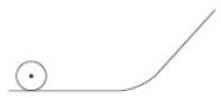 JEE Mains 2019 Hard
 - A block of mass \(5\,kg\) is placed at rest on a table of rough surface. Now, if a force of \(30\,N\) is applied in the direction parallel to surface of the table, the block slides through a distance of \(50\,m\) in an interval of time \(10\,s\). Coefficient of kinetic friction is (given, \(g =10\,ms ^{-2}\))JEE Mains 2023 Medium
- If \(K_{1}\) and \(K_{2}\) are the thermal conductivities \(L_{1}\) and \(L _{2}\) are the lengths and \(A _{1}\) and \(A _{2}\) are the cross sectional areas of steel and copper rods respectively such that \(\frac{K_{2}}{K_{1}}=9, \frac{A_{1}}{A_{2}}=2, \frac{L_{1}}{L_{2}}=2\). Then, for the arrangement as shown in the figure. The value of temperature \(T\) of the steel - copper junction in the steady state will be ........... \(^{\circ} C\)
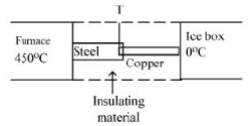 JEE Mains 2022 Medium
 - A circular disc reaches from top to bottom of an inclined plane of length \('L'.\) When it slips down the plane, it takes time \('t_{1}'\). when it rolls down the plane, it takes time \(t_{2}\). The value of \(\frac{t_{2}}{t_{1}}\) is \(\sqrt{\frac{3}{x}}\). The value of \(x\) will be .... .JEE Mains 2021 Hard
More PYQs from JEE Mains
- If \(\int \frac{\mathrm{d} \theta}{\cos ^{2} \theta(\tan 2 \theta+\sec 2 \theta)}=\lambda \tan \theta+2 \log _{\mathrm{e}}|\mathrm{f}(\theta)|+\mathrm{C}\) where \(\mathrm{C}\) is a constant of integration, then the ordered pair \((\lambda, f(\theta))\) is equal toJEE Mains 2020 Hard
- The total number of \(5\)-digit numbers, formed by using the digits \(1,2,3,5,6,7\) without repetition, which are multiple of \(6\), isJEE Mains 2022 Medium
- A wire of \(1 \,\Omega\) has a length of \(1\, m\). It is stetched till its length increases by \(25\, \%\). The percentage change in resistance to the neartest integer is .....\(\%\)JEE Mains 2021 Hard
- A wire carrying current \(I\) is bent in the shape \(A\,B\,C\,D\,E\,F\,A\) as shown, where rectangle \(A\,B\,C\,D\,A\) and \(A\,D\,E\,F\,A\) are perpendicular to each other. If the sides of the rectangles are of lengths \(a\) and \(b,\) then the magnitude and direction of magnetic moment of the loop \(A\,B\,C\,D\,E\,F\,A\,\) is
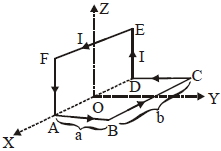 JEE Mains 2020 Hard
 - Let \(x \in \left( {0,1} \right)\). The set of all \(x\) such that \({\sin ^{ - 1}}\,x > {\cos ^{ - 1}}\,x\), is the intervalJEE Mains 2013 Hard
- A meter bridge setup is shown in the figure. It is used to determine an unknown resistance \(R\) using a given resistor of \(15\,\Omega\). The galvanometer \((G)\) shows null deflection when tapping key is at \(43\,cm\) mark from end \(A\). If the end correction for end \(A\) is \(2\,cm\). then the determined value of \(R\) will be__________ \(\Omega\)
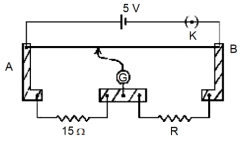 JEE Mains 2022 Hard