


JEE Mains · Physics · STD 11 - 4.1 newtons laws of motion
Particle \(A\) of mass \(m _{1}\) moving with velocity \((\sqrt{3} \hat{i}+\hat{j})\, ms ^{-1}\) collides with another particle \(B\) of mass \(m _{2}\) which is at rest initially. Let \(\overrightarrow{ V }_{1}\) and \(\overrightarrow{ V }_{2}\) be the velocities of particles \(A\) and \(B\) after collision respectively. If \(m _{1}=2\, m _{2}\) and after collision \(\overrightarrow{ V }_{1}=(\hat{ i }+\sqrt{3} \hat{ j })\, ms ^{-1},\) the angle between \(\overrightarrow{ V }_{1}\) and \(\overrightarrow{ V }_{2}\) is\(......^o\)
- A \(60\)
- B \(15\)
- C \(-45\)
- D \(105\)
Answer & Solution
Correct Answer
(D) \(105\)
Step-by-step Solution
Detailed explanation
\(\overrightarrow{ v }_{01}=(\sqrt{3 \hat{ i }}+\hat{ j }) m / s\) \(\overrightarrow{ v }_{02}=\overrightarrow{0}\) \(m _{1}=2 m _{2}\) After collision, \(\overrightarrow{ v }_{1}=(\hat{ i }+\sqrt{3} \hat{ j }) m / s\) \(\overrightarrow{ v }_{2}=?\) Applying conservation of…
See the Complete Solution
Get step-by-step explanations for this and 2.5 Lakh+ more JEE, NEET & CET questions.
- Unlock all solutions
- Practice the full chapter
- Track accuracy across PYQs
4.8 rated on Google Play · 14,000+ reviews
More questions from Physics
- A paramagnetic material has \(10^{28}\,atoms/m^3.\) Its magnetic susceptibility at temperature \(350\,K\) is \(2.8 \times 10^{-4}.\) Its susceptibility at \(300\,K\) isJEE Mains 2019 Medium
- A particle is moving in a straight line such that its velocity is increasing at \(5\,ms ^{-1}\) per meter. The acceleration of the particle is \(ms ^{-2}\) at a point where its velocity is \(20\,ms ^{-1}\).JEE Mains 2022 Medium
- Electrons are accelerated through a potential difference \(V\) and protons are accelerated through a potential difference \(4\, V\). The de-Broglie wavelengths are \(\lambda_e \) and \(\lambda_p \) for electrons and protons respectively. The ratio of \(\frac{{{\lambda _e}}}{{{\lambda _p}}}\) is given by : (given \(m_e\) is mass of electron and \(m_p\) is mass of proton).JEE Mains 2013 Hard
- A metal string \(A\) is suspended from a rigid support and its free end is attached to a block of mass \(M\). Second block having mass \(2M\) is suspended at the bottom of the first block using a string \(B\). The area of cross sections of strings \(A\) and \(B\) are same. The ratio of lengths of strings of \(A\) to \(B\) is \(2\) and the ratio of their Young's moduli \((Y_A/Y_B)\) is \(0.5\). The ratio of elongations in \(A\) to \(B\) is ______.JEE Mains 2026 Medium
- One mole of an ideal monoatomic gas is compressed isothermally in a rigid vessel to double its pressure at room temperature, \(27\,^oC\).The work done on the gas will beJEE Mains 2018 Medium
- Three charges \(Q, +q\) and \(+q\) are placed at the vertices of a right -angle isosceles triangle as shown below. The net electrostatic energy of the configuration is zero, if the value of \(Q\) is
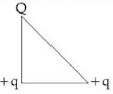 JEE Mains 2019 Hard
More PYQs from JEE Mains
- Let \(z =1+ i\) and \(z _1=\frac{1+ i \overline{ z }}{\overline{ z }(1- z )+\frac{1}{ z }}\). Then \(\frac{12}{\pi}\) \(\arg \left(z_1\right)\) is equal to \(..........\).JEE Mains 2023 Hard
- A hoop of radius \(r\) and mass \(m\) rotating with an angular velocity \(\omega_0\) is placed on a rough horizontal surface. The initial velocity of the centre of the hoop is zero. What will be the velocity of the centre of the hoop when it ceases to slip?JEE Mains 2013 Medium
- Let ABC be an equilateral triangle with orthocenter at the origin and the side BC on the line \(x+2\sqrt{2}y=4\). If the co-ordinates of the vertex A are (\(\alpha, \beta\)), then the greatest integer less than or equal to \(|\alpha+\sqrt{2}\beta|\) isJEE Mains 2026 Easy
- Let the area of a \(\triangle P Q R\) with vertices \(P(5,4), Q(-2,4)\) and \(R(a, b)\) be 35 square units. If its orthocenter and centroid are \(O\left(2, \frac{14}{5}\right)\) and \(C(c, d)\) respectively, then \(c+2 d\) is equal toJEE Mains 2025 Easy
- If the collision frequency of hydrogen molecules in a closed chamber at \(27^{\circ} \mathrm{C}\) is \(\mathrm{Z}\), then the collision frequency of the same system at \(127^{\circ} \mathrm{C}\) is _______.JEE Mains 2024 Hard
- A spherically symmetric charge distribution is characterised by a charge density having the following variations \(\rho (r)\, = \,{\rho _0}\left( {1 - \frac{r}{R}} \right)\) for \(r < R\) \(\rho (r)\,=\,0\) for \(r\, \ge \,R\) Where \(r\) is the distance from the centre of the charge distribution \(\rho _0\) is a constant. The electric field at an internal point \((r < R)\) isJEE Mains 2014 Hard