


JEE Mains · Chemistry · STD 12 - Electrochemistry
- JEE Mains 2025
- Medium
- MCQ
For the given cell
\(\mathrm{Fe}^{2+}{ }_{(\mathrm{aq})}+\mathrm{Ag}^{+}{ }_{(\mathrm{aq})} \rightarrow \mathrm{Fe}_{(\mathrm{aq})}^{3+}+\mathrm{Ag}_{(\mathrm{s})}\)
The standard cell potential of the above reaction is Given:
\(\begin{array}{lr}
\mathrm{Ag}^{+}+\mathrm{e}^{-} \rightarrow \mathrm{Ag} & \mathrm{E}^\theta=\mathrm{xV} \\
\mathrm{Fe}^{2+}+2 \mathrm{e}^{-} \rightarrow \mathrm{Fe} & \mathrm{E}^\theta=\mathrm{yV} \\
\mathrm{Fe}^{3+}+3 \mathrm{e}^{-} \rightarrow \mathrm{Fe} & \mathrm{E}^\theta=\mathrm{zV}
\end{array}\)
Pick an option to check your answer.
Answer & Solution
Correct Answer
(C) \(x+2 y-3 z\)
Step-by-step Solution
Detailed explanation
\(\mathrm{Fe}^{2+}(\mathrm{aq})+\mathrm{Ag}^{+}(\mathrm{aq}) \rightarrow \mathrm{Fe}^{3+}(\mathrm{aq})+\mathrm{Ag}(\mathrm{s})\)
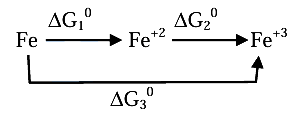
\(\begin{aligned}
& \Delta \mathrm{G}_3^0=\Delta \mathrm{G}_1^0+\Delta \mathrm{G}_2^0 \\
& -3 \mathrm{~F}(-\mathrm{z})=-2 \mathrm{~F}(-\mathrm{y})+\Delta \mathrm{G}_2{ }^0 \\
& \Delta \mathrm{G}_2^0=3 \mathrm{Fz}-2 \mathrm{Fy}
\end{aligned}\)
Also \(\Delta \mathrm{G}_2^0=-\mathrm{nFE}_{\mathrm{Fe}^{+2} / \mathrm{Fe}^{t^{43}}}^0\)
\(\begin{aligned}
& 3 \mathrm{Fz}-2 \mathrm{Fy}=-1 \mathrm{~F}\left(\mathrm{E}_{\mathrm{Fe}^{t^2} / \mathrm{Fe}^{43}}^0\right) \\
& \mathrm{E}_{\mathrm{Fe}^{2+2} / \mathrm{Fe}^{t^3}}^0=2 \mathrm{y}-3 \mathrm{z}
\end{aligned}\)
\(\mathrm{E}_{\text {Cell }}^0\) for reaction will be
\(\begin{aligned}
& \mathrm{E}_{\mathrm{Ag}^{+} / \mathrm{Ag}}^0+\mathrm{E}_{\mathrm{Fe}^{t^2 / \mathrm{Fe}}}^{03} \\
& =\mathrm{x}+2 \mathrm{y}-3 \mathrm{z}
\end{aligned}\)
\(\begin{aligned}
& \Delta \mathrm{G}_3^0=\Delta \mathrm{G}_1^0+\Delta \mathrm{G}_2^0 \\
& -3 \mathrm{~F}(-\mathrm{z})=-2 \mathrm{~F}(-\mathrm{y})+\Delta \mathrm{G}_2{ }^0 \\
& \Delta \mathrm{G}_2^0=3 \mathrm{Fz}-2 \mathrm{Fy}
\end{aligned}\)
Also \(\Delta \mathrm{G}_2^0=-\mathrm{nFE}_{\mathrm{Fe}^{+2} / \mathrm{Fe}^{t^{43}}}^0\)
\(\begin{aligned}
& 3 \mathrm{Fz}-2 \mathrm{Fy}=-1 \mathrm{~F}\left(\mathrm{E}_{\mathrm{Fe}^{t^2} / \mathrm{Fe}^{43}}^0\right) \\
& \mathrm{E}_{\mathrm{Fe}^{2+2} / \mathrm{Fe}^{t^3}}^0=2 \mathrm{y}-3 \mathrm{z}
\end{aligned}\)
\(\mathrm{E}_{\text {Cell }}^0\) for reaction will be
\(\begin{aligned}
& \mathrm{E}_{\mathrm{Ag}^{+} / \mathrm{Ag}}^0+\mathrm{E}_{\mathrm{Fe}^{t^2 / \mathrm{Fe}}}^{03} \\
& =\mathrm{x}+2 \mathrm{y}-3 \mathrm{z}
\end{aligned}\)
More questions from Chemistry
- Given below are two statements :
Statement I : On passing \(HCl _{( g )}\) through a saturated solution of \(BaCl _2\), at room temperature white turbidity appears.
Statement II : When HCl gas is passed through a saturated solution of NaCl , sodium chloride is precipitated due to common ion effect.
In the light of the above statements, choose the most appropriate answer from the options given below:JEE Mains 2024 Medium - \(\left[\mathrm{Co}\left(\mathrm{NH}_3\right)_6\right]^{3+}\) and \(\left[\mathrm{CoF}_6\right]^{3-}\) are respectively known as _______.JEE Mains 2024 Hard
- For octahedral \(Mn(II)\) and tetrahedral \(Ni(II)\) complexes, consider the following statements : \((I)\) both the complexes can be high spin \((II)\) \(Ni(II)\) complex can very rarely be low spin. \((III)\) with strong field ligands, \(Mn(II)\) complexes can be low spin. \((IV)\) aqueous solution of \(Mn ( II )\) ions is yellow in color.JEE Mains 2020 Medium
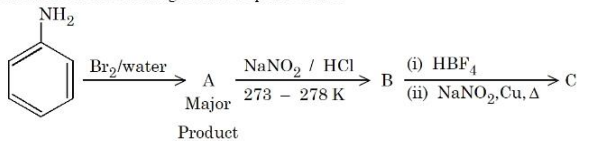
- Product \(C\) of the following reaction sequence will be
 JEE Mains 2026 Hard
- The \("N"\) which does not contribute to the basicity for the compound is
 JEE Mains 2016 Hard
- The standard reduction potentials at \(298 \mathrm{~K}\) for the following half cells are given below : \(\mathrm{Cr}_2 \mathrm{O}_7{ }^{2-}+14 \mathrm{H}^{+}+6 \mathrm{e}^{-} \rightarrow 2 \mathrm{Cr}^{3+}+7 \mathrm{H}_2 \mathrm{O}, \mathrm{E}^{\circ}=1.33 \mathrm{~V}\) \(\mathrm{Fe}^{3+}(\mathrm{aq})+3 \mathrm{e}^{-} \rightarrow \mathrm{Fe} \mathrm{E}^{\circ}=-0.04 \mathrm{~V}\) \(\mathrm{Ni}^{2+}(\mathrm{aq})+2 \mathrm{e}^{-} \rightarrow \mathrm{Ni} \mathrm{E}^{\circ}=-0.25 \mathrm{~V}\) \(\mathrm{Ag}^{+}(\mathrm{aq})+\mathrm{e}^{-} \rightarrow \mathrm{Ag} \mathrm{E}^{\circ}=0.80 \mathrm{~V}\) \(\mathrm{Au}^{3+}(\mathrm{aq})+3 \mathrm{e}^{-} \rightarrow \mathrm{Au} \mathrm{E}^{\circ}=1.40 \mathrm{~V}\) Consider the given electrochemical reactions, The number of metal\((s)\) which will be oxidized be \(\mathrm{Cr}_2 \mathrm{O}_7{ }^{2-}\), in aqueous solution is _______.JEE Mains 2024 Medium
More PYQs from JEE Mains
- Which of the following would not give \(2-\) phenylbutane as the major product in a Friedel-Crafts alkylation reaction ?JEE Mains 2013 Hard
- A \(90 \mathrm{~kg}\) body placed at \(2 \mathrm{R}\) distance from surface of earth experiences gravitational pull of _______. ( \(\mathrm{R}=\) Radius of earth, \(\mathrm{g}=10 \mathrm{~ms}^{-2}\) )JEE Mains 2024 Hard
- A radioactive nucleus \(A\) with a half life \(T\), decays into a nucleus \(B.\) At \(t = 0\), there is no nucleus \(B\). At sometime \(t\), the ratio of the number of \(B\) to that of \(A\) is \(0.3\). Then, \(t\) is given byJEE Mains 2017 Hard
- Methylation of \(10\, \mathrm{~g}\) of benzene gave \(9.2\, \mathrm{~g}\) of toluene. Calculate the percentage yield of toluene \(......\). (Nearest integer)JEE Mains 2021 Medium
- Match List-I with List-II.
List-I List-II (A) Al3+ < Mg2+ < Na+ < F- (I) Ionisation Enthalpy (B) B < C < O < N (II) Metallic character (C) B < Al < Mg < K (III) Electronegativity (D) Si < P < S < Cl (IV) Ionic radius
Choose the correct answer from the options given below :JEE Mains 2025 Medium - A \(0.5 \,kg\) block moving at a speed of \(12 \,ms ^{-1}\) compresses a spring through a distance \(30\, cm\) when its speed is halved. The spring constant of the spring will be \(Nm ^{-1}\).JEE Mains 2022 Medium