


All Electrochemistry questions
Newest firstShowing 101–150 of 185 questions
-
- (A) \(95\)
- (B) \(202\)
- (C) \(23\)
- (D) \(4\)
Show answer and solution
Correct Answer: (C)
Explanation:
Let us systematically derive the net spontaneous cell reaction and calculate the correct potential step-by-step:
1. Identify Cathode and Anode via Reduction Potentials:
For a cell reaction to be spontaneous, the overall standard cell potential (\( E^\circ_{\text{cell}} \)) must be positive. Therefore, the half-cell with the higher standard reduction potential acts as the cathode (undergoes reduction), and the one with the lower value acts as the anode (undergoes oxidation).
Standard reduction potential of Iron couple: \( E^\circ_{\text{Fe}^{3+}/\text{Fe}^{2+}} = 0.77\text{ V} \) (Higher value \(\rightarrow\) Cathode)
Standard reduction potential of Iodine couple: \( E^\circ_{\text{I}_2/2\text{I}^-} = 0.54\text{ V} \) (Lower value \(\rightarrow\) Anode)
2. Balanced Half-Cell and Net Spontaneous Reactions:
At Cathode (Reduction): \( 2\text{Fe}^{3+} + 2\text{e}^- \rightarrow 2\text{Fe}^{2+} \)
At Anode (Oxidation): \( 2\text{I}^- \rightarrow \text{I}_2 + 2\text{e}^- \)
Net Spontaneous Cell Reaction: \( 2\text{Fe}^{3+} + 2\text{I}^- \rightarrow 2\text{Fe}^{2+} + \text{I}_2 \)
3. Calculate Standard Cell Potential (\( E^\circ_{\text{cell}} \)):
Using the standard EMF formula:
\( E^\circ_{\text{cell}} = E^\circ_{\text{cathode}} - E^\circ_{\text{anode}} \)
\( E^\circ_{\text{cell}} = E^\circ_{\text{Fe}^{3+}/\text{Fe}^{2+}} - E^\circ_{\text{I}_2/2\text{I}^-} \)
\( E^\circ_{\text{cell}} = 0.77\text{ V} - 0.54\text{ V} = 0.23\text{ V} \)
4. Match with the given scientific expression:
We are given: \( E^\circ_{\text{cell}} = x \times 10^{-2}\text{ V} \)
\( 0.23\text{ V} = 23 \times 10^{-2}\text{ V} \)
Comparing both sides gives: \( x = 23 \).
Hence, Option C is the correct choice. -
- (A) \(( A )-( I ),( B )-( II ),( C )-( III ),( D )-( IV )\)
- (B) \(( A )-( IV ),( B )-( I ),( C )-( II ),( D )-( III )\)
- (C) \(( A )-( II ),( B )-( I ),( C )-( IV ),( D )-( III )\)
- (D) \(( A )-( II ),( B )-( I ),( C )-( III ),( D )-( IV )\)
Show answer and solution
Correct Answer: (C)
\((a)\) \(Cd ( s )+2 Ni ( OH )_{3}( s ) \rightarrow CdO ( s )+2 Ni ( OH )_{2}( s )\) \(+ H _{2} O (l)\)Discharge of secondary Battery
\((b)\) \(Zn ( Hg )+ HgO\) (s) \(\rightarrow ZnO ( s )+ Hg (l)\)
(Primary Battery Mercury cell)
\((c)\) \(2 PbSO _{4}\) (s) \(+2 H _{2} O (l) \rightarrow Pb ( s )+ PbO _{2}\) (s) \(+\) \(2 H _{2} SO _{4}( aq )\)
Charging of secondary Battery
\((d)\) \(2 H _{2}( g )+ O _{2}( g ) \rightarrow 2 H _{2} O ( l )-\) Fuel cell
-
- (A) \(1000\)
- (B) \(2000\)
- (C) \(3000\)
- (D) \(4000\)
Show answer and solution
Correct Answer: (A)
\(\frac{\ell}{ A }=129\; m ^{-1}\)\(KCl\) solution \(1\) :
\(74.5\; ppm , R _{1}=100\; \Omega\)
\(KCl\) solution \(2\) :
\(149\; ppm , R _{2}=50 \;\Omega\)
\(149\;ppm , R _{2}=50 \;\Omega\)
Here, \(\frac{ ppm _{1}}{ ppm _{2}}=\frac{ M _{1}}{ M _{2}}\left(=\frac{ W _{1} / M _{0}}{ V } \times \frac{ V }{ W _{2} / M _{0}}\right)\)
\(\frac{\wedge_{1}}{\wedge_{2}}=\frac{\kappa_{1} \times \frac{1000}{M_{1}}}{\kappa_{2} \times \frac{1000}{M_{2}}}\)
\(=\frac{\kappa_{1}}{\kappa_{2}} \times \frac{M_{2}}{M_{1}}\)
\(=\frac{50}{100} \times 2\)
\(=\frac{\wedge_{1}}{\wedge_{2}}=1,000 \times 10^{-3}\)
- 104. The amount of charge in \(F\) (Faraday) required to obtain one mole of iron from \(Fe _{3} O _{4}\) is (Nearest Integer) 2022 Easy
- (A) \(3\)
- (B) \(2\)
- (C) \(1\)
- (D) \(0\)
Show answer and solution
Correct Answer: (A)
\(Fe _{3} O _{4} \stackrel{+8 e^{-}}{\longrightarrow} 3\,Fe\)Charge for \(1\,mole\) \(Fe =8 / 3 F\)
\(=2.67\,F\)
-
- (A) \(50\)
- (B) \(5\)
- (C) \(15\)
- (D) \(25\)
Show answer and solution
Correct Answer: (B)
Anode \(: H _{2} \rightarrow 2 H ^{+}+2 e ^{-}\)Cathode: \(Cu ^{2+}+2 e ^{-} \rightarrow Cu\)
\(\overline{ Cu ^{2+}+ H _{2} \rightarrow 2 H ^{+}+ Cu }\)
\(E _{\text {cell }}= E _{\text {cell }}^{0}-\frac{0.06}{2} \log \frac{\left[ H ^{+}\right]^{2}}{\left[ Cu ^{2+}\right]}\)
\(0.576=0.34-\frac{0.06}{2} \log \left\{\frac{\left[ H ^{+}\right]^{2}}{(0.01)}\right\}\)
\(+3.93-\log \left( H ^{+}\right)+\log 0.1\)
\(\Rightarrow pH =4.93 \simeq 5\)
-
- (A) \(70\)
- (B) \(7\)
- (C) \(75\)
- (D) \(90\)
Show answer and solution
Correct Answer: (B)
Explanation:
Let us solve this problem step-by-step using the Nernst equation from the Electrochemistry chapter of the NCERT Class 12 Chemistry textbook:
Step 1: Write the half-cell reactions and overall cell reaction
- Anode (Oxidation): \(H_2(g) \rightarrow 2H^+(aq) + 2e^-\)
- Cathode (Reduction): \(Cu^{2+}(aq) + 2e^- \rightarrow Cu(s)\)
- Overall Reaction: \(H_2(g) + Cu^{2+}(aq) \rightarrow 2H^+(aq) + Cu(s)\)
Here, the number of moles of electrons transferred is \(n = 2\).
The standard cell potential is: \(E^\circ_{\text{cell}} = E^\circ_{Cu^{2+}/Cu} - E^\circ_{H^+/H_2} = 0.34\text{ V} - 0\text{ V} = 0.34\text{ V}\).
Step 2: Determine concentration from \(\text{pH}\)
By definition, \(\text{pH} = -\log[H^+]\). Given that the \(\text{pH}\) of the solution is 3:
\([H^+] = 10^{-\text{pH}} = 10^{-3}\text{ M}\)
The concentration of copper ions is given as \([Cu^{2+}] = 10^{-x}\text{ M}\).
Step 3: Set up the Nernst Equation
The Nernst equation at \(298\text{ K}\) for this cell is:
\(E_{\text{cell}} = E^\circ_{\text{cell}} - \frac{0.06}{n} \log \frac{[H^+]^2}{[Cu^{2+}] \cdot P_{H_2}}\)
Substituting the given values (\(E_{\text{cell}} = 0.31\text{ V}\), \(E^\circ_{\text{cell}} = 0.34\text{ V}\), \(n = 2\), and \(P_{H_2} = 1\text{ bar}\)):
\(0.31 = 0.34 - \frac{0.06}{2} \log \frac{(10^{-3})^2}{10^{-x}}\)
Step 4: Solve for \(x\)
Subtract \(0.34\) from both sides:
\(0.31 - 0.34 = -0.03 \log \frac{10^{-6}}{10^{-x}}\)
\(-0.03 = -0.03 \log(10^{-6 - (-x)})\)
Divide both sides by \(-0.03\):
\(1 = \log(10^{x - 6})\)
Using the logarithmic property \(\log(10^a) = a\):
\(1 = x - 6\)
\(x = 1 + 6 = 7\)
Hence, Option B is the correct choice. -
- (A) \(8\)
- (B) \(9\)
- (C) \(3\)
- (D) \(2\)
Show answer and solution
Correct Answer: (D)
\(E = E ^{0}-\frac{2.303 RT }{ nF } \log Q\)Here, \(E =+0.801\,V , E ^{0}=0.008-(-0.763)\)
\(=+0.771\,V\)
\(\therefore 0.801=+0.771-\frac{0.06}{ n } \log 10^{-2}\)
\(n =4\)
-
- (A) \(A > C > B > D > E\)
- (B) \(A > B > C > D > E\)
- (C) \(A > C > B > E > D\)
- (D) \(A > B > C > E > D\)
Show answer and solution
Correct Answer: (A)
\(E _{ Cl _{2} / Cl ^{-}}^{\circ}=+1.36\, V\)\(E _{ I _{2} / I ^{-}}^{\circ}=+0.54\, V\)
\(E _{ Ag ^{+} / Ag }^{\circ}=+0.80\, V\)
\(E _{ Na ^{+} / Na }^{\circ}=-2.71 \,V\)
\(E _{ Li ^{+} / Li }^{\circ}=-3.05\, V\)
-
- (A) \(A\)
- (B) \(B\)
- (C) \(C\)
- (D) \(D\)
Show answer and solution
Correct Answer: (C)
A cell with less variation in EMF with temperature is preferred as reference electrode because it can be used for wider range of temperature without much derivation from standard value so a cell with less \(\left(\frac{\partial E }{\partial T }\right)_{ P }\) is preferred. -
- (A) \(150\)
- (B) \(14\)
- (C) \(89\)
- (D) \(123\)
Show answer and solution
Correct Answer: (B)
Given\((1)\) \(\lambda_{ m }^{\infty}( NaI )=12.7 \,m\,S m ^{2}\, mol ^{-1}\)
\((2)\) \(\lambda_{ m }^{\infty}\left( NaNO _{3}\right)=12.0 \,m\,S m ^{2}\, mol ^{-1}\)
\((3)\) \(\lambda_{ m }^{\infty}\left( AgNO _{3}\right)=13.3\,m\,S m ^{2}\, mol ^{-1}\)
\(\lambda_{ m }^{\infty}( Ag I )=(1)+(3)-(2)\)
\(=12.7+13.3-12.0\)
\(=26.0-12.0\)
\(\lambda_{ m }^{\infty}( Ag I )=14.0\)
-
- (A) \(\Lambda_{m 2}=2 \Lambda_{m 1}\)
- (B) \(\Lambda_{ m 2}=\Lambda_{ m 1} / 2\)
- (C) \(\Lambda_{ m 2}=\Lambda_{ m 1}\)
- (D) \(\Lambda_{ m 2}=4 \Lambda_{ m 1}\)
Show answer and solution
Correct Answer: (A)
\(\Lambda_{ m }=\kappa \times \frac{1000}{ M }\)\(\Lambda_{ m } \propto \frac{1}{ M }\)
\(\frac{\Lambda_{ m _{1}}}{\Lambda_{ m _{2}}}=\frac{ M _{2}}{ M _{1}}=\frac{\frac{20}{80}}{\frac{10}{20}}=\frac{1}{4} \times \frac{2}{1}=\frac{1}{2}\)
\(\Lambda_{ m _{2}}=2 \Lambda_{ m _{1}}\)
- 112. The quantity of electricity in Faraday needed reduce \(1\, mol\) of \(Cr _{2} O _{7}^{2-}\) to \(Cr ^{3+}\) is .... 2022 Medium
- (A) \(50\)
- (B) \(6\)
- (C) \(600\)
- (D) \(300\)
Show answer and solution
Correct Answer: (B)
\(Cr _{2} O _{7}^{-2}+6 e ^{-} \longrightarrow 2 Cr ^{+3}\)\(1 \,mol \quad 6\, mol\)
\(\Rightarrow\) number of faradays \(=\) moles of electrons \(=6\)
-
- (A) \(452\)
- (B) \(312\)
- (C) \(266\)
- (D) \(199\)
Show answer and solution
Correct Answer: (C)
\(K =\frac{1}{ R } \times \text { cell cons } \tan t\)\(0.152 \times 10^{-3}=\frac{1}{1750}\) cell constant
cell constant \(=266 \times 10^{-3}\)
-
- (A) \(133\)
- (B) \(195\)
- (C) \(143\)
- (D) \(241\)
Show answer and solution
Correct Answer: (C)
Given conc \(^{\text {n }}\) of \(KCl =\frac{ m . mol }{ L }\): Conductance \(( G )=0.55 mS\)
: Cell constant \(\left(\frac{\ell}{ A }\right)=1.3 cm ^{-1}\)
To Calculate : Molar conductivity \(\left(\lambda_{ m }\right)\) of sol.
\(\rightarrow\) Since \(\lambda_{ m }=\frac{1}{1000} \times \frac{ k }{ m }\)
\(\rightarrow\) Molarity \(=5 \times 10^{-3} \frac{ mol }{ L }\)
\(\rightarrow\) Conductivity \(= G \times\left(\frac{\ell}{ A }\right)=0.55 \,mS \times \frac{1.3}{\frac{1}{100}} \,m ^{-1}\)
\(=55 \times 1.3 \, mSm ^{-1}\)
eq \(^{ n }(1) \,{\lambda_{ m }}=\frac{1}{1000} \times \frac{55 \times 1.3}{\left(\frac{5}{1000}\right)} \frac{ mSm ^{2}}{ mol }\)
\(\Rightarrow \lambda_{ m }=14.3 \, \frac{ mSm ^{2}}{ mol }\)
-
- (A) \(28\)
- (B) \(107\)
- (C) \(67\)
- (D) \(57\)
Show answer and solution
Correct Answer: (D)
\(\kappa=\frac{1}{R} \cdot G^{*}\)For same conductivity cell, \(G ^{*}\) is constant and hence \(\kappa . R .=\) constant.
\(\therefore 0.14 \times 4.19=\kappa \times 1.03\)
or,\(\kappa\) of HCl solution \(=\frac{0.14 \times 4.19}{1.03}\)
\(=0.5695\, Sm ^{-1}\)
\(=56.95 \times 10^{-2} Sm ^{-1} \approx 57 \times 10^{-2} \,Sm ^{-1}\)
-
- (A) \(5\)
- (B) \(2\)
- (C) \(3\)
- (D) \(9\)
Show answer and solution
Correct Answer: (C)
\(\mathrm{E}=\mathrm{E}^{\circ}-\frac{0.059}{2} \log \frac{\left[\mathrm{Cu}^{+2}\right]}{\left[\mathrm{Ag}^{+}\right]^{2}}\)\(=2.97-\frac{0.059}{2} \log \frac{0.25}{\left(10^{-3}\right)^{2}}=2.81\,\mathrm{~V}\)
- 117. Compound \(A\) used as a strong oxidizing agent is amphoteric in nature. It is the part of lead storage batteries. Compound \(A\) is 2021 Easy
- (A) \(PbO _{2}\)
- (B) \(PbO\)
- (C) \(PbSO _{4}\)
- (D) \(Pb _{3} O _{4}\)
Show answer and solution
Correct Answer: (A)
\(PbO _{2}\) is amphoteric and strong oxidizing agent and also a component of lead storage batteries. -
- (A) \(20\)
- (B) \(21\)
- (C) \(22\)
- (D) \(24\)
Show answer and solution
Correct Answer: (D)
\(\mathrm{Zn} \longrightarrow \mathrm{Zn}^{2+}+2 \mathrm{e}^{-}\)\(2 \mathrm{Fe}^{3+} \longrightarrow \mathrm{e}^{-}+\mathrm{e}^{2+}\)
___________________________________________________________
\(\mathrm{Zn}+2 \mathrm{Fe}^{3+} \longrightarrow \mathrm{Zn}^{2+}+2 \mathrm{Fe}^{2+}\)
________________________________________________________
\(\mathrm{E}_{\mathrm{cell}}^{0}=0.77-(0.76)\)
\(=1.53 \mathrm{~V}\)
\(1.50=1.53-\frac{0.06}{2} \log \left(\frac{\mathrm{Fe}^{2+}}{\mathrm{Fe}^{3+}}\right)^{2}\)
\(\log \left(\frac{\mathrm{Fe}^{2+}}{\mathrm{Fe}^{3+}}\right)=\frac{0.03}{0.06}=\frac{1}{2}\)
\(\frac{\left[\mathrm{Fe}^{2+}\right]}{\left[\mathrm{Fe}^{3+}\right]}=10^{1 / 2}=\sqrt{10}\)
\(\frac{\left[\mathrm{Fe}^{3+}\right]}{\left[\mathrm{Fe}^{2+}\right]}=\frac{1}{\sqrt{10}}frac{\left[\mathrm{Fe}^{3+}\right]}{\left[\mathrm{Fe}^{2+}\right]+\left[\mathrm{Fe}^{3+}\right]}\)
\(\frac{1}{1+\sqrt{10}}=\frac{1}{4.16}\)
\(=0.2402\)
\(=24 \times 10^{-2}\)
-
- (A) \(35\)
- (B) \(25\)
- (C) \(12\)
- (D) \(8\)
Show answer and solution
Correct Answer: (B)
The reaction given is: \(MnO _4^{-}+8 H ^{+}+5 e ^{-} \rightarrow Mn ^{2+}+4 H _2 O\)In this reaction, \(1\, mole\) \(MnO _4{ }^{-}\)reduces to form \(Mn ^{2+}\) and for this reaction \(5 F e^{-}\)are required.
\(MnO _4{ }^{-} \rightarrow Mn ^{2+}\)
\(+7 \quad\quad+2\)
Now,
\(1\, mole \,MnO _4^{-}=5 \,F\)
\(5\, mole \,MnO _4^{-}=(5 \times 5) \,F\)
\(=25 \,F\)
Therefore, the quantity of electricity required to reduce five moles of \(MnO _4{ }^{-}\) is \(25 \,F\).
-
- (A) \(1\)
- (B) \(2\)
- (C) \(3\)
- (D) \(4\)
Show answer and solution
Correct Answer: (D)
Explanation:
Let us determine the value of \(2x\) step-by-step using the Nernst equation from the Electrochemistry chapter of the NCERT Class 12 Chemistry textbook:
Step 1: Write down the half-cell reduction reactions
The two reduction processes taking place at the cathode are:
Reaction 1: Reduction of \(\text{NO}_3^-\) to \(\text{NO}\)
\(\text{NO}_3^- + 4\text{H}^+ + 3\text{e}^- \rightarrow \text{NO} + 2\text{H}_2\text{O}\), \(E^\circ_1 = 0.96\text{ V}\)
Reaction 2: Reduction of \(\text{NO}_3^-\) to \(\text{NO}_2\)
\(\text{NO}_3^- + 2\text{H}^+ + \text{e}^- \rightarrow \text{NO}_2 + \text{H}_2\text{O}\), \(E^\circ_2 = 0.79\text{ V}\)
Step 2: Relate thermodynamic tendency to reduction potentials
The thermodynamic tendency for reduction by copper is identical when the cell EMF values (\(E_{\text{cell}}\)) for both processes are equal. Since the oxidation half-cell (copper anode) is fixed and identical for both reactions, their reduction potentials at the cathode must be equal:
\(E_1 = E_2\)
Step 3: Define concentration terms for \(\text{HNO}_3\)
Since \(\text{HNO}_3\) is a strong acid, it dissociates completely in solution:
\(\text{HNO}_3 \rightarrow \text{H}^+ + \text{NO}_3^-\)
Let the molar concentration of \(\text{HNO}_3\) be \(C\). Thus:
\([\text{H}^+] = C\) and \([\text{NO}_3^-] = C\)
Step 4: Apply Nernst Equation
Using Nernst equation at \(298\text{ K}\) with \(\frac{2.303RT}{F} = 0.059\text{ V}\), and assuming \(P_{\text{NO}} = P_{\text{NO}_2} = 1\text{ bar}\):
For Reaction 1:
\(E_1 = E^\circ_1 - \frac{0.059}{3} \log \left(\frac{1}{[\text{NO}_3^-][\text{H}^+]^4}\right) = 0.96 + \frac{0.059}{3} \log \left([\text{NO}_3^-][\text{H}^+]^4\right)\)
\(E_1 = 0.96 + \frac{0.059}{3} \log (C \cdot C^4) = 0.96 + \frac{0.295}{3} \log C\)
For Reaction 2:
\(E_2 = E^\circ_2 - \frac{0.059}{1} \log \left(\frac{1}{[\text{NO}_3^-][\text{H}^+]^2}\right) = 0.79 + \frac{0.059}{1} \log \left([\text{NO}_3^-][\text{H}^+]^2\right)\)
\(E_2 = 0.79 + \frac{0.059}{1} \log (C \cdot C^2) = 0.79 + 0.177 \log C\)
Step 5: Equate \(E_1\) and \(E_2\) to find \(x\)
\(0.96 + \frac{0.295}{3} \log C = 0.79 + 0.177 \log C\)
\(0.96 - 0.79 = 0.177 \log C - 0.0983 \log C\)
\(0.17 = 0.0787 \log C\)
\(\log C = \frac{0.17}{0.0787} \approx 2.16\)
Since the concentration is given in the form \(10^x\text{ M}\):
\(C = 10^{2.16} = 10^x \implies x = 2.16\)
Therefore, the value of \(2x\) is:
\(2x = 2 \times 2.16 = 4.32\)
Rounding off to the nearest integer gives 4.
Hence, Option D is the correct choice. -
- (A) \(147\)
- (B) \(157\)
- (C) \(188\)
- (D) \(288\)
Show answer and solution
Correct Answer: (A)
\(Zn _{( s )} \rightarrow Zn _{( aq .)}^{2+}+2 e ^{-}\)\(2 Ag ^{+}_{( aq. )}+2 e ^{-} \rightarrow 2 Ag _{( s )}\)
__________________________________________________
\(Zn _{( s )}+2 Ag ^{+}_{( aq. )} \rightarrow Zn _{( aq .)}^{2+}+ 2 Ag _{( s )}\)
__________________________________________________________
\(E _{ cell }^{0}= E _{ Ag ^{+} / Ag }^{0}- E _{ zn ^{2+} / Zn }^{0}\)
\(=0.80-(-0.76)\)
\(=1.56 \,V\)
\(E _{\text {cell }}=1.56 \frac{-0.059}{2} \log \frac{\left[ Zn ^{2+}\right]}{\left[ Ag ^{+}\right]^{2}}\)
\(=1.56-\frac{0.059}{2} \log \frac{0.1}{(0.01)^{2}}\)
\(=1.56-\frac{0.059}{2} \times 3\)
\(=1.56-0.0885\)
\(=1.4715\)
\(=147.15 \times 10^{-2}\)
-
- (A) \(4\)
- (B) \(14\)
- (C) \(28\)
- (D) \(36\)
Show answer and solution
Correct Answer: (C)
Cell reaction is:\(\mathrm{Cu}(\mathrm{s})+2 \mathrm{Ag}^{+}(\mathrm{aq}) \rightarrow \mathrm{Cu}^{2+}+2 \mathrm{Ag}(\mathrm{s})\)
Now, \(\mathrm{E}_{\text {cell }}-\frac{0.059}{2} \log \frac{\left[\mathrm{cu}^{+}+\right]}{\left[\mathrm{Ag}^{+}\right]^{2}}...(1)\)
\(\therefore \mathrm{E}_{1}=0.3095=\mathrm{E}_{\text {cell }}^{0}-\frac{0.059}{2} \cdot \log \frac{0.01}{(0.001)^{2}} \ldots(2)\)
From \((1)\) and \((2),\) \(\mathrm{E}_{2}=0.28\, \mathrm{~V}=28 \times 10^{-2}\, \mathrm{~V}\)
-
- (A) \(1090\)
- (B) \(109\)
- (C) \(10.9\)
- (D) \(1.09\)
Show answer and solution
Correct Answer: (B)
Galvanic cell:\(\mathrm{Zn}_{(\mathrm{s})}+\mathrm{Cu}_{\left(\mathrm{aq.}\right)}^{+2} \rightarrow {\mathrm{Zn}^{+2}}+\mathrm{Cu}(\mathrm{s})\)
\(\quad\quad\quad\quad0.02\,M\quad0.04\,M\)
\(\text { Nernst equation }=\mathrm{F}_{\text {cell }}=\mathrm{E}_{\text {cell }}^{\circ}-\frac{0.059}{2} \log \frac{\left[2 \mathrm{n}^{+2}\right]}{\left[\mathrm{Cu}^{+2}\right]}\)
\(\Rightarrow \mathrm{E}_{\text {cell }}\left[\mathrm{E}_{\text {cell }}^{\circ}-\mathrm{E}_{\mathrm{Zn}^{+2} / \mathrm{Zn}}^{\circ}\right]-\frac{0.059}{2} \log \frac{0.04}{0.02}\)
\(\Rightarrow \mathrm{E}_{\text {cell }}[0.34-(-0.76)]-\frac{0.059}{2} \log ^{2}\)
\(\Rightarrow \mathrm{E}_{\text {cell }} 1-1-\frac{0.059}{2} \times 0.3010\)
\(\quad=1.0911=109.11 \times 10^{-2}\)
\(\quad=109\)
-
- (A) Statement \(I\) is true but Statement \(II\) is false.
- (B) Statement \(I\) is false but Statement \(II\) is true.
- (C) Both Statement \(I\) and Statement \(II\) are true.
- (D) Both Statement \(I\) and Statement \(II\) are false.
Show answer and solution
Correct Answer: (D)
\(Ion\) \(\mathrm{H}^{+}\) \(\mathrm{K}^{+}\) \(\mathrm{Cl}^{-}\) \(\mathrm{CH}_{3} \mathrm{COO}^{-}\) \(\Lambda_{\mathrm{m} \mathrm{Sem}^{2} / \mathrm{mole}}^{\infty}\) \(349.8\) \(73.5\) \(76.3\) \(40.9\) So \(\Lambda_{\mathrm{m} \mathrm{CH}_{3} \mathrm{COOH}}^{\infty}=\Lambda_{\mathrm{m}\left(\mathrm{H}^{+}\right)}^{\infty}+\Lambda_{\mathrm{m} \mathrm{CH}_{3} \mathrm{COO}^{-}}^{\infty}\)
\(=349.8+40.9\)
\(=390.7\, \mathrm{Scm}^{2} / \mathrm{mole}\)
\(\Lambda_{\mathrm{m} \mathrm{KCl}}^{\infty}= \Lambda_{\mathrm{m}\left(\mathrm{K}^{*}\right)}^{\infty}+\Lambda_{\mathrm{m}(\mathrm{Cl}^{-})}^{\infty})\)
\(= 73.5+76.3\)
\(= 149.3\, \mathrm{Scm}^{2} / \mathrm{mole}\)
So statement\(-I\) is wrong or False.
As the concentration decreases, the dilution increases which increases the degree of dissociation, thus increasing the no. of ions, which increases the molar conductance.
So statement\(-II\) is false.

-
- (A) \(260\)
- (B) \(39\)
- (C) \(26\)
- (D) \(13\)
Show answer and solution
Correct Answer: (C)
\(\mathrm{k}=1.07 \times 10^{6}\, \mathrm{Sm}^{-1}, \quad \mathrm{R}=0.243\, \Omega\)\(\mathrm{G}=\frac{1}{\mathrm{R}}=\frac{1}{0.243}\, \Omega^{-1}\)
\(\mathrm{k}=\mathrm{G} \times \mathrm{G}^{*}\)
\(\mathrm{G}^{*}=\frac{\mathrm{k}}{\mathrm{G}}=\frac{1.07 \times 10^{6}}{\frac{1}{0.243}} \simeq 26 \times 10^{4}\, \mathrm{~m}^{-1}\)
-
- (A) \((\mathrm{a})-(\mathrm{iii}),(\mathrm{b})-(\mathrm{i}),(\mathrm{c})-(\mathrm{iv}),(\mathrm{d})-(\mathrm{ii})\)
- (B) \((\mathrm{a})-(\mathrm{iii}),(\mathrm{b})-(\mathrm{i}),(\mathrm{c})-(\mathrm{ii}),(\mathrm{d})-(\mathrm{iv})\)
- (C) \((a)-(i), (b)-(iv), (c)-(iii), (d)-(ii)\)
- (D) \((a)-(ii), (b)-(i), (c)-(iii), (d)-(iv)\)
Show answer and solution
Correct Answer: (A)
Cell constant \(=\left(\frac{\ell}{\mathrm{A}}\right) \Rightarrow\) Units \(=\mathrm{m}^{-1}\)Molar conductivity \(\left(\Lambda_{m}\right) \Rightarrow\) Units \(=\mathrm{Sm}^{2} \,\mathrm{~mole}^{-1}\)
Conductivity \((\mathrm{K}) \Rightarrow\) Units \(=\mathrm{S}\, \mathrm{m}^{-1}\)
Degree of dissociation \((\alpha) \rightarrow\) Dimensionless
\(\therefore\) \((a) - (iii)\)
\(\quad(b) - (i)\)
\(\quad(c) - (iv)\)
\(\quad(d) - (ii)\)
-
- (A) \(1\)
- (B) \(2\)
- (C) \(3\)
- (D) \(4\)
Show answer and solution
Correct Answer: (A)
Given balanced equation is\(6 \mathrm{OH}^{-}+\mathrm{Cl} ^{-}\rightarrow \mathrm{ClO}_{3}^{-}+3 \mathrm{H}_{2} \mathrm{O}+6 \mathrm{e}^{-}\)
\(\rightarrow 10\, \mathrm{~g}\, \mathrm{KClO}_{3} \Rightarrow \frac{10}{122.6} \,\mathrm{~mol} \,\mathrm{KCO} 3\) in obtained
\(\rightarrow\) From the above reaction, it is concluded that by \(6\, \mathrm{~F}\) charge \(1\, \mathrm{~mol} \,\mathrm{KClO}_{3}\) is obtained.
\(\rightarrow\) By the passage of \(6\, \mathrm{~F}\) charge \(=1\, \mathrm{~mol} \,\mathrm{KClO}_{3}\)
\(\therefore\) By the passage of \(\frac{x \times 10 \times 60 \times 60}{96500}\, \mathrm{~F}\) charge
\(=\frac{1}{6} \times \frac{x \times 10 \times 60 \times 60}{96500}\)
Now \(\frac{x \times 10 \times 60 \times 60}{6 \times 96500}=\frac{10}{122.6}\)
\(\Rightarrow x=\frac{10 \times 965}{60 \times 122.6}=\frac{965}{735.6}=1.311 \simeq 1\)
OR
\(W=\frac{E}{F} \times I \times t\)
\(10=\frac{122.6}{96500 \times 6} \times x \times 10 \times 3600\)
\(X=1.311\)
-
- (A) \(18\)
- (B) \(12\)
- (C) \(61\)
- (D) \(14\)
Show answer and solution
Correct Answer: (B)
\(\wedge_{\mathrm{m}}=1000 \times \frac{\kappa}{\mathrm{M}}\)\(=1000 \times \frac{2 \times 10^{-5}}{0.001}=20 \mathrm{~S} \mathrm{~cm}^{2} \mathrm{~mol}^{-1}\)
\(\Rightarrow \alpha=\frac{\wedge_{\mathrm{m}}}{\wedge_{\mathrm{m}}^{\infty}}=\frac{20}{190}=\left(\frac{2}{19}\right)\)
\(\mathrm{HA} \rightleftharpoons \mathrm{H}^{+}+\mathrm{A}^{-}\)
\(0.001(1-\alpha) \,\,0.001 \alpha \,\,0.001 \alpha\)
\(\Rightarrow \quad \mathrm{k}_{\mathrm{a}}=0.001\left(\frac{\alpha^{2}}{1-\alpha}\right)=\frac{0.001 \times\left(\frac{2}{19}\right)^{2}}{1-\left(\frac{2}{19}\right)}\)
\(=12.3 \times 10^{-6}\)
-
- (A) \(3776\)
- (B) \(3800\)
- (C) \(4276\)
- (D) \(1552\)
Show answer and solution
Correct Answer: (A)
Eqn is-\(MnO _{4}^{-}+ H ^{\oplus}+5 e ^{-} \rightarrow Mn ^{+2}+4 H _{2} O\)
Nernst equation:
\(E _{\text {cell }}= E _{ Cell }^{0}-\frac{0.059}{5} \log \frac{\left[ Mn ^{+2}\right]}{\left[ MnO _{4}^{-}\right]}\left[\frac{1}{ H ^{+}}\right]^{8}\)
\((I)\) Given \(\left[ H ^{\oplus}\right]=1\, M\)
\(E _{1}= E ^{0}-\frac{0.059}{5} \log \frac{\left[ Mn ^{+2}\right]}{\left[ MnO _{4}^{-}\right]}\)
\((II)\) Now : \(\left[ H ^{\oplus}\right]=10^{-4}\, M\)
\(E _{2}= E ^{0}-\frac{0.059}{5} \log \frac{\left[ Mn ^{+2}\right]}{\left[ MnO _{4}^{-}\right]} \times \frac{1}{\left(10^{-4}\right)^{8}}\)
\(= E ^{0}-\frac{0.059}{5} \log \frac{ Mn ^{+2}}{\left[ MnO _{4}^{-}\right]}+\frac{0.059}{5} \log 10^{-32}\)
therefore : \(\left| E _{1}- E _{2}\right|=\frac{0.059}{5} \times 32\)
\(=0.3776\, V =3776 \times 10^{-4}\)
\(x =3776\)
-
- (A) \(102\)
- (B) \(328\)
- (C) \(488\)
- (D) \(288\)
Show answer and solution
Correct Answer: (D)
From Kohlrausch's law\(\Lambda_{ m }^{\infty}\left( BaSO _{4}\right)=\lambda_{ m }^{\infty}\left( Ba ^{2+}\right)+\lambda_{ m }^{\infty}\left( SO _{4}^{2-}\right)\)
\(\Lambda_{ m }^{\infty}\left( BaSO _{4}\right)=\Lambda_{ m }^{\infty}\left( BaCl _{2}\right)+\Lambda_{ m }^{\infty}\left( H _{2} SO _{4}\right)-2\Lambda_{ m }^{\infty}\left( HCl\right)\)
\(=280+860-2(426)\)
\(=288 \,Scm ^{2} mol ^{-1}\)
- 131. The nature of charge on resulting colloidal particles when \(FeCl _{3}\) is added to excess of hot water is : 2021 Easy
- (A) Positive
- (B) Sometimes positive and sometimes negative
- (C) Neutral
- (D) Negative
Show answer and solution
Correct Answer: (A)
If \(FeCl _{3}\) is added to hot water, a positively charged sol, hydrated ferric oxide is formed
due to adsorption of \(Fe ^{3+}\) ions.\(Fe _{2} O _{3} . xH _{2} O / Fe ^{3+}\)
Positively charged.
- 132. The product obtained from the electrolytic oxidation of acidified sulphate solution, is: 2021 Medium
- (A) \(\mathrm{HO}_{2} \mathrm{SOSO}_{2} \mathrm{H}\)
- (B) \(\mathrm{HO}_{3} \mathrm{SOOSO}_{3} \mathrm{H}\)
- (C) \(\mathrm{HSO}_{4}^{-}\)
- (D) \(\mathrm{HO}_{3} \mathrm{SOSO}_{3} \mathrm{H}\)
Show answer and solution
Correct Answer: (B)
anode: \(2 \mathrm{SO}_{4}^{-2}(\mathrm{aq}) \rightarrow\left(\mathrm{S}_{2} \mathrm{O}_{8}\right)^{-2}+2 \mathrm{e}^{-}\)Cathode : \(2 \mathrm{H}^{2}+2 \mathrm{e}^{-} \rightarrow \mathrm{H}_{2}(\mathrm{~g})\)
Electrolysis of concentrated solution of acidified sulphate solution yields \(\mathrm{H}_{2} \mathrm{~S}_{2} \mathrm{O}_{8}\).
-
- (A) \(760\)
- (B) \(76\)
- (C) \(7.6\)
- (D) \(141\)
Show answer and solution
Correct Answer: (A)
\(\mathrm{K}=\frac{1}{\mathrm{R}} \times \ell / \mathrm{A}=\left(\left(\frac{1}{1500}\right) \times 1.14\right)\, \mathrm{S}\, \mathrm{cm}^{-1}\)\(\Rightarrow \wedge_{\mathrm{m}}=1000 \times \frac{\left(\frac{1.14}{1500}\right)}{0.001}\, \mathrm{~S}\, \mathrm{~cm}^{2} \,\mathrm{~mol}^{-1}\)
\(=760 \mathrm{~S}\, \mathrm{~cm}^{2} \,\mathrm{~mol}^{-1}\)
\(\Rightarrow 760\)
-
- (A) only silver
- (B) only gold
- (C) silver and gold in equal mass proportion
- (D) silver and gold in proportion to their atomic weights
Show answer and solution
Correct Answer: (D)
As voltage is \({ }^{\prime} 2 V ^{\prime}\) so both \(Ag ^{+} \& Au ^{+}\) will reduce and their equal gm equivalent will reduce so\(gmeq\, Ag = gmeq\) of \(Au\)
\(\frac{ Wt _{ Ag }}{ E _{ qw t _{ Ag }}}=\frac{ Wt _{ Au }}{ E _{ qwt_{ Au}} }\)
So \(\frac{ wt _{ Ag }}{ wt _{ Au }}=\)\(\frac{E_{q w t_{Ag}}}{E_{q w t_{A u}}}\)\(=\frac{A t w t_{A g}}{A t w t_{A u}}\)
-
- (A) \(60\)
- (B) \(56\)
- (C) \(64\)
- (D) \(50\)
Show answer and solution
Correct Answer: (A)
Moles of \(e ^{\ominus}=\left(\frac{8 \times 60 \times 2}{96000}\right)\)Using stoichiometry; theoritically
\(\frac{ n _{ e ^{\ominus}} used }{6}=\)\(\frac{ n _{ cr ^{+3}} \text {produced }}{2}\)
\(\Rightarrow n _{ cr ^{+3}}\) produced \(=\frac{2}{6} \times \frac{8 \times 60 \times 2}{96000}\)
\(=\frac{0.02}{6}\)
\(\Rightarrow wt _{ cr ^{+3}}\) theoritically produced
\(=\left(\frac{0.02}{6} \times 52\right) g\)
\(\Rightarrow \%\) efficiency \(=\frac{0.104 g }{\left(\frac{0.02 \times 52}{6}\right) g } \times 100\)
\(=60 \%\)
-
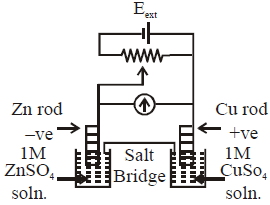
- (A) If \(E _{ ext }>1.1\, V , Zn\) dissolves at \(Zn\) electrode and \(Cu\) deposits at \(Cu\) electrode
- (B) If \(E _{\text {ext }}>1.1\, V , e ^{-}\) flows from \(Cu\) to \(Zn\)
- (C) If \(E _{ ext }=1.1 \,V ,\) no flow of e \(^{-}\) or current occurs
- (D) If \(E _{\text {ext }}<1.1\, V , Zn\) dissolves at anode and \(Cu\) deposits at cathode
Show answer and solution
Correct Answer: (A)
\(E _{\text {cell }}^{\circ}=0.34-(-0.76)\)\(\quad=1.10\) volt
If \(E _{\text {ext }}>1.10\) volt
\(Cu \rightarrow\) Anode
\(Zn \rightarrow\) Cathode
If \(E _{\text {ext }}=1.10\, volt\)
\(Zn \rightarrow\) Anode
\(Cu \rightarrow\) Cathode
-
- (A) \(2.15\)
- (B) \(3.33\)
- (C) \(1.67\)
- (D) \(4.33\)
Show answer and solution
Correct Answer: (A)
Cell reaction is\(\mathrm{Sn}(\mathrm{s})+\mathrm{Pb}^{+2}(\mathrm{aq}) \rightarrow \mathrm{Sn}^{+2}(\mathrm{aq})+\mathrm{Pb}(\mathrm{s})\dots (1)\)
Apply Nernst equation:
\(\mathrm{E}_{\text {cell}}=\mathrm{E}_{\text {cel }}^{0}-\frac{0.06}{2} \log \frac{\left[\mathrm{Sn}^{+2}\right]}{\left[\mathrm{Pb}^{+2}\right]}\)
\(\mathrm{E}_{\mathrm{cell}}^{0}=-0.13+0.14=0.01 \mathrm{V}\)
At equilibrium : \(E_{\text {cell}}=0\)
Substituting in \(( 1)\)
\(0=0.01-\frac{0.06}{2} \log \frac{\left[\mathrm{Sn}^{+2}\right]}{\left[\mathrm{Pb}^{+2}\right]}\)
\(\Rightarrow \quad \frac{1}{3}=\log \frac{\left[\mathrm{Sn}^{+2}\right]}{\left[\mathrm{Pb}^{+2}\right]}\)
\(\Rightarrow\; \frac{\left[\mathrm{Sn}^{+2}\right]}{\left\lceil\mathrm{Pb}^{+2}\right\rceil}=2.15\)
-
- (A) \(140\)
- (B) \(144\)
- (C) \(150\)
- (D) \(156\)
Show answer and solution
Correct Answer: (B)
\(Cu ^{+} \longrightarrow Cu + e ^{-}\)\(Cu ^{+}+ e ^{-} \longrightarrow Cu ( s )\)
__________________________________
\(2 Cu ^{+} \longrightarrow Cu ^{2+}+ Cu\)
\(E_{c e l l}^{o}=E_{C u^{+} / C u}^{0}-E_{C u^{2+} / C u^{+}}^{0}\)
\(=0.52-0.16\)
\(=0.36 V\)
At equilibrium \(\rightarrow E _{\text {cell }}=0\)
\(E_{c e l l}^{o}=\frac{R T}{n F} l n K\)
\(\ln K =\frac{ E _{ eell }^{\circ} \times nF }{ RT }\)
\(\ln K =\frac{0.36 \times 1}{0.025}\)
\(=14.4=144 \times 10^{-1}\)
-
- (A) \(C _{1}=2 C _{2}\)
- (B) \(C_{2}=\frac{C 1} {\sqrt{2}}\)
- (C) \(C _{1}= C _{2}\)
- (D) \(C _{2}=\sqrt{2} C _{1}\)
Show answer and solution
Correct Answer: (D)
\(\Delta G =- n F E _{\text {cell }}\)\(\Delta G\) is negative, if \(E _{\text {cell }}\) is positive
Anode : \(\quad Cu ( s ) \longrightarrow Cu ^{-2}\left( C _{1}\right)+2 e ^{-}: E ^{\circ}\)
\(\frac{\text { Cathode }: Cu ^{+2}\left( C _{2}\right)+2 e ^{-} \longrightarrow Cu ( S ):- E ^{\circ}}{\text { Cell reaction }: Cu ^{+2}\left( C _{2}\right) \longrightarrow Cu ^{+2}\left( C _{1}\right) E _{\text {cell }}^{\circ}=0}\)
\(E _{\text {cell }}= E _{\text {cell }}^{\circ}-\frac{2.303 RT }{ nF } \log Q\)
\(E _{\text {cell }}=0-\frac{2.303 RT }{ nF } \log \left(\frac{ C _{1}}{ C _{2}}\right)\)
\(E _{\text {cell }}>0:\) if \(\frac{ C _{1}}{ C _{2}}<1 \Rightarrow C _{1}< C _{2}\)
-
- (A) \(0.158\; \mathrm{V}\)
- (B) \(0.182\; \mathrm{V}\)
- (C) \(-0.182\; \mathrm{V}\)
- (D) \(-0.158\; \mathrm{V}\)
Show answer and solution
Correct Answer: (A)
\(\quad \quad \quad \quad \quad \quad \quad \quad \quad \quad E^{o}\quad \quad \quad \Delta G^o\)\(\mathrm{Cu}^{2 \mathrm{+}}+2 \mathrm{e}^{-} \longrightarrow \mathrm{Cu} \quad 0.34 \quad=-2 \mathrm{F}(0.34)\)
\(\mathrm{Cu}^{+}+\mathrm{e}^{-} \longrightarrow \mathrm{Cu} \quad \quad 0.522 \quad=-\mathrm{F}(0.522)\)
\(\mathrm{Cu}^{2 \mathrm{+}}+\mathrm{e}^{-} \longrightarrow \mathrm{Cu}^{+}\)
\(\Delta \mathrm{G}^{0}=-2 \mathrm{F}(0.34)-(-\mathrm{F}(0.522))\)\(=-\mathrm{F}(0.68-0.522)=-F(0.158)\)
\(\mathrm{E}^{0}=\frac{-\mathrm{F}(0.158)}{-\mathrm{F}}=0.158 \mathrm{V}\)
-
- (A) \(11\)
- (B) \(8\)
- (C) \(18\)
- (D) \(22\)
Show answer and solution
Correct Answer: (A)
\(\frac{10}{122} \times 6=\frac{2 \times( hr ) \times 3600 \times 60 \%}{96500}\)\(+( hr )=\frac{96500}{122 \times 72}=10.98 hr\)
\(=11\) hours
-
- (A) \(\left(\Lambda_{\mathrm{m}}^{0}\right)_{\mathrm{NaBr}}-\left(\Lambda_{\mathrm{m}}^{0}\right)_{\mathrm{NaI}}=\left(\Lambda_{\mathrm{m}}^{0}\right)_{\mathrm{KBr}}-\left(\Lambda_{\mathrm{m}}^{0}\right)_{\mathrm{NaBr}}\)
- (B) \(\left(\Lambda_{\mathrm{m}}^{0}\right)_{\mathrm{H}_{2} \mathrm{O}}=\left(\Lambda_{\mathrm{m}}^{0}\right)_{\mathrm{HCl}}+\left(\Lambda_{\mathrm{m}}^{0}\right)_{\mathrm{NaOH}}-\left(\Lambda_{\mathrm{m}}^{0}\right)_{\mathrm{NaCl}}\)
- (C) \(\left(\Lambda_{\mathrm{m}}^{0}\right)_{\mathrm{KCl}}-\left(\Lambda_{\mathrm{m}}^{0}\right)_{\mathrm{NaCl}}=\left(\Lambda_{\mathrm{m}}^{0}\right)_{\mathrm{KBr}}-\left(\Lambda_{\mathrm{m}}^{0}\right)_{\mathrm{NaBr}}\)
- (D) \(\left(\Lambda_{\mathrm{m}}^{0}\right)_{\mathrm{NaBr}}-\left(\Lambda_{\mathrm{m}}^{0}\right)_{\mathrm{NaCl}}=\left(\Lambda_{\mathrm{m}}^{0}\right)_{\mathrm{KBr}}-\left(\Lambda_{\mathrm{m}}^{0}\right)_{\mathrm{KCl}}\)
Show answer and solution
Correct Answer: (A)
According to Kohlrausch's law correct expression \(\overline{15}\)\(\left(\Lambda_{\mathrm{m}}^{0}\right)_{\mathrm{KBr}}-\left(\Lambda_{\mathrm{m}}^{0}\right)_{\mathrm{NaI}}=\left(\Lambda_{\mathrm{m}}^{0}\right)_{\mathrm{KBr}}-\left(\Lambda_{\mathrm{m}}^{0}\right)_{\mathrm{KI}}\)
The other statements are correct.
-
- (A) \(96500\)
- (B) \(96455\)
- (C) \(96530\)
- (D) \(96570\)
Show answer and solution
Correct Answer: (A)
\(\Delta G =\Delta G ^{\circ}+ RT \ln \left[\frac{ Sn ^{+2}}{ Cu ^{+2}}\right]\)\(=-2 \times 96500[(-0.16)-0.34]+ RT \ln \left(\frac{1}{1}\right)\)
\(=96500 J\)
-
- (A) \(146\)
- (B) \(150\)
- (C) \(142\)
- (D) \(154\)
Show answer and solution
Correct Answer: (C)
\(\frac{1}{2} H _{2} \rightarrow H ^{+}+ e ^{\ominus}\)\(e ^{\ominus}+ AgCl _{(s)} \rightarrow Ag _{(s)}+ Cl ^{\ominus}\)
_______________________________________________________
\(\frac{1}{2} H _{2}+ AgCl _{(s)} \rightarrow H _{( aq )}^{+}+ Ag _{(s)}+ Cl _{( aq )}^{\ominus}\)
\(E =\varepsilon^{0}-\frac{.06}{1} \log \frac{\left[ H ^{+}\right]\left[ Cl ^{\ominus}\right]}{ P _{ H _{2}}^{\frac{1}{2}}}\)
\(E =0.22-.06 \log \frac{\left(10^{-1}\right)\left(10^{-1}\right)}{1^{\frac{1}{2}}}\)
\(E =0.22+.12=34 volt\)
\(\Rightarrow\) total energy of photon will be (for Na)
\(=2.3+0.34=2.64\,eV\)
\(\Rightarrow\) stopping potential required for \(K\)
\(=2.64-2.25=0.39\) volt
\(E=\varepsilon^{0}-\frac{.06}{1} \log \frac{\left[ H ^{+}\right]\left[ Cl ^{-}\right]}{ P _{ H _{2}}^{\frac{1}{2}}}\)
as \(\left[ H ^{+}\right]=\left[ Cl ^{\ominus}\right]\) so
\(0.39=0.22-.06 \log \frac{\left[ H ^{+}\right]^{2}}{1^{\frac{1}{2}}}\)
\(0.17=+.12 pH\)
\(pH =1.4166 \Rightarrow 1.42\)
-
- (A) \(0.64,-5.71\) and \(-14.29\)
- (B) \(28.4,-7.14\) and \(-5.71\)
- (C) \(28.4,-5.71\) and \(-14.29\)
- (D) \(0.64,-7.14\) and \(-5.71\)
Show answer and solution
Correct Answer: (C)
\(\operatorname{In}\left[\frac{ k _{2}}{ k _{1}}\right]=\frac{\Delta H ^{\circ}}{ R }\left\{\frac{1}{ T _{1}}-\frac{1}{ T _{2}}\right\}\)\(\ln (10)=\frac{\Delta H ^{\circ}}{ R }\left\{\frac{1}{298}-\frac{1}{373}\right\}\)
\(373 \times 298 \times R \times 2.303=\Delta H ^{\circ}=28.37 kJ mol ^{-1}\)
\(\Delta G _{ T _{1}}^{\circ}=- RT _{1} \ln \left( K _{1}\right)=-298 R \ln (10)=-5.71 k mol ^{-1}\)
\(\Delta G _{ T _{2}}^{\circ}=- RT _{2} \ln \left( K _{2}\right)=-373 R \ln (100)\)
\(=-14.283 kJ / mol\)
-
- (A) \(CH _{3} COOH\)
- (B) \(KNO _{3}\)
- (C) \(HCl\)
- (D) \(NaCl\)
Show answer and solution
Correct Answer: (A)
Its a weak electrolyte hence : \(CH _{3} COOH\) -
- (A) \(1.52\)
- (B) \(2.56\)
- (C) \(0.36\)
- (D) \(3.56\)
Show answer and solution
Correct Answer: (A)
\(\mathrm{O}_{2}(\mathrm{g})+4 \mathrm{H}^{+}+4 \mathrm{e}^{-} \rightarrow 2 \mathrm{H}_{2} \mathrm{O}(l) ; \mathrm{E}_{\mathrm{red.}}^{0}=1.23 \mathrm{V}\)From nernst equation
\(\mathrm{E}_{\text {cell }}=\mathrm{E}_{\text {cell }}^{0}-\frac{\mathrm{RT}}{\mathrm{nF}} \ln \mathrm{Q}\)
at \(1\; bar\) and \(298 \mathrm{K}\)
\(\frac{2.303 \mathrm{RT}}{\mathrm{F}}=0.059\)
\(\mathrm{pH}=5 \Rightarrow\left[\mathrm{H}^{+}\right]=10^{-5} \mathrm{M}\)
\(\mathrm{E}_{\text {cell }}=1.23-\frac{0.059}{4} \log \left[\mathrm{H}^{+}\right]^{4}\)
\(\mathrm{E}_{\text {cell }}=1.23-\frac{0.059}{4} \log \left(10^{-5}\right)^{4}\)
\(=1.23+0.295=1.525 \mathrm{V}\)
-
- (A) \(0.20\)
- (B) \(0.05\)
- (C) \(0.10\)
- (D) \(0.15\)
Show answer and solution
Correct Answer: (B)
\(1\,F\) deposits \(1\,g\) equivalent of \(Ni\) or \(1/2\,mole\) of \(Ni\)\(\therefore \,F\) will deposit \(\frac {1}{20}\,=\,0.05\,moles\) of \(Ni\)
-
- (A) \(x -z\)
- (B) \(x + y -z\)
- (C) \(x -y\)
- (D) \(x + 2y -3z\)
Show answer and solution
Correct Answer: (D)
\(F{{e}^{2+}}(aq)\,+\,A{{g}^{+}}(aq)\,\to \,F{{e}^{3+}}\,(aq)\,+\,Ag\,(s)\)\(E_{cell}^o\, = \,3\)
Given :
\(E_{A{g^ + }/Ag}^o\, = \,x\) ....... \((1)\)
\(E_{F{e^{2 + }}/Fe}^o\, = \,y\) ....... \((2)\)
\(E_{F{e^{3 + }}/Fe}^o\, = \,Z\) ....... \((3)\)
Using equation:
\(\Delta {G^o}\, = \, - \,nF{E^o}\)
\(\Delta G_1^0\, = \, - \,Fx\)
\(\Delta G_2^0\, = \, - \,2Fy\)
\(\Delta G_3^0\, = \, - \,3Fz\)
\(F{e^{2 + }}\, + \,2{e^ - }\, \to \,Fe\, - \,2Fy\)
\(\mathop {F{e^{3 + }}}\limits_ - \, + \,\mathop {3{e^ - }}\limits_ - \, \to \,\mathop {Fe}\limits_ - \, - \,\mathop {3Fz}\limits_ + \)
\(\overline {F{e^{2 + }}\, \to \,F{e^{3 + }}\, + \,{e^ - }\,( - 2Fy\, + \,3Fz)} \)
\(\underline {A{g^ + }\, + \,{e^ - }\, \to \,Ag\, - \,Fx} \)
\(\Delta {G_{Total\,}}\, = \, - \,2\,Fy\, + \,3Fz\, - \,Fx\, = \, - \,FE_{cell}^o\)
\(E_{cell}^o\, = \,x\, + \,2y\, - \,3z\)
-
- (A) \(Ca < Zn < Mg < Ni\)
- (B) \(Ni < Zn < Mg < Ca\)
- (C) \(Zn < Mg < Ni < Ca\)
- (D) \(Ca < Mg < Zn < Ni\)
Show answer and solution
Correct Answer: (B)
Lesser the \(SRP\) value higher the reducing power.

No questions on this page match these filters.