


JEE Mains · Chemistry · STD 11 - Some basic concept of chemistry
- JEE Mains 2014
- Hard
- MCQ
The amount of \(BaSO_4\) formed upon mixing \(100\,mL\) of \(20.8\%\) \(BaCl_2\) solution with \(50\,mL\) of \(9.8\%\) \(H_2SO_4\) solution will be ............. \(\mathrm{g}\) ( \(Ba = 137,\,\,Cl = 35.5,\,\,S = 32,\,\,H = 1\) and \(O = 16\) )
Pick an option to check your answer.
Answer & Solution
Correct Answer
(A) \(11.65\)
Step-by-step Solution
Detailed explanation
Explanation:
Let us determine the mass of the precipitate formed step-by-step using the concept of limiting reagents:
1. Calculate the mass and moles of \(\text{BaCl}_2\):
- Molar mass of \(\text{BaCl}_2 = 137 + 2(35.5) = 208\text{ g mol}^{-1}\)
- Mass of \(\text{BaCl}_2\) in \(100\text{ mL}\) of \(20.8\%\) solution \(= \frac{20.8}{100} \times 100 = 20.8\text{ g}\)
- Moles of \(\text{BaCl}_2 = \frac{20.8}{208} = 0.1\text{ mol}\)
2. Calculate the mass and moles of \(\text{H}_2\text{SO}_4\):
- Molar mass of \(\text{H}_2\text{SO}_4 = 2(1) + 32 + 4(16) = 98\text{ g mol}^{-1}\)
- Mass of \(\text{H}_2\text{SO}_4\) in \(50\text{ mL}\) of \(9.8\%\) solution \(= \frac{9.8}{100} \times 50 = 4.9\text{ g}\)
- Moles of \(\text{H}_2\text{SO}_4 = \frac{4.9}{98} = 0.05\text{ mol}\)
3. Identify the Limiting Reagent:
The balanced chemical equation for the precipitation reaction is:
\(\text{BaCl}_2 + \text{H}_2\text{SO}_4 \rightarrow \text{BaSO}_4 \downarrow + 2\text{HCl}\)
According to the stoichiometry, \(1\text{ mol}\) of \(\text{BaCl}_2\) reacts completely with \(1\text{ mol}\) of \(\text{H}_2\text{SO}_4\).
Since we have \(0.1\text{ mol}\) of \(\text{BaCl}_2\) and only \(0.05\text{ mol}\) of \(\text{H}_2\text{SO}_4\), \(\text{H}_2\text{SO}_4\) is the limiting reagent and will determine the amount of product formed.
4. Calculate the mass of \(\text{BaSO}_4\) formed:
- Molar mass of \(\text{BaSO}_4 = 137 + 32 + 4(16) = 233\text{ g mol}^{-1}\)
- Moles of \(\text{BaSO}_4\) produced = Moles of limiting reagent \(= 0.05\text{ mol}\)
- Mass of \(\text{BaSO}_4 = 0.05 \times 233 = 11.65\text{ g}\)
Hence, Option A is the correct choice.
More questions from Chemistry
- Identify the incorrect statement from the following :JEE Mains 2021 Medium
- \(10 \mathrm{~mL}\) of gaseous hydrocarbon on combustion gives \(40 \mathrm{~mL}\) of \(\mathrm{CO}_2(\mathrm{~g})\) and \(50 \mathrm{~mL}\) of water vapour. Total number of carbon and hydrogen atoms in the hydrocarbon is _______.JEE Mains 2024 Medium
- For the following gas phase equilibrium reaction at constant temperature,
\(NH_3(g) \rightleftharpoons \frac{1}{2} N_2(g)+\frac{3}{2} H_2(g)\)
If the total pressure is \(\sqrt{3} \) atm and the pressure equilibrium constant \(\left( K _{ p }\right)\) is 9 atm , then the degree of dissociation is given as \(\left(x \times 10^{-2}\right)^{-1 / 2}\).
The value of \(x\) is __________ (Nearest integer)JEE Mains 2026 Easy - Which one of the following reactions will not form acetaldehyde ?JEE Mains 2021 Medium
- How many grams of methyl alcohol should be added to \(10\, litre\) tank of water to prevent its freezing at \(268\, K\) ? ............. \(\mathrm{g}\) (\(K_f\) for water is \(1.86\, K\, kg\,mol^{-1}\) )JEE Mains 2013 Medium
- \(1\, gram\) of a carbonate \((M_2CO_3)\) on treatment with excess \(HCl\) produces \(0.01186\, mole\) of \(CO_2.\) The molar mass of \(M_2CO_3\) in \(g\, mol^{-1}\) is :JEE Mains 2017 Hard
More PYQs from JEE Mains
- A body of mass \(10 kg\) is projected at an angle of \(45^{\circ}\) with the horizontal. The trajectory of the body is observed to pass through a point \((20,10)\). If \(T\) is the time of flight, then its momentum vector, at time \(t =\frac{ T }{\sqrt{2}}\), is. \(\left[\right.\) Take \(\left.g=10 m / s ^{2}\right]\)JEE Mains 2022 Hard
- The potassium ferrocyanide solution gives Prussian blue colour, when added to :JEE Mains 2021 Hard
- A convex mirror of radius of curvature \(30 \mathrm{~cm}\) forms an image that is half the size of the object. The object distance is :JEE Mains 2024 Hard
- The increasing order of diazotisation of the following compounds is
 JEE Mains 2018 Hard
- The electronic spectrum of \(\left[ Ti \left( H _{2} O \right)_{6}\right]^{3+}\) shows a single broad peak with a maximum at \(20,300\, cm ^{-1} .\) The crystal field stabilization energy \((CFSE)\) of the complex ion, in \(kJ\, mol ^{-1}\), is :JEE Mains 2020 Medium
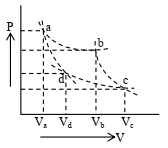
- Two different adiabatic paths for the same gas intersect two isothermal curves as shown in\(P-V\) diagram. The relation between the ratio \(\frac{V_a}{V_d}\) and the ratio \(\frac{V_b}{V_c}\) is _______.
 JEE Mains 2024 Hard