


- JEE Mains 2018
- Hard
- MCQ
Take the mean distance of the moon and the sun from the earth to be \(0.4 \times 10^6\,km\) and \(150 \times 10^6\,km\) respectively. Their masses are \(8 \times 10^{22}\, kg\) and \(2 \times 10^{30}\, kg\) respectively. The radius of the earth is \(6400\, km\). Let \(\Delta {F_1}\) be the difference in the forces exerted by the moon at the nearest and farthest points on the earth and \(\Delta {F_2}\) be the difference in the force exerted by the sun at the nearest and farthest points on the earth. Then, the number closest to \(\frac{{\Delta {F_1}}}{{\Delta {F_2}}}\) is
Answer & Solution
(A) \(2\)
Step-by-step Solution
Detailed explanation
\(F = \frac{{GMm}}{{{R^2}}}\)
\({F_1} = \frac{{G{M_e}m}}{{r_1^2}}\,and\,{F_2} = \frac{{G{m_e}{M_s}}}{{r_2^2}}\)
\(\Delta {F_1} = \frac{{2G{M_e}m}}{{r_1^3}}\Delta {r_1}\,and\,\Delta {F_2} = \frac{{G{M_e}{M_s}}}{{r_2^3}}\Delta {r_2}\)
\(\frac{{\Delta {F_1}}}{{\Delta {F_2}}} = \frac{{m\Delta {r_1}}}{{r_1^3}}\frac{{r_2^3}}{{{M_s}\Delta {r_2}}} = \left( {\frac{m}{{{M_s}}}} \right)\left( {\frac{{r_2^3}}{{r_1^3}}} \right)\left( {\frac{{\Delta {r_1}}}{{\Delta {r_2}}}} \right)\)
Using \(\Delta {r_1} = \Delta {r_2} = 2{R_{earth}};m = 8 \times {10^{22}}\,kg;\)
\({M_s} = 2 \times {10^{30\,}}kg\)
\({r_1} = 0.4 \times {10^6}km\,and\,{r_2} = 150 \times {10^6}\,km\)
\(\frac{{\Delta {F_1}}}{{\Delta {F_2}}} = \left( {\frac{{8 \times {{10}^{22}}}}{{2 \times {{10}^{30}}}}} \right){\left( {\frac{{150 \times {{10}^6}}}{{0.4 \times {{10}^6}}}} \right)^3} \times 1 \cong 2\)
More questions from Physics
- A large number \((n)\) of identical beads, each of mass \(m\) and radius \(r\) are strung on a thin smooth rigid horizontal rod of length \(L\, (L >> r)\) and are at rest at random positions. The rod is mounted between two rigid supports (see figure) . If one of the beads is now given a speed \(v\), the average force experienced by each support after a long time is (assume all collisions are elastic)
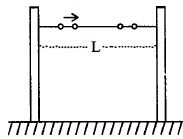 JEE Mains 2015 Hard
- A bullet of mass \(50 \mathrm{~g}\) is fired with a speed \(100 \mathrm{~m} / \mathrm{s}\) on a plywood and emerges with \(40 \mathrm{~m} / \mathrm{s}\). The percentage loss of kinetic energy is _______.JEE Mains 2024 Hard
- A \(25\,cm\) long solenoid has radius \(2\,cm\) and \(500\) total number of turns. It carries a current of \(15\,A.\) If it is equivalent to a magnet of the same size and magnetization \(\vec M\) ( magnetic moment/ volume), then \(\left| {\vec M} \right|\) isJEE Mains 2015 Medium
- A light wave described by \(E =60 \sin \left(3 \times 10^{15}\right) t + \sin \left(12 \times 10^{15}\right)\) t] (in SI units) falls on a metal surface of work function 2.8 eV . The maximum kinetic energy of ejected photoelectron is (approximately) _________ eV .JEE Mains 2026 Medium
- The magnitude of vectors \(\overrightarrow{ OA }, \overrightarrow{ OB }\) and \(\overrightarrow{ OC }\) in the given figure are equal. The direction of \(\overrightarrow{ OA }+\overrightarrow{ OB }-\overrightarrow{ OC }\) with \(x\)-axis will be
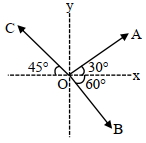 JEE Mains 2021 Hard
- When the position vector \(\overrightarrow{ r }=x \hat{ i }+y \hat{ j }+z \hat{ k }\) changes sign as \(-\overrightarrow{ r }\), which one of the following vector will not flip under sign change ?JEE Mains 2026 Easy
More PYQs from JEE Mains
- Two identical particles of mass \(1\, {kg}\) each go round a circle of radius \({R}\), under the action of their mutual gravitational attraction. The angular speed of each particle is :JEE Mains 2021 Medium
- In the given circuit, the charge on \(4\, \mu F\) capacitor will be.....\(\mu C\)
 JEE Mains 2019 Hard
- A light planet is revolving around a massive star in a circular orbit of radius \(R\) with a period of revolution \(T\). If the force of attraction between planet and star is proportional to \(\mathrm{R}^{-3 / 2}\) then choose the correct option.JEE Mains 2024 Hard