


JEE Mains · Physics · STD 11 - 13. oscillations
An oscillator of mass \(M\) is at rest in its equilibrium position in a potential \(V\, = \,\frac{1}{2}\,k{(x - X)^2}.\) A particle of mass \(m\) comes from right with speed \(u\) and collides completely inelastically with \(M\) and sticks to it . This process repeats every time the oscillator crosses its equilibrium position .The amplitude of oscillations after \(13\) collisions is: \((M = 10,\, m = 5,\, u = 1,\, k = 1 ).\)
- A \(\frac {1}{2}\)
- B \(\frac {1}{\sqrt 3}\)
- C \(\frac {2}{3}\)
- D \(\sqrt {\frac {3}{5}}\)
Answer & Solution
Correct Answer
(B) \(\frac {1}{\sqrt 3}\)
Step-by-step Solution
Detailed explanation
In first collision \(mu\) momentum will be imparted to system, in second collision when momentum of \((\mathrm{M}+\mathrm{m})\) is in opposite direction \(mu\) momentum of particle will make its momentum zero. On \(13^{\text {th }}\) collision,…
See the Complete Solution
Get step-by-step explanations for this and 2.5 Lakh+ more JEE, NEET & CET questions.
- Unlock all solutions
- Practice the full chapter
- Track accuracy across PYQs
4.8 rated on Google Play · 14,000+ reviews
More questions from Physics
- Two projectiles are fired with same initial speed from same point on ground at angles of \(\left(45^{\circ}-\alpha\right)\) and \(\left(45^{\circ}+\alpha\right)\), respectively, with the horizontal direction. The ratio of their maximum heights attained is :JEE Mains 2025 Medium
- If the two metals \(A\) and \(B\) are exposed to radiation of wavelength \(350\,nm\). The work functions of metals \(A\) and \(B\) are \(4.8\,eV\) and \(2.2\,eV\). Then choose the correct optionJEE Mains 2023 Medium
- In a carnot engine, the temperature of reservoir is \(527^{\circ} C\) and that of \(\operatorname{sink}\) is \(200 \; K\). If the workdone by the engine when it transfers heat from reservoir to sink is \(12000 \; kJ\), the quantity of heat absorbed by the engine from reservoir is \(\times 10^{6} \; J\)JEE Mains 2022 Medium
- A sonometer wire of length \(114\, cm\) is fixed at both the ends. Where should the two bridges be placed so as to divide the wire into three segments whose fundamental frequencies are in the ratio \(1 : 3 : 4\) ?JEE Mains 2013 Hard
- A convex lens of focal length 30 cm is placed in contact with a concave lens of focal length 20 cm. An object is placed at 20 cm to the left of this lens system. The distance of the image from the lens in cm is ________JEE Mains 2025 Easy
- The current passing through a conducting loop in the form of equilateral triangle of side \(4\sqrt{3}\) cm is 2A. The magnetic field at its centroid is \(\alpha\times10^{-5}T\). The value of \(\alpha\) is ___________.
(Given : \(\mu_{o}=4\pi\times10^{-7}\) SI units)JEE Mains 2026 Medium
More PYQs from JEE Mains
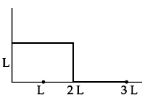
- The position vector of the centre of mass \(\vec r\, cm\) of an asymmetric uniform bar of negligible area of cross-section as shown in figure is
 JEE Mains 2019 Medium
 - The line \(L_1\) is parallel to the vector \(\vec{a}=-3 \hat{i}+2 \hat{j}+4 \hat{k}\) and passes through the point \((7,6,2)\) and the line \(L_2\) is parallel to the vector \(\vec{b}=2 \hat{i}+\hat{j}+3 \hat{k}\) and passes through the point \((5,3,4)\). The shortest distance between the lines \(L_1\) and \(L_2\) is :JEE Mains 2025 Medium
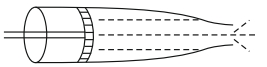
- Figure below shows a liquid being pushed out of the tube by a piston having area of cross section \(2.0\,cm ^2\). The area of cross section at the outlet is \(10\,mm ^2\). If the piston is pushed at a speed of \(4\,cm s ^{-1}\), the speed of outgoing fluidis \(.........\,cm s ^{-1}\).
 JEE Mains 2023 Easy
 - Among the statements
(S1) : The set \(\left\{\mathrm{z} \in \mathbb{C}-\{-\mathrm{i}\}:|\mathrm{z}|=1\right.\) and \(\frac{\mathrm{z}-\mathrm{i}}{\mathrm{z}+\mathrm{i}}\) is purely real} contains exactly two elements, and (S2) : The set \(\left\{\mathrm{z} \in \mathbb{C}-\{-1\}:|\mathrm{z}|=1\right.\) and \(\frac{\mathrm{z}-1}{\mathrm{z}+1}\) is purely imaginary contains infinitely many elements.JEE Mains 2025 Medium - The mass of a hydrogen molecule is \(3.32 \times 10^{-27 } \) \(kg\). If \(10^{23}\) hydrogen molecules strike, per second, a fixed wall of area \(2\) \(cm^2\) at an angle of \(45^o \) to the normal, and rebound elastically with a speed of \(10^3\ m/s\), then the pressure on the wall is nearly:JEE Mains 2018 Medium
- If the curve \(y = f(x)\) passes through the point \((1, e)\) and satisfies the differential equation \(dy = y(2 + \log_e x)\,dx\), \(x > 0\), then \(f(e)\) is equal to :JEE Mains 2026 Medium