


JEE Mains · Physics · STD 11 - Oscillations
- JEE Mains 2017
- Hard
- MCQ
The ratio of maximum acceleration to maximum velocity in a simple harmonic motion is \(10\,s^{-1}\). At, \(t = 0\) the displacement is \(5\, m\). What is the maximum acceleration ? The initial phase is \(\frac{\pi }{4}\)
Pick an option to check your answer.
Answer & Solution
Correct Answer
(B) \(500\,\sqrt 2 \,m/{s^2}\)
Step-by-step Solution
Detailed explanation
Maximum velocity in \(\mathrm{SHM}, \mathrm{v}_{\max }=\mathrm{a} \omega\)
Maximum acceleration in \(\mathrm{SHM}, \mathrm{A}_{\max }=\mathrm{a} \omega^{2}\)
where \(a\) and \(\omega\) are maximum amplitude and angular frequency.
Given that, \(\frac{A_{\max }}{v_{\max }}=10\)
i.e., \(\omega=10 \mathrm{s}^{-1}\)
Displacement is given by
Maximum acceleration in \(\mathrm{SHM}, \mathrm{A}_{\max }=\mathrm{a} \omega^{2}\)
where \(a\) and \(\omega\) are maximum amplitude and angular frequency.
Given that, \(\frac{A_{\max }}{v_{\max }}=10\)
i.e., \(\omega=10 \mathrm{s}^{-1}\)
Displacement is given by
\(x=a \sin (\omega t+\pi t 4)\)
at \(t=0, x=5\)
\(5=a \sin \pi / 4\)
\(5=a \sin 45^{\circ} \Rightarrow a=5 \sqrt{2}\)
Maximum acceleration \(\mathrm{A}_{\mathrm{max}}=\mathrm{a} \omega^{2}\)
\(=500\sqrt{2}\,m/s^2\)
More questions from Physics
- A machine gun of mass \(10\,kg\) fires \(20\,g\) bullets at the rate of \(180\) bullets per minute with a speed of \(100\,m s ^{-1}\) each. The recoil velocity of the gun is \(.............\,m/s\)JEE Mains 2023 Easy
- The half-life of \(Au ^{198}\) is \(2.7\, days.\) The activity of \(1.50\, mg\) of \(Au ^{198}\) if its atomic weight is \(198\, g mol ^{-1}\) is .......\(Ci\) \(\left( N _{ A }=6 \times 10^{23}\, / mol \right)\)JEE Mains 2021 Hard
- Two Carnot engines \(A\) and \(B\) are operated in series. Engine \(A\) receives heat from a reservoir at \(600\,K\) and rejects heat to a reservoir at temperature \(T\). Engine \(B\) receives; heat rejected by engine \(A\) and in turn rejects it to a reservoir at \(100\,K\). If the efficiencies of the two engines \(A\) and \(B\) are represented by \({\eta _A}\) and \({\eta _B}\) respectively, then what is the value of \(\frac{{{\eta _A}}}{{{\eta _B}}}\)JEE Mains 2018 Hard
- A parallel beam of light travelling in air (refractive index 1.0) is incident on a convex spherical glass surface of radius of curvature 50 cm . Refractive index of glass is 1.5 . The rays converge to a point at a distance x cm from the centre of the curvature of the spherical surface. The value of x is __________ cm.JEE Mains 2026 Medium
- Match the LIST-I with LIST-II
Choose the correct answer from the options given below :LIST-I LIST-II (A) Gravitational constant (I) \(\left[\mathrm{LT}^{-2}\right]\) (B) Gravitational potential energy (II) \(\left[\mathrm{L}^2 \mathrm{~T}^{-2}\right]\) (C) Gravitational potential (III) \(\left[\mathrm{ML}^2 \mathrm{~T}^{-2}\right]\) (D) Acceleration due to gravity (IV) \(\left[\mathrm{M}^{-1} \mathrm{~L}^3 \mathrm{~T}^{-2}\right]\) JEE Mains 2025 Medium - A small square loop of wire of side \(l\) is placed inside a large square loop of wire \(L(L \gg l)\). Both loops are coplanar and their centres coincide at point \(O\) as shown in figure. The mutual inductance of the system is.
 JEE Mains 2022 Hard
More PYQs from JEE Mains
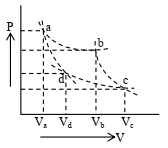
- Two different adiabatic paths for the same gas intersect two isothermal curves as shown in\(P-V\) diagram. The relation between the ratio \(\frac{V_a}{V_d}\) and the ratio \(\frac{V_b}{V_c}\) is _______.
 JEE Mains 2024 Hard
- The relation between time \(t\) and distance \(x\) for a moving body is given as \(t=m x^{2}+n x\), where \({m}\) and \({n}\) are constants. The retardation of the motion is - (Where \(v\) stands for velocity)JEE Mains 2021 Hard
- Assuming human pupil to have a radius of \(0.25\ cm\) and a comfortable viewing distance of \(25\ cm\), the minimum separation between two objects that human eye can resolve at \(500\ nm\) wavelength is.....\(\mu m\)JEE Mains 2015 Medium
- A vertical electric field of magnitude \(4.9 \times 10^{5} N / C\) just prevents a water droplet of a mass \(0.1\, g\) from falling. The value of charge on the droplet will be ........ \(\times 10^{-9} \;C\) \(\left(\right.\) Given \(\left.g =9.8 m / s ^{2}\right)\)JEE Mains 2022 Medium