


JEE Mains · Physics · STD 11 - 5. work,energy,power and collision
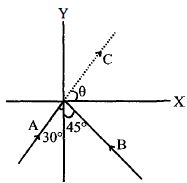
Two particles \(A\) and \(B\) of equal mass \(M\) are moving with the same speed \(v\) as shown in the figure . They collide completely inelastically and move as a single particle \(C\). The angle \(\theta \) that the path of \(C\) makes with the \(X-\) axis is given by
- A \(\tan \theta = \frac{{\sqrt 3 + \sqrt 2 }}{{1 - \sqrt 2 }}\)
- B \(\tan \theta = \frac{{\sqrt 3 - \sqrt 2 }}{{1 - \sqrt 2 }}\)
- C \(\tan \theta = \frac{{1 - \sqrt 2 }}{{\sqrt 2 \left( {1 + \sqrt 3 } \right)}}\)
- D \(\tan \theta = \frac{{1 - \sqrt 3 }}{{1 + \sqrt 2 }}\)
Answer & Solution
Correct Answer
(A) \(\tan \theta = \frac{{\sqrt 3 + \sqrt 2 }}{{1 - \sqrt 2 }}\)
Step-by-step Solution
Detailed explanation
For particle \(C,\) According to law of conservation of linear momentum, verticle component, \(2\,mv'\,\sin \,\theta = mv\sin {60^ \circ } + mv\,\sin {45^ \circ }\)…
See the Complete Solution
Get step-by-step explanations for this and 2.5 Lakh+ more JEE, NEET & CET questions.
- Unlock all solutions
- Practice the full chapter
- Track accuracy across PYQs
4.8 rated on Google Play · 14,000+ reviews
More questions from Physics
- The de-Broglie wavelength associated with a particle of mass \(m\) and energy \(E\) is \(\mathrm{h} / \sqrt{2 m E}\) The dimensional formula for Planck's constant is _______.JEE Mains 2024 Hard
- A wire of resistance \(R_{1}\) is drawn out so that its length is increased by twice of its original length.The ratio of new resistance to original resistance is.JEE Mains 2022 Easy
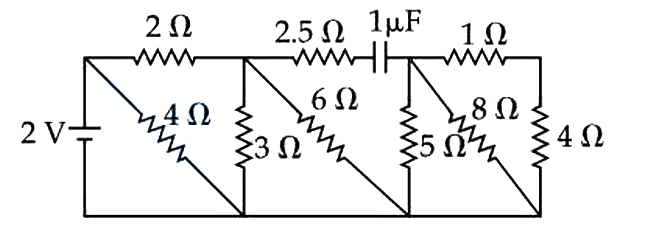
- The net current flowing in the given circuit is_______ A.
 JEE Mains 2025 Medium
 - A null point is found at \(200\,cm\) in potentiometer when cell in secondary circuit is shunted by \(5\,\Omega\). When a resistance of \(15\,\Omega\) is used for shunting null point moves to \(300\,cm\). The internal resistance of the cell is \(..............\,\Omega\).JEE Mains 2023 Medium
- Train \(A\) and train \(B\) are running on parallel tracks in the opposite directions with speeds of \(36\, km / hour\) and \(72 \,km / hour,\) respectively. A person is walking in train \(A\) in the direction opposite to its motion with a speed of \(1.8\, km / hr\). Speed (in \(ms ^{-1}\) ) of this person as observed from train \(B\) will be close to (take the distance between the tracks as negligible)JEE Mains 2020 Medium
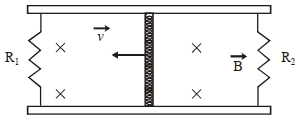
- A conducting bar of length \(L\) is free to slide on two parallel conducting rails as shown in the figure Two resistors \(R _{1}\) and \(R _{2}\) are connected across the ends of the rails. There is a uniform magnetic field \(\vec{B}\) pointing into the page. An external agent pulls the bar to the left at a constant speed \(v\) The correct statement about the directions of induced currents \(I _{1}\) and \(I _{2}\) flowing through \(R _{1}\) and \(R _{2}\) respectively is
 JEE Mains 2021 Medium
More PYQs from JEE Mains
- Let \(z\) satisfy \(\left| z \right| = 1\) and \(z = 1 - \vec z\). Statement \(1\) : \(z\) is a real number Statement \(2\) : Principal argument of \(z\) is \(\frac{\pi }{3}\)JEE Mains 2013 Hard
- A cyclotron is used to accelerate protons. If the operating magnetic field is \(1.0\,T\) and the radius of the cyclotron 'dees' is \(60 cm\), the kinetic energy of the accelerated protons in \(MeV\) will be. [use \(m _{p}=1.6 \times 10^{-27} kg , e =1.6 \times 10^{-19} C\) ]JEE Mains 2022 Medium
- Let \(y=f(x)\) be a thrice differentiable function in \((-5,5)\). Let the tangents to the curve \(y=f(x)\) at \((1, \mathrm{f}(1))\) and \((3, \mathrm{f}(3))\) make angles \(\frac{\pi}{6}\) and \(\frac{\pi}{4}\), respectively with positive \(x\)-axis. If \(27 \int_1^3\left(\left(f^{\prime}(t)\right)^2+1\right) f^{\prime \prime}(t) d t=\alpha+\beta \sqrt{3}\) where \(\alpha, \beta\) are integers, then the value of \(\alpha+\beta\) equalsJEE Mains 2024 Hard
- Consider a class of \(5\) girls and \(7\) boys. The number of different teams consisting of \(2\) girls and \(3\) boys that can be formed from this class, if there are two specific boys \(A\) and \(B\), who refuse to be the members of the same team, isJEE Mains 2019 Hard
- If \(10 \sin ^4 \theta+15 \cos ^4 \theta=6\), then the value of \(\frac{27 \operatorname{cosec}^6 \theta+8 \sec ^6 \theta}{16 \sec ^8 \theta}\) is:JEE Mains 2025 Easy
- If \(x\) and \(y\) coordinates of a projectile as a function of time \((t)\) are given as \(24t\) and \(43.6t-4.9t^2\), respectively, then the angle (in degrees) made by the projectile with horizontal when \(t=2\) s is ______.JEE Mains 2026 Medium