


JEE Mains · Physics · STD 12 - Electric potential and capacitance
- JEE Mains 2026
- Medium
- Numerical
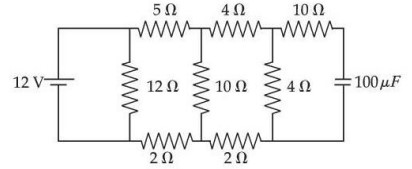
The stored charge in the capacitor in steady state of the following circuit is ________ \(\mu\)C.
Pick an option to check your answer.
Answer & Solution
Correct Answer
(D) 200
Step-by-step Solution
Detailed explanation
In steady state, the capacitor acts as an open circuit, meaning no current flows through the branch containing the \(100\ \mu\text{F}\) capacitor. Consequently, no current flows through the \(10\ \Omega\) resistor in series with it on the top right.
The voltage across the capacitor will be equal to the voltage across the \(4\ \Omega\) vertical resistor.
Let's simplify the circuit to find this voltage. The \(12\ \Omega\) resistor on the left is in parallel with the \(12\ \text{V}\) battery, so the voltage across the rest of the circuit remains \(12\ \text{V}\).
For the rightmost part of the active circuit, the \(4\ \Omega\) top resistor, the \(4\ \Omega\) vertical resistor, and the \(2\ \Omega\) bottom resistor are in series. Their equivalent resistance is:
\(R_{\text{right}} = 4\ \Omega + 4\ \Omega + 2\ \Omega = 10\ \Omega\)
This \(10\ \Omega\) equivalent resistance is in parallel with the \(10\ \Omega\) vertical resistor in the middle. The equivalent resistance of this parallel combination is:
\(R_{\text{mid}} = \dfrac{10 \times 10}{10 + 10} = 5\ \Omega\)
Now, the total resistance of the main circuit connected to the \(12\ \text{V}\) source is the sum of the \(5\ \Omega\) top-left resistor, the \(5\ \Omega\) equivalent middle resistance, and the \(2\ \Omega\) bottom-left resistor:
\(R_{\text{total}} = 5\ \Omega + 5\ \Omega + 2\ \Omega = 12\ \Omega\)
The total current flowing from the \(12\ \text{V}\) source into this main branch is:
\(I = \dfrac{12\ \text{V}}{12\ \Omega} = 1\ \text{A}\)
The voltage across the parallel combination (the middle section) is:
\(V_{\text{mid}} = I \times R_{\text{mid}} = 1\ \text{A} \times 5\ \Omega = 5\ \text{V}\)
This \(5\ \text{V}\) is applied across the right branch which has a total resistance of \(10\ \Omega\). The current through this branch is:
\(I_{\text{right}} = \dfrac{5\ \text{V}}{10\ \Omega} = 0.5\ \text{A}\)
The voltage across the \(4\ \Omega\) vertical resistor is:
\(V_{4\Omega} = I_{\text{right}} \times 4\ \Omega = 0.5\ \text{A} \times 4\ \Omega = 2\ \text{V}\)
Since the capacitor is in parallel with this \(4\ \Omega\) resistor (with no voltage drop across the \(10\ \Omega\) resistor in its branch), the voltage across the capacitor is also \(2\ \text{V}\).
The stored charge in the capacitor is:
\(Q = C \times V = 100\ \mu\text{F} \times 2\ \text{V} = 200\ \mu\text{C}\)
Answer: \(200\)
More questions from Physics
- A Carnot engine operating between two reservoirs has efficiency \(\frac{1}{3}\). When the temperature of cold reservoir raised by \(x\), its efficiency decreases to \(\frac{1}{6}\). The value of \(x\), if the temperature of hot reservoir is \(99^{\circ}\,C\), will be \(........\,K\)JEE Mains 2023 Medium
- A massless square loop, of wire of resistance \(10\,\Omega\). supporting a mass of \(1\,g\). hangs vertically with one of its sides in a uniform magnetic field of \(10^3\, G\), directed outwards in the shaded region. A dc voltage \(V\) is applied to the loop. For what value of V. the magnetic force will exactly balance the weight of the supporting mass of \(1\,g\) ? (If sides of the loop \(=10\,cm , g =10\,ms ^{-2}\) )
 JEE Mains 2023 Medium
- A bullet looses \({\left( {\frac{1}{n}} \right)^{th}}\) of its velocity passing through one plank. The number of such planks that are required to stop the bullet can beJEE Mains 2014 Hard
- An object of mass ' \(m\) ' initially at rest on a smooth horizontal plane starts moving under the action of force \(F=2 N\). In the process of its linear motion, the angle \(\theta\) (as shown in figure) between the direction of force and horizontal varies as \(\theta= kx\), where \(k\) is a constant and \(x\) is the distance covered by the object from its initial position. The expression of kinetic energy of the object will be \(E =\frac{ n }{ k } \sin \theta\). The value of \(n\) is \(.....\)
 JEE Mains 2023 Hard
- Water flows into a large tank with flat bottom at the rate of \({10^{ - 4}}\,{m^3}{s^{ - 1}}\). Water is also leaking out of a hole of area \(1\, cm^2\) at its bottom. If the height of the water in the tank remains steady, then this height is........ \(cm\)JEE Mains 2019 Medium
- A solid sphere (\(A\)) of mass \(5m\) and a spherical shell (\(B\)) of mass \(m\), both having same radius, are placed on a rough surface. When a force of same magnitude is applied tangentially at the highest points of \(A\) and \(B\), they start rolling without slipping with an acceleration of \(a_A\) and \(a_B\), respectively. The ratio of \(a_A\) and \(a_B\) is __________.JEE Mains 2026 Hard
More PYQs from JEE Mains
- Two parallel, long wires are kept \(0.20\,m\) apart in vacuum, each carrying current of \(x\) in the same direction. If the force of attraction per meter of each wire is \(2 \times 10^{-6}\,N\), then the value of \(x\) is approximatelyJEE Mains 2022 Medium
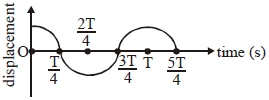
- The displacement time graph of a particle executing \(S.H.M.\) is given in figure: (sketch is schematic and not to scale) Which of the following statements is are true for this motion? \((A)\) The force is zero \(t=\frac{3 T}{4}\) \((B)\) The acceleration is maximum at \(t=T\) \((C)\) The speed is maximum at \(t =\frac{ T }{4}\) \((D)\) The \(P.E.\) is equal to \(K.E.\) of the oscillation at \(t=\frac{T}{2}\)
 JEE Mains 2020 Hard
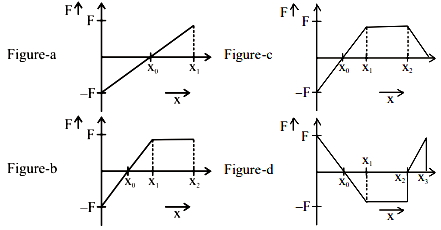
- Arrange the four graphs in descending order of total work done; where \(W _{1}, W _{2}, W _{3}\) and \(W _{4}\) are the work done corresponding to figure \(a , b , c\) and d respectively.
 JEE Mains 2022 Medium
- Time \((T)\), velocity \((C)\) and angular momentum \((h)\) are chosen as fundamental quantities instead of mass, length and time. In terms of these, the dimensions of mass would beJEE Mains 2017 Hard