


JEE Mains · Chemistry · STD 11 - Chemical bonding and molecular structure
- JEE Mains 2025
- Medium
- MCQ
Match the LIST-I with LIST-II
| LIST-I (Classification of molecules based on octet rule) | LIST-II (Example) |
| (A) Molecules obeying octet rule | (I) NO, NO2 |
| (B). Molecules with incomplete octet | (II) BCl3, AlCl3 |
| (C) Molecules with incomplete octet with odd electron | (III) H2SO4, PCl5 |
| (D) Molecules with expanded octet | (IV) CCl4, CO2 |
Choose the correct answer from the options given below:
Pick an option to check your answer.
Answer & Solution
Correct Answer
(B) A-IV, B-II, C-I, D-III
Step-by-step Solution
Detailed explanation
\(\mathrm{NO}=7 \mathrm{e}^{-}\)Incomplete octet with
\(\mathrm{NO}_2=7 \mathrm{e}^{-} \int \quad\) odd electron
\(\left.\begin{array}{l}\mathrm{BCl}_3=6 \mathrm{e}^{-} \\ \mathrm{AlCl}_3=6 \mathrm{e}^{-}\end{array}\right\}\)Incomplete octet
\(\mathrm{H}_2 \mathrm{SO}_4=12 \mathrm{e}^{-}, \mathrm{PCl}_5=10 \mathrm{e}^{-} \Rightarrow\) molecules with expanded octet
\(\mathrm{CCl}_4=8 \mathrm{e}^{-}, \mathrm{CO}_2=8 \mathrm{e}^{-} \Rightarrow\) molecules obeying octet rule
More questions from Chemistry
- The correct set of ions (aqueous solution) with same colour from the following is which?JEE Mains 2025 Easy
- The species having identical radii according to the Bohr's theory are:
A. \(H\) (first orbit)
B. \(He^+\) (first orbit)
C. \(He^+\) (Second orbit)
D. \(Li^{2+}\) (first orbit)
E. \(Be^{3+}\) (Second orbit)
Choose the correct answer from the options given below:JEE Mains 2026 Medium - \(250\,g\) solution of \(D-glucose\) in water contains \(10.8 \%\) of carbon by weight. The molality of the solution is nearest to(Given: Atomic Weights are \(H , 1\,u ; C , 12\,u ; O , 16\,u\))JEE Mains 2022 Hard
- Number of compounds/species from the following with non-zero dipole moment is _______.
[\(\mathrm{BeCl}_2, \mathrm{BCl}_3, \mathrm{NF}_3, \mathrm{XeF}_4, \mathrm{CCl}_4, \mathrm{H}_2 \mathrm{O} \mathrm{H}_2 \mathrm{~S}, \mathrm{HBr}\), \(\mathrm{CO}_2, \mathrm{H}_2, \mathrm{HCl}\)]JEE Mains 2024 Medium - Match List - I with List - II :
Choose the correct answer from the options given below :List - I (Applications) List - II (Batteries / Cell) (A) Transistors (I) Anode \(-\text{Zn} / \text{Hg};\) Cathode \(- \text{HgO} +\text C\) (B) Hearing aids (II) Hydrogen fuel cell (C) Invertors (III) Anode \(-\text{Zn};\) Cathode \(-\) Carbon (D) Apollo space ship (IV) Anode \(-\text{Pb};\) Cathode \(- \text{Pb} \mid \text{PbO} _2\) JEE Mains 2025 Medium - Given below are two statements : Statement \(I\) : Boron is extremely hard indicating its high lattice energy Statement \(II\) : Boron has highest melting and boiling point compared to its other group members. In the light of the above statements, choose the most appropriate answer from the options given belowJEE Mains 2023 Medium
More PYQs from JEE Mains
- Vanillin compound obtained from vanilla beans, has total sum of oxygen atoms and \(\pi\) electrons is _______.JEE Mains 2024 Medium
- The magnetic field in a region is given by \(\overrightarrow{ B }= B _{0}\left(\frac{ x }{ a }\right) \,\hat{ k }\). A square loop of side \(d\) is placed with its edges along the \(x\) and \(y\) axes. The loop is moved with a constant velocity \(\overrightarrow{ v }= v _{0} \hat{ i }\). The emf induced in the loop is:
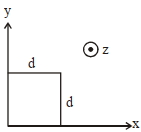 JEE Mains 2021 Hard
- The output voltage in the following circuit is : (Consider ideal diode case)
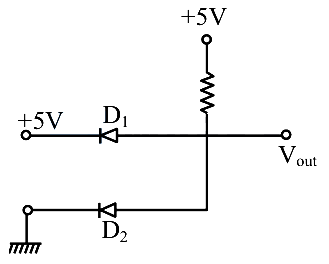 JEE Mains 2025 Medium
- Four closed surfaces and corresponding charge distributions are shown below Let the respective electric fluxes through the surfaces be \({\phi _1},{\phi _2},{\phi _3}\) and \({\phi _4}\) . Then
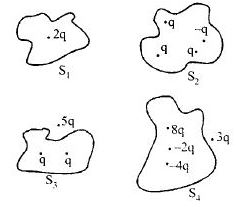 JEE Mains 2017 Hard
- Which is the most suitable reagent for the following transformation ? \(\begin{array}{*{20}{c}}
{\,\,\,\,\,\,\,\,\,\,\,\,\,\,\,\,\,\,\,\,\,\,\,\,\,\,\,\,\,\,\,\,\,\,\,\,\,\,\,\,\,\,\,\,\,\,\,\,\,\,\,\,OH} \\
{\,\,\,\,\,\,\,\,\,\,\,\,\,\,\,\,\,\,\,\,\,\,\,\,\,\,\,\,\,\,\,\,\,\,\,\,\,\,\,\,\,\,\,\,\,\,\,\,\,\,|\,\,} \\
{C{H_3} - CH = CH - C{H_2} - CH - C{H_3}}
\end{array}\) \(\longrightarrow \) \(C{H_3} - CH = CH - C{H_2}C{O_2}H\)JEE Mains 2019 Hard - In an experiment, electrons are accelerated, from rest, by applying, a voltage of \(500 \,V.\) Calculate the radius of the path if a magnetic field \(100\,mT\) is then applied. [Charge of the electron \(= 1.6 \times 10^{-19}\,C\) Mass of the electron \(= 9.1 \times 10^{-31}\,kg\) ]JEE Mains 2019 Medium