


JEE Mains · Chemistry · STD 11 - 9. Hydricarbon
Following are the four molecules "P", "Q", "R" and "S".
Which one among the four molecules will react with \(\mathrm{H}-\mathrm{Br}_{(\mathrm{aq})}\) at the fastest rate?
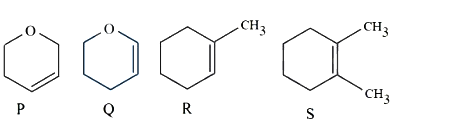
- A R
- B P
- C Q
- D S
Answer & Solution
Correct Answer
(C) Q
Step-by-step Solution
Detailed explanation
Addition of \(\mathrm{H}-\mathrm{Br}_{(\mathrm{aq})}\) to alkene follows electrophilic addition mechanism. In the rate determining step a carbocation intermediate is formed. Among P, Q, R & S compound Q will form most stable carbocation intermediate since it is resonance…
See the Complete Solution
Get step-by-step explanations for this and 2.5 Lakh+ more JEE, NEET & CET questions.
- Unlock all solutions
- Practice the full chapter
- Track accuracy across PYQs
4.8 rated on Google Play · 14,000+ reviews
More questions from Chemistry
- Given below are two statements:
Statement I: The number of pairs among \([\text{Ti}^{4+}, \text{V}^{2+}]\), \([\text{V}^{2+}, \text{Mn}^{2+}]\), \([\text{Mn}^{2+}, \text{Fe}^{3+}]\) and \([\text{V}^{2+}, \text{Cr}^{2+}]\) in which both ions are coloured is \(3\).
Statement II: The number of pairs among \([\text{La}^{3+}, \text{Yb}^{2+}]\), \([\text{Lu}^{3+}, \text{Ce}^{4+}]\) and \([\text{Ac}^{3+}, \text{Lr}^{3+}]\) ions in which both are diamagnetic is \(3\).
In the light of the above statements, choose the correct from the options given below:JEE Mains 2026 Hard - An electrochemical cell is constructed using half cells in the direction of spontaneous change
\(Fe(OH)_2(s) + 2e^- \rightarrow Fe(s) + 2OH^-(aq) \quad E^\theta = -0.88\) V
and \(AgBr(s) + e^- \rightarrow Ag(s) + Br^-(aq) \quad E^\theta = +0.07\) V
Which of the following option is correct?JEE Mains 2026 Medium - During " S " estimation, 160 mg of an organic compound gives 466 mg of barium sulphate. The percentage of Sulphur in the given compound is _______ %.
(Given molar mass in \(\mathrm{g} \mathrm{mol}^{-1}\) of \(\mathrm{Ba}: 137, \mathrm{~S}: 32, {\mathrm{O}: 16}\) )JEE Mains 2025 Medium - Match List - I with List - II. Given \(V_1\) and \(V_2\) are initial and final volumes respectively.
Choose the correct answer from the options given below :List - I (Isothermal process) List - II (Expression) A. Reversible expansion I. \(q = 0\) B. Free expansion II. \(q = nRT \ln\dfrac{V_2}{V_1}\) C. Irreversible Compression III. \(w = -p_{ext}(V_1 - V_2)\) D. Cyclic reversible IV. \(\dfrac{q_{rev}}{T} = 0\) JEE Mains 2026 Medium - Identify the incorrect statementJEE Mains 2013 Hard
- The disproportionation of \(MnO _{4}^{2-}\) in acidic medium resulted in the formation of two manganese compounds \(A\) and \(B\). If the oxidation state of \(Mn\) in \(B\) is smaller than that of \(A\), then the spin-only magnetic moment \((\mu)\) value of \(B\) in \(BM\) is \(.........\) (Nearest integer)JEE Mains 2022 Medium
More PYQs from JEE Mains
- The type of hybridization and the magnetic property of \(\left[\mathrm{MnCl}_6\right]^{3-}\) are _______.JEE Mains 2025 Medium
- The set of all values of \(\mathrm{k}\,>\,-1\), for which the equation \(\left(3 x^{2}+4 x+3\right)^{2}-(k+1)\left(3 x^{2}+4 x+3\right)\) \(\left(3 x^{2}+4 x+2\right)+k\left(3 x^{2}+4 x+2\right)^{2}=0\) has real roots is:JEE Mains 2021 Hard
- The locus of the midpoints of the chord of the circle, \(x^{2}+y^{2}=25\) which is tangent to the hyperbola \(, \frac{ x ^{2}}{9}-\frac{ y ^{2}}{16}=1\) isJEE Mains 2021 Hard
- Let \(C\) be the circle in the complex plane with centre \(z_0=\frac{1}{2}(1+3 i)\) and radius \(r=1\). Let \(z_1=1+\) \(i\) and the complex number \(z_2\) be outside the circle \(C\) such that \(\left|z_1-z_0\right|\left|z_2-z_0\right|=1\). If \(z_0, z_1\) and \(z_2\) are collinear, then the smaller value of \(\left|z_2\right|^2\) is equal to \(.............\).JEE Mains 2023 Hard
- The number of \(S=O\) and \(S-OH\) bonds present in peroxodisulphuric acid and pyrosulphuric acid respectively areJEE Mains 2017 Hard
- Let \(\vec{a}=4 \hat{i}-\hat{j}+\hat{k}, \vec{b}=11 \hat{i}-\hat{j}+\hat{k}\) and \(\vec{c}\) be a vector such that \((\vec{a}+\vec{b}) \times \vec{c}=\vec{c} \times(-2 \vec{a}+3 \vec{b}) \text {. }\) If \((2 \vec{a}+3 \vec{b}) \cdot \vec{c}=1670\), then \(|\vec{c}|^2\) is equal to :JEE Mains 2024 Hard