


JEE Mains · Chemistry · STD 11 - Chemical bonding and molecular structure
- JEE Mains 2025
- Medium
- MCQ
Consider ' \(n\) ' is the number of lone pair of electrons present in the equatorial position of the most stable structure of \(\mathrm{ClF}_3\). The ions from the following with ' \(n\) ' number of unpaired electrons are _______.
A. \(\mathrm{V}^{3+}\)
B. \(\mathrm{Ti}^{3+}\)
C. \(\mathrm{Cu}^{2+}\)
D. \(\mathrm{Ni}^{2+}\)
E. \(\mathrm{Ti}^{2+}\)
Choose the correct answer from the options given below:
Pick an option to check your answer.
Answer & Solution
Correct Answer
(B) A, D and E Only
Step-by-step Solution
Detailed explanation
\(\mathrm{ClF}_3\)
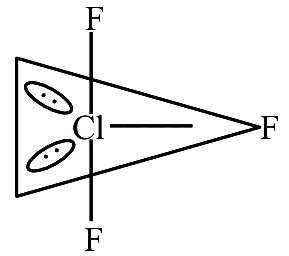
\(\mathrm{n}=2(\) No of lone pair present in equitorial plane \()\) (Unpaired \(\mathrm{e}^{-}\))
(A) \(\mathrm{V}^{+3}:[\mathrm{Ar}] 3 \mathrm{~d}^2 \quad 2\)
(B) \(\mathrm{Ti}^{3+}:[\mathrm{Ar}] 3 \mathrm{~d}^1 \quad 1\)
(C) \(\mathrm{Cu}^{+2}:[\mathrm{Ar}] 3 \mathrm{~d}^9 \quad 1\)
(D) \(\mathrm{Ni}^{+2}:[\mathrm{Ar}] 3 \mathrm{~d}^8 \quad 2\)
(E) \(\mathrm{Ti}^{+2}:[\mathrm{Ar}] 3 \mathrm{~d}^2 \quad 2\)
More questions from Chemistry
- Identify the reaction which does not liberate hydrogenJEE Mains 2016 Medium
- Quantitative analysis of an organic compound (X) shows following % composition.
C : \(14.5 \%\)
Cl : 64.46%
H: 1.8 %
(Empirical formula mass of the compound \((\mathrm{X})\) is __________ \(\times 10^{-1}\)
(Given molar mass in \(\mathrm{g} \mathrm{mol}^{-1}\) of \(\mathrm{C}: 12, \mathrm{H}: 1, \mathrm{O}: 16, \mathrm{Cl}: 35.5\))JEE Mains 2025 Medium - The Spin only magnetic moment value of square planar complex \(\left[\mathrm{Pt}\left(\mathrm{NH}_3\right)_2 \mathrm{Cl}\left(\mathrm{NH}_2 \mathrm{CH}_3\right)\right] \mathrm{Cl}\) is \(B.M.\) (Nearest integer) (Given atomic number for \(\mathrm{Pt}=78\)JEE Mains 2024 Hard
- Which of the following is diamagnetic ?JEE Mains 2013 Hard
- \(\mathrm{A}(\mathrm{g}) \rightarrow \mathrm{B}(\mathrm{g})+\mathrm{C}(\mathrm{g})\) is a first order reaction.
\(\begin{array}{|l|l|l|}\hline \text{Time} & T & \infty \\\hline \mathbf{P}_{\text {system }} & \mathrm{P}_{\mathrm{t}} & \mathrm{P}_{\infty} \\\hline\end{array}\)
The reaction was started with reactant A only. Which of the following expression is correct for rate constant k ?JEE Mains 2025 Medium - Identify the correct statements from the following
A. \([Fe(C_2O_4)_3]^{3-}\) is the most stable complex among \([Fe(OH)_6]^{3-}\), \([Fe(C_2O_4)_3]^{3-}\) and \([Fe(SCN)_6]^{3-}\)
B. The stability of \([Cu(NH_3)_4]^{2+}\) is greater than that of \([Cu(en)_2]^{2+}\)
C. The hybridization of Fe in \(K_4[Fe(CN)_6]\) is \(d^2sp^3\)
D. \([Fe(NO_2)_3Cl_3]^{3-}\) exhibits linkage isomerism
E. \(NO_2^-\) and \(SCN^-\) ligands are NOT ambidentate ligands
Choose the correct answer from the options given below :JEE Mains 2026 Hard
More PYQs from JEE Mains
- A gas is compressed from a volume of \(2\,m^3\) to a volume of \(1\, m^3\) at a constant pressure of \(100\, N/m^2\). Then it is heated at constant volume by supplying \(150\, J\) of energy. As a result, the internal energy of the gasJEE Mains 2014 Medium
- The most suitable reagent for the given conversion is
 JEE Mains 2020 Hard
- The oxidation sate of phosphorus in hypophosphoric acid is \(+......\)JEE Mains 2023 Medium
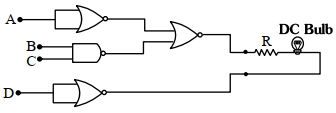
- Following gates section is connected in a complete suitable circuit. For which of the following combination, bulb will glow \((ON)\)?
 JEE Mains 2024 Hard
- Consider the hypothetical situation where the azimuthal quantum number, \(l\), takes values \(0\) , \(1,2, \ldots \ldots n+1,\) where \(n\) is the principal quantum number. Then, the element with atomic numberJEE Mains 2020 Hard
- Two reactions are given below: \(2 \mathrm{Fe}_{(\mathrm{s})}+\frac{3}{2} \mathrm{O}_{2(\mathrm{~g})} \rightarrow \mathrm{Fe}_2 \mathrm{O}_{3(\mathrm{~s})}, \Delta \mathrm{H}^{\mathrm{o}}=-822 \mathrm{~kJ} / \mathrm{mol}\) \(\mathrm{C}_{(\mathrm{s})}+\frac{1}{2} \mathrm{O}_{2(\mathrm{~g})} \rightarrow \mathrm{CO}_{(\mathrm{g})}, \Delta \mathrm{H}^{\mathrm{o}}=-110 \mathrm{~kJ} / \mathrm{mol}\) Then enthalpy change for following reaction \(3\mathrm{C}_{(\mathrm{s})}+\mathrm{Fe}_2 \mathrm{O}_{3(\mathrm{~s})} \rightarrow 2 \mathrm{Fe}_{(\mathrm{s})}+3 \mathrm{CO}_{(\mathrm{g})}\)JEE Mains 2024 Hard