


JEE Mains · Chemistry · STD 11 - 5. Thermodynamics and thermochemistry
The reaction \(MgO(s) + C(s) \to Mg(s) + CO(g)\), for which \(\Delta _r{H^o} = + 491.1\,kJ\,mo{l^{ - 1}}\) and \(\Delta _r{S^o} = 198.0\,Jk^{-1}\,mo{l^{ - 1}}\) is not feasible at \(298\, K\). Temperature above which reaction will be feasible is.....\(K\)
- A \(2040.5\)
- B \(1890\)
- C \(2480.3\)
- D \(2380.5\)
Answer & Solution
Correct Answer
(C) \(2480.3\)
Step-by-step Solution
Detailed explanation
In order to be spontaneous \(\Delta G^o\) should be \(-ve\) \(\Delta {G^o} = \Delta {H^o} - T\Delta {S^o}\) \(0 = 491.1 \times {10^3} - T \times 198\) \(T = \frac{{491100}}{{198}} = 2480\) If temp is above \(2480\,K\), the reaction will be spontaneous.
See the Complete Solution
Get step-by-step explanations for this and 2.5 Lakh+ more JEE, NEET & CET questions.
- Unlock all solutions
- Practice the full chapter
- Track accuracy across PYQs
4.8 rated on Google Play · 14,000+ reviews
More questions from Chemistry
- Consider the following complexes. \((A)\) \(\left[\mathrm{CoCl}\left(\mathrm{NH}_3\right)_5\right]^{2+}\), \(\quad\) \((B)\) \(\left[\mathrm{Co}(\mathrm{CN})_6\right]^{3-} \text {, }\) \((C)\) \(\left[\mathrm{Co}\left(\mathrm{NH}_3\right)_5\left(\mathrm{H}_2 \mathrm{O}\right)\right]^{3+}\), \(\quad\) \((D)\) \(\left[\mathrm{Cu}\left(\mathrm{H}_2 \mathrm{O}\right)_4\right]^{2+}\) The correct order of \(A\), \(B\), \(C\) and \(D\) in terms of wavenumber of light absorbed is _______.JEE Mains 2024 Medium
- Suitable reaction condition for preparation of Methyl phenyl ether isJEE Mains 2023 Easy
- The ratio of the mass percentages of \('C\) \(\&\) \(H'\) and \('C\) \(\&\) \(O'\) of a saturated acyclic organic compound\('X'\) are \(4 : 1\) and \(3 : 4\) respectively. Then, the moles of oxygen gas required for complete combustion of two moles of organic compound \('X\)' isJEE Mains 2020 Hard
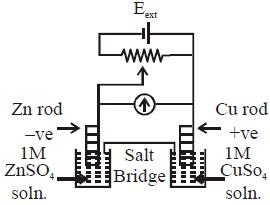
- \(E _{ Cu ^{2+} \mid Cu }^{\circ}=+0.34 V\) \(E _{ Zn ^{2}+\mid Zn }^{ o }=-0.76 V\) Identify the incorrect statement from the options below for the above cell
 JEE Mains 2020 Medium
 - What quantity (in \(mL\)) of a \(45\%\) acid solution of a mono-protic strong acid must be mixed with a \(20\%\) solution of the same acid to produce \(800\, mL\) of a \(29.875\%\) acid solution?JEE Mains 2017 Hard
- The \(\mathrm{Eu}^{2+}\) ion is a strong reducing agent in spite of its ground state electronic configuration (outermost) : [Atomic number of \(\mathrm{Eu}=63\) ]JEE Mains 2021 Easy
More PYQs from JEE Mains
- The binding energy per nucleon of \(^{209}_{83}Bi\) is _______ MeV.
\([\text{Take } m(^{209}_{83}Bi) = 208.980388 \, u, \, m_p = 1.007825 \, u, \, m_n = 1.008665 \, u, \, 1 \, u = 931 \, \text{MeV}/c^2]\)JEE Mains 2026 Medium - The mass of the moon is \(1 / 144\) times the mass of a planet and its diameter \(1 / 16\) times the diameter of a planet. If the escape velocity on the planet is \(\mathrm{v}\), the escape velocity on the moon will be _______.JEE Mains 2024 Hard
- If \(\int \limits_0^1 \frac{1}{\left(5+2 x -2 x ^2\right)\left(1+ e ^{(2-4 x)}\right)} dx =\frac{1}{\alpha} \log _{ e }\left(\frac{\alpha+1}{\beta}\right)\) \(\alpha, \beta > 0\), then \(\alpha^4-\beta^4\) is equal to:JEE Mains 2023 Hard
- For, \(\alpha, \beta, \gamma, \delta \in N\), if \(\int\left(\left(\frac{x}{e}\right)^{2 x}+\left(\frac{e}{x}\right)^{2 x}\right) \log _{ e } x d x=\frac{1}{\alpha}\left(\frac{ x }{ e }\right)^{\beta x}-\frac{1}{\gamma}\left(\frac{ e }{ x }\right)^{\delta x }+ C ,\) Where \(e =\sum \limits_{ n =0}^{\infty} \frac{1}{ n !}\) and \(C\) is constant of integration, then \(\alpha+2 \beta+3 \gamma-4 \delta\) is equal to:JEE Mains 2023 Hard
- If \(\sum_{r=1}^{10} r !\left( r ^{3}+6 r ^{2}+2 r +5\right)=\alpha(11 !),\) then the value of \(\alpha\) is equal to ...... .JEE Mains 2021 Hard
- For a given chemical reaction \(\gamma_{1} A +\gamma_{2} B \rightarrow \gamma_{3} C +\gamma_{4} D\) Concentration of \(C\) changes from \(10\, mmol\) appearance of \(D\) is \(1.5\) times the rate of disappearance of \(B\) which is twice the rate of disappearance \(A\). The rate of appearance of \(D\) has been experimentally determined to be \(9 \,m\,mol\) \(dm ^{-3} s ^{-1}\). Therefore the rate of reaction is \(......\,m\,mol\, dm ^{-3} \,s ^{-1}\). (Nearest Integer)JEE Mains 2022 Medium