


प्रश्न
6 प्रश्न6 में से 1–6 प्रश्न
-
- (A) \(2.5 \times {10^{ - 2}}\,\Omega \)
- (B) \(1.25 \times {10^{ - 3}}\,\Omega \)
- (C) \(2.5 \times {10^{ - 3}}\,\Omega \)
- (D) \(1.25 \times {10^{ - 2}}\,\Omega \)
उत्तर और हल देखें
सही उत्तर: (D)
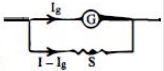
A ccording to question, current through galvanometer, \(\mathrm{I}_{\mathrm{g}}=1\, \mathrm{mA}\)Current through shunt \(\left(I-I_{g}\right)=2\, A\)
Galvanometer resistance \(\mathrm{R}_{\mathrm{g}}=25\, \Omega\)
Resistance of shunt, \(\mathrm{S}=?\)
\(\mathrm{I}_{\mathrm{g}} \mathrm{R}_{\mathrm{g}}=\left(\mathrm{I}-\mathrm{I}_{\mathrm{g}}\right) \mathrm{S}\)
\( \Rightarrow S = \frac{{{{10}^{ - 3}} \times 25}}{2}\)
\(S \simeq 1.25 \times {10^{ - 2}}\,\Omega \)
-
- (A) \(55\)
- (B) \(110\)
- (C) \(220\)
- (D) \(550\)
उत्तर और हल देखें
सही उत्तर: (B)
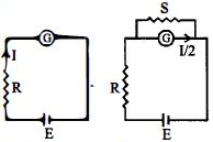
Figure of merit of a galvanometer is the current required to produce a deflection of one division in the galvancmeter i.e., figure of merit \(=\frac{\mathrm{I}}{\theta}\)\(\mathrm{I}=\frac{\varepsilon}{\mathrm{R}+\mathrm{G}} \quad \mathrm{G}=\frac{1}{9}\, \mathrm{K}\, \Omega\)
\(\frac{1}{2}=\frac{\varepsilon}{R+\frac{G S}{G+\bar{S}}} \times \frac{S}{S+G} \Rightarrow \frac{1}{2}=\frac{\varepsilon S}{R(S+G)+G S}\)
\(S=\frac{R G \times \frac{1}{2}}{\varepsilon-\frac{(R+G) I}{2}}\)
\(S=\frac{11 \times 10^{3} \times \frac{1}{2} \times 10^{2} \times 270 \times 10^{-6}}{6-\left(\frac{6}{2}\right)}=110\, \Omega\)
-
- (A) \(\sqrt 3 \)
- (B) \(\sqrt 2 \)
- (C) \(\frac{1}{{\sqrt 2 }}\)
- (D) \(2\)
उत्तर और हल देखें
सही उत्तर: (B)
Magnetic field at the centre of \(\operatorname{loop}, B_{1}=\frac{\mu_{0} I}{2 R}\)Dipole moment of circular loop is \(m=I A\)
\(\mathrm{m}_{1}=\mathrm{I} \cdot \mathrm{A}=\mathrm{I} \pi \mathrm{R}^{2} \quad\{\mathrm{R}=\text { Radius of the loop }\}\)
If moment is doubled (keeping current constant) \(R\) becomes \(\sqrt{2 \mathrm{R}}\)
\({{\text{m}}_2} = {\text{L}}\pi {(\sqrt 2 {\text{R}})^2} = 2.{\text{I}}\pi {{\text{R}}^2} = 2{{\text{m}}_1}\)
\(B_{2}=\frac{\mu_{0} I}{2(\sqrt{2} R)}\)
-
- (A) \(\frac{{4N{\mu _0}I}}{{{5^{3/2}}R}}\)
- (B) \(\frac{{8N{\mu _0}I}}{{{5^{3/2}}R}}\)
- (C) \(\frac{{4N{\mu _0}I}}{{{5^{1/2}}R}}\)
- (D) \(\frac{{8N{\mu _0}I}}{{{5^{1/2}}R}}\)
उत्तर और हल देखें
सही उत्तर: (B)
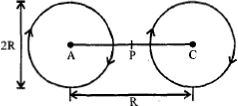
Point \(P\) is situated at the mid-point of the line joining the centres of the circular wires which have same radii \((R)\). The magnetic fields \((\vec{B})\) at \(P\) due to the currents in the wires are in same direction.Magnitude of magnetic fieldat point, \(P\)
\(B = 2\left\{ {\frac{{{\mu _0}NI{R^2}}}{{2{{\left( {{R^2} + \frac{{{R^2}}}{4}} \right)}^{3/2}}}}} \right\}\)
\(=\frac{\mu_{0} N I R^{2}}{\frac{5^{3 / 2}}{8}}=\frac{8 \mu_{0} N I}{5^{3 / 2} R}\)
-
- (A) \(r_e < r_p\) \(=\) \(\;{r_\alpha }\)
- (B) \(r_e < r_p\) \( <\) \(\;{r_\alpha }\)
- (C) \(r_e < \) \(\;{r_\alpha }\) \(< r_p\)
- (D) \(r_e > r_p\) \(=\) \(\;{r_\alpha }\)
उत्तर और हल देखें
सही उत्तर: (A)
As we know, radius of circular path in magnetic field \(\mathrm{r}=\frac{\sqrt{2 \mathrm{Km}}}{\mathrm{qB}}\)For electron, \(\mathrm{r}_{\mathrm{e}}=\frac{\sqrt{2 \mathrm{Km}_{\mathrm{e}}}}{\mathrm{eB}}.........(i)\)
For proton, \(\mathrm{r}_{\mathrm{p}}=\frac{\sqrt{2 \mathrm{Km}_{\mathrm{p}}}}{\mathrm{eB}}.........(ii)\)
For \(\alpha\) particle,
\(\mathrm{r}_{\alpha}=\frac{\sqrt{2 \mathrm{Km}_{\mathrm{a}}}}{\mathrm{q}_{\alpha} \mathrm{B}}=\frac{\sqrt{2 \mathrm{K} 4 \mathrm{m}_{\mathrm{p}}}}{2 \mathrm{eB}}=\frac{\sqrt{2 \mathrm{Km}_{\mathrm{p}}}}{\mathrm{eB}} .........(iii)\)
\(\mathrm{r}_{\mathrm{e}}<\mathrm{r}_{\mathrm{p}}=\mathrm{r}_{\alpha} \quad\left(\because \mathrm{m}_{\mathrm{e}}<\mathrm{m}_{\mathrm{p}}\right)\)
-
- (A) \(\frac{1}{2}\,\,q\omega {r^2}\)
- (B) \(\frac{4}{3}\,\,q\omega {r^2}\)
- (C) \(\frac{3}{2}\,\,q\omega {r^2}\)
- (D) \(q\omega {r^2}\)
उत्तर और हल देखें
सही उत्तर: (A)
Magnetic moment, \(\mu \, = \,IA\, = \,\frac{{qv}}{{2\pi r}}(\pi {r^2})\)or, \(\mu \,\, = \,\,\frac{{qr\omega }}{{2\pi r}}(\pi {r^2})\, = \,\frac{1}{2}\,q{r^2}\omega \)
इस पेज पर इन फ़िल्टर से कोई प्रश्न नहीं मिला।