


प्रश्न
3 प्रश्न3 में से 1–3 प्रश्न
-
- (A) \(1.985 \times 10^3\) \(Ω\)
- (B) \(2.045 \times 10^3 \) \( Ω\)
- (C) \(2.535 \times 10^3 \) \(Ω\)
- (D) \(4.005 \times10^3\) \( Ω\)
उत्तर और हल देखें
सही उत्तर: (A)
Given : Current through the galvanometer, \(i_{g}=5 \times 10^{-3} \,A\)Galvanometer resistance, \(G=15\, \Omega\)
Let resistance \(R\) to be put in series with the galvanometer to convert it into a voltmeter.
\(V=i_{g}(R+G)\)
\(10= 5 \times 10^{-3}(R+15) \)
\( \therefore \quad R=2000-15=1985 \)
\(=1.985 \times 10^{3} \,\Omega \)
-
- (A) \(\vec E = - {v_0}{B_0}\left( {3\hat i - 2\hat j - 4\hat k} \right)\)
- (B) \(\vec E = - {v_0}{B_0}\left( {\hat i + \hat j + 7\hat k} \right)\)
- (C) \(\vec E = {v_0}{B_0}\left( {14\hat j + 7\hat k} \right)\)
- (D) \(\vec E = - {v_0}{B_0}\left( {14\hat j + 7\hat k} \right)\)
उत्तर और हल देखें
सही उत्तर: (D)
According to question, as the test charge experiences no net force in that region i.e., sum of electric force \(\left( {{{\text{F}}_{\text{e}}} = {\text{q}}\overrightarrow {\text{E}} } \right)\,\) and magnetic forces \([{{\text{F}}_{\text{m}}} = {\text{q}}(\overline {\text{v}} \times \overline {\text{B}} ]\) will be zero.Hence, \(F_{e}+F_{m}=0\)
\(\mathrm{F}_{\mathrm{e}}=-\mathrm{q}(\overline{\mathrm{v}} \times \overline{\mathrm{B}})\)
\(=-\mathrm{B}_{0} \mathrm{v}_{0}[(3 \hat{\mathrm{i}}-\hat{\mathrm{j}}+2 \hat{\mathrm{k}}) \times(\mathrm{i}+2 \hat{\mathrm{j}}-4 \hat{\mathrm{k}})]\)
\(=-B_{0} v_{0}(14 \hat{j}+7 \hat{k})\)
-
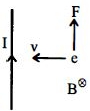
- (A) तार से दूर
- (B) तार की और
- (C) तार से समान्तर एवं धारा की दिशा में
- (D) तार के समान्तर एवं धारा की विपरीत दिशा में
उत्तर और हल देखें
सही उत्तर: (B)
The force is parallel to the direction of current in magnetic field,hence \(\mathrm{F}=\mathrm{q}(\mathrm{v} \times \overrightarrow{\mathrm{B}})\)
According to Fleming's left hand rule,
we have, the direction of motion of charge is towards the wire.
इस पेज पर इन फ़िल्टर से कोई प्रश्न नहीं मिला।