


प्रश्न
8 प्रश्न8 में से 1–8 प्रश्न
-
- (A) \(14\)
- (B) \(8.4\)
- (C) \(4\)
- (D) \(1.4\)
उत्तर और हल देखें
सही उत्तर: (A)
Work done \(= MB \left(\cos \theta_{1}-\cos \theta_{2}\right)\)\(\theta_{1}=0^{\circ}, \theta_{2}=60^{\circ}\)
\(=2 \times 10^{5} \times 14 \times 10^{-5}(1-1 / 2)\)
\(=14 \;J\)
-
- (A) \(2: 1\)
- (B) \(8: 3\)
- (C) \(1: 3\)
- (D) \(27: 16\)
उत्तर और हल देखें
सही उत्तर: (B)
\(T =2 \pi \sqrt{\frac{ I }{ MB _{ H }}}\)\(\frac{ T _{1}}{ T _{2}}=\frac{2 \pi \sqrt{\frac{ I _{1}}{ M _{1} B _{ H }}}}{2 \pi \sqrt{\frac{ I _{2}}{ M _{2} B _{ H }}}}=\frac{3}{4}\)
\(\sqrt{\frac{ I _{1}}{ I _{2}}} \times \frac{ M _{2}}{ M _{1}}=\frac{3}{4}\)
\(\sqrt{\frac{ I _{1}}{ I _{2}}} \times \sqrt{\frac{ M _{2}}{ M _{1}}}=\frac{3}{4}\)
\(\sqrt{\frac{3}{2}} \times \sqrt{\frac{ M _{2}}{ M _{1}}}=\frac{3}{4}\)
\(\frac{3}{2} \times \frac{ M _{2}}{ M _{1}}=\frac{9}{16}\)
\(\frac{ M _{1}}{ M _{2}}=\frac{8}{3}\)
-
- (A) \(4 \pi \times 10^{-7}\)
- (B) \(4 \pi \times 10^{-4}\)
- (C) \(4 \pi \times 10^{-5}\)
- (D) \(4 \pi \times 10^{-6}\)
उत्तर और हल देखें
सही उत्तर: (C)
Susceptibility \(\chi=99\)\(\mu_{r}=\frac{\mu}{\mu_{0}}=1+\chi\)
\(\mu=\mu_{0}(1+\chi)\)
\(=4 \pi \times 10^{-7}[1+99]\)
\(=4 \pi \times 10^{-5}\)
-
- (A) \(\tan ^{-1}\left(\sqrt{\frac{3}{2}}\right)\)
- (B) \(\tan ^{-1}(\sqrt{6})\)
- (C) \(\tan ^{-1}\left(\sqrt{\frac{2}{3}}\right)\)
- (D) \(\tan ^{-1}\left(\sqrt{\frac{1}{2}}\right)\)
उत्तर और हल देखें
सही उत्तर: (A)
\(\tan \theta^{\prime}=\frac{\tan \theta}{\cos \alpha}\)\(\theta^{\prime}=60^{\circ}\)
\(\alpha=45^{\circ}\)
\(\sqrt{3}=\frac{\tan \theta}{\frac{1}{\sqrt{2}}}\)
\(\tan \theta=\sqrt{\frac{3}{2}}\)
\(\theta=\tan ^{-1} \sqrt{\frac{3}{2}}\)
-
- (A) \(8 \times 10^{-5}\,T\)
- (B) \(6 \times 10^{-5}\,T\)
- (C) \(5 \times 10^{-4}\,T\)
- (D) \(1 \times 10^{-4}\,T\)
उत्तर और हल देखें
सही उत्तर: (D)
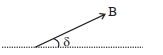
\(\left(\delta=37^{\circ}\right)\)\(B _{ V }= B \sin \delta\)
\(6 \times 10^{-5}= B \frac{3}{5}\)
\(B =10 \times 10^{-5}\,T\)
\(=10^{-4}\,T\)
-
- (A) \(\sqrt{3}: 4\)
- (B) \(4: \sqrt{3}\)
- (C) \(\sqrt{3}: 2\)
- (D) \(2: \sqrt{3}\)
उत्तर और हल देखें
सही उत्तर: (A)
\(T =2 \pi \sqrt{\frac{ I }{ B _{ H } M }}\)\(T _{1}=3\,sec =2 \pi \sqrt{\frac{ I }{\left( B _{ p } \cos 30^{\circ}\right) M }}\)
\(T _{2}=6\,sec =2 \pi \sqrt{\frac{ I }{\left( B _{ Q } \cos 60^{\circ}\right) M }}\)
\(\frac{3}{6}=\sqrt{\frac{ B _{ Q } / 2}{B _{ p } \frac{\sqrt{3}}{2}}}\)
\(\frac{3}{6}=\sqrt{\frac{ B _{ Q }}{\sqrt{3} B _{ p }}}\)
\(\frac{ B _{ Q }}{\frac{3}{4}}=\frac{ B _{ p }}{ B _{ Q }}=\sqrt{3}: 4\)
-
- (A) \(\frac{1}{\sqrt{3}}\)
- (B) \(\frac{1}{2}\)
- (C) \(\sqrt{3}\)
- (D) \(1\)
उत्तर और हल देखें
सही उत्तर: (A)
\(B _{ H }= B \cos \theta\)\(\therefore B =\frac{ B _{ H }}{\cos \theta}=\frac{0.5 G }{\cos 30^{\circ}} \Rightarrow \frac{ G }{\sqrt{3}}\)
-
- (A) कथन \(-I\) तथा कथन \(-II\) दोनों सत्य है।
- (B) कथन \(-I\) तथा कथन \(-II\) दोनों असत्य है।
- (C) कथन \(-I\) सत्य है पर कथन \(-II\) असत्य है।
- (D) कथन \(-I\) असत्य है पर कथन \(-II\) सत्य है।
उत्तर और हल देखें
सही उत्तर: (A)
According to curie's law, magnetic susceptibility is inversely proportional to temperature for a fixed value of external magnetic field i.e. \(\chi=\frac{C}{T}\).The same is applicable for ferromagnet and the relation is given as \(\chi=\frac{ C }{ T - T _{ C }} \quad\left( T _{ C }\right.\) is curie temperature)
Diamagnetism is due to non-cooperative behaviour of orbiting electrons when exposed to external magnetic field.
Hence option \((A).\)
इस पेज पर इन फ़िल्टर से कोई प्रश्न नहीं मिला।