


वैद्युत रसायन के सभी प्रश्न
नए पहले179 में से 151–179 प्रश्न
-
- (A) \(22.8\)
- (B) \(15.2\)
- (C) \(7.6\)
- (D) \(11.4\)
उत्तर और हल देखें
सही उत्तर: (C)
\(Pb\,(s)\, + \,SO_4^{2 - }\, \to \,PbS{O_4}\, + \,2{e^ - }\)For \(2\,F\) current passed, \(PdSO_4\) deposited \(=\,303\,g/mol\)
For \(0.05\,F\) \(:\,PdSO_4\) deposited \( = \,\frac{{0.05\, \times \,303}}{2}\, = \,7.6\,g\)
-
- (A) \(e^{-80}\)
- (B) \(e^{-160}\)
- (C) \(e^{320}\)
- (D) \(e^{160}\)
उत्तर और हल देखें
सही उत्तर: (D)
\(Zn\,(S)\, + \,C{u^{2 + }}(aq)\, \rightleftharpoons \,Z{n^{2 + }}\,(aq)\, + \,Cu(s)\)\( - nF{E_{cell}}\, = \, - \,RT\ln \,K\)
\(\ln \,K\, = \,\frac{{2\, \times \,96500\, \times \,2}}{{8\, \times \,300}}\, = \,160.83\)
\(K\, = \,{e^{160}}\)
-
- (A) \(0.50\)
- (B) \(0.25\)
- (C) \(0.125\)
- (D) \(0.75\)
उत्तर और हल देखें
सही उत्तर: (C)
\(\lambda _{m}^{o}(HA)\,=\,100.5\,+\,425.9\,-\,126.4\,=400\)\(\lambda _{m}^{o}=\,\frac{K\,\times \,1000}{M}\,=\,\frac{5\,\times \,{{10}^{-5}}\,\times \,{{10}^{3}}}{{{10}^{-3}}}\,=50\)
\(\alpha \,=\,\frac{50}{400}\,=\,0.125\)
-
- (A) \(Ca < Zn < Mg < Ni\)
- (B) \(Ni < Zn < Mg < Ca\)
- (C) \(Zn < Mg < Ni < Ca\)
- (D) \(Ca < Mg < Zn < Ni\)
उत्तर और हल देखें
सही उत्तर: (B)
Lesser the \(SRP\) value higher the reducing power. -
- (A) \(0.94\)
- (B) \(0.76\)
- (C) \(0.40\)
- (D) \(0.20\)
उत्तर और हल देखें
सही उत्तर: (D)
\(E\, = \,{E^o}\, - \,0.06\,\log \,\frac{{[{H^ + }]\,[C{l^ - }]}}{{{{[{H_2}]}^{1/2}}}}\)\(0.92\, = \,{E^o}\, - \,0.06\,\log \,\frac{{{{10}^{ - 6}}\,.\,{{10}^{ - 6}}}}{{{1^{1/2}}}}\)
\(0.92\, = \,{E^o}\, - \,0.06\,\log \,{10^{ - 12}}\)
\({E^o} + \,\,0.06\, \times \,12\)
\({E^o}\, = \,0.92\, - \,0.06\, \times \,12\)
\({E^o}\, = \,0.92\, - \,0.72\)
\(E_{Ag}^o\,/\,AgCl\, = \,0.20\)
-
- (A) \(S1\) गलत है तथा \(S 2\) सही है।
- (B) \(S 1\) तथा \(S 2\) दोनों गलत हैं।
- (C) \(S 1\) सही है तथा \(S 2\) गलत है।
- (D) \(S1\) तथा \(S2\) दोनों सही हैं।
उत्तर और हल देखें
सही उत्तर: (A)
We know that\(\lambda _m=\frac {K}{C}\) Here \(\lambda _m\,=\) molar conductivity
\(K=\) conductivity
\(C\,=\) concentration
when concentration increase conductivity always increases. The molar conductivity always increase wih the decrease in the concentration
-
- (A) \(Ag^+\,/\,Ag\)
- (B) \(Fe^{3+}\,/\,Fe^{2+}\)
- (C) \(Au^{3+}\,/\,Au\)
- (D) \(Fe^{2+}\,/\,Fe\)
उत्तर और हल देखें
सही उत्तर: (C)
\(E_{cell}^o{\kern 1pt} = E_{Cathode}^o\, - \,E_{Z{n^{2 + }}/Zn}^o\)Since \(Au^{3+} \to Au\) has maximum value.
-
- (A) \(x -z\)
- (B) \(x + y -z\)
- (C) \(x -y\)
- (D) \(x + 2y -3z\)
उत्तर और हल देखें
सही उत्तर: (D)
\(F{{e}^{2+}}(aq)\,+\,A{{g}^{+}}(aq)\,\to \,F{{e}^{3+}}\,(aq)\,+\,Ag\,(s)\)\(E_{cell}^o\, = \,3\)
Given :
\(E_{A{g^ + }/Ag}^o\, = \,x\) ....... \((1)\)
\(E_{F{e^{2 + }}/Fe}^o\, = \,y\) ....... \((2)\)
\(E_{F{e^{3 + }}/Fe}^o\, = \,Z\) ....... \((3)\)
Using equation:
\(\Delta {G^o}\, = \, - \,nF{E^o}\)
\(\Delta G_1^0\, = \, - \,Fx\)
\(\Delta G_2^0\, = \, - \,2Fy\)
\(\Delta G_3^0\, = \, - \,3Fz\)
\(F{e^{2 + }}\, + \,2{e^ - }\, \to \,Fe\, - \,2Fy\)
\(\mathop {F{e^{3 + }}}\limits_ - \, + \,\mathop {3{e^ - }}\limits_ - \, \to \,\mathop {Fe}\limits_ - \, - \,\mathop {3Fz}\limits_ + \)
\(\overline {F{e^{2 + }}\, \to \,F{e^{3 + }}\, + \,{e^ - }\,( - 2Fy\, + \,3Fz)} \)
\(\underline {A{g^ + }\, + \,{e^ - }\, \to \,Ag\, - \,Fx} \)
\(\Delta {G_{Total\,}}\, = \, - \,2\,Fy\, + \,3Fz\, - \,Fx\, = \, - \,FE_{cell}^o\)
\(E_{cell}^o\, = \,x\, + \,2y\, - \,3z\)
-
- (A) \(109\)
- (B) \(98.1\)
- (C) \(9.81\)
- (D) \(10.9\)
उत्तर और हल देखें
सही उत्तर: (C)
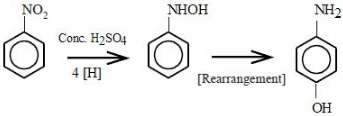
\(9. 65\) ampere current was passed for \(1 .0\) hour ( \(3600\) seconds) Number of moles of electrons passed \( = \frac{{I(A) \times t(s)}}{{96500}} = \frac{{9.65A \times 3600s}}{{96500}} = 0.36\,moles\)\({C_6}{H_5}N{O_2}\, + \,4{e^ - } + 4{H^ + } \to \,{\text{p - Aminophenol}} + {H_2}O\)
\(4\) moles of electrons will reduce \(1\) mole of nitrobenzene to \(p-\) aminophenol. \(0.36\) moles of electrons will reduce \(\frac{{0.36}}{4} = 0.09\) moles of nitrobenzene to \(p-\) aminophenol \(p-\) aminophenol molar mass \(= 109 .14\,\,g/mol\) Mass of \(p-\) aminophenol obtained \(= 109.14\,g/mol \times 0.09\,mol = 9.81\,g\)
-
- (A) \(2.0\)
- (B) \(0.1\)
- (C) \(0.5\)
- (D) \(1.0\)
उत्तर और हल देखें
सही उत्तर: (D)
Reduction at cathode:\(2{e^ - }\, + \,2{H_2}O\, \to \,{H_2}\, + \,2O{H^ - }\)
(valence factor) \(H_2=2\)
At \(NTP\) \(22400\,mL\) of \(H_2=1\,mole\) of \(H_2\,\,112\,mL\) of
\({H_2}\, = \,\frac{1}{{22400}}\, \times \,112\, = \,0.005\,mole\) of \(H_2\)
Moles of \(H_2\) produced
\( = \frac{{I\, \times t}}{{96500}}\, \times \) mole ratio
\(0.005 = \frac{{I\, \times 965}}{{96500}}\, \times \frac{{1\,\,mole\,\,of\,\,{H_2}}}{{2\,\,mole\,\,of\,\,{e^ - }}}\)
\(I\,=\,1.0\,A\)
-
- (A) \(Cr\)
- (B) \(Mn^{2+}\)
- (C) \(Cr^{+3}\)
- (D) \(Cl^-\)
उत्तर और हल देखें
सही उत्तर: (A)
Lower the reduction potential, greater is the tendency of the element to get oxidized, hence, greater is the reducing ability. Since, chromium system has lowest reduction potential; therefore, it is the strongest reducing agent. -
- (A) \(-0.057\)
- (B) \(+0.057\)
- (C) \(+0.30\)
- (D) \(-0.30\)
उत्तर और हल देखें
सही उत्तर: (A)
\(\Delta {G^o}\, = \, - nF{E^o}\)\((i)\,F{e^{2 + }}\, + \,2{e^ - }\, \to \,Fe;\) \({E^o}\, = \, - 0.47\,\,V;\)
\((ii)\,F{e^{3 + }}\, + \,{e^ - }\, \to \,F{e^{2 + }};\) \({E^o}\, = \, + 0.77\,\,V;\)
\((iii)\,F{e^{3 + }}\, + \,3{e^ - }\, \to Fe\)
\((i)\,\Delta {G^o}\, = \, - nF{E^o}\, = \, - \,2\,( - 0.47)F\, = \,0.94\,F\)
\((ii)\,\Delta {G^o}\, = \, - nF{E^o}\, = \, - \,1\,( + 0.77)F\, = \, - 0.77\,F\)
\((iii)\) on adding \(:\,\Delta {G^o}\, = \, + \,0.17\,F\)
\(\Delta {G^o}\, = \, - nF{E^o}\,{E^o}\) for
\((F{e^{3 + }} \to Fe)\, = \,\frac{{\Delta {G^o}}}{{ - nF}}\,\) \( = \,\frac{{0.17F}}{{ - 3F}}\, = \, - \,0.057\,V\)
-
- (A) \(0.38\)
- (B) \(0.32\)
- (C) \(1.28\)
- (D) \(0.66\)
उत्तर और हल देखें
सही उत्तर: (B)
Cell reaction :\(M\, + \,3A{g^ + }(aq)\, \to \,{M^{3 + }}\, + \,3Ag(s)\)
\(E\, = \,{E^o}\, - \,\frac{{0.0591}}{n}\log \,\) \(\frac{{[\operatorname{Re} duction\,\,state]}}{{[Oxidised\,\,\,state]}}\)
\(0.421\, = \,{E^o}\, - \,\frac{{0.0591}}{3}\log \,\frac{{0.001}}{{{{(0.01)}^3}}}\)
\({E^o}\, = \,0.48\)
\({E^o}\, = \,E_{A{g^ + }/Ag}^o\, - \,E_{{M^{3 + }}/M}^o\)
\(E_{{M^{3 + }}/M}^o\, = \,0.8\,V\, - \,0.48\,V\, = \,0.32\,volt\)
- 164. निम्न आयनों में से कौन सा तनु अम्लों से अभिक्रिया करने पर हाइड्रोजन गैस नहीं निकालता ? 2017 कठिन
- (A) \(Ti^{2+}\)
- (B) \(V^{2+}\)
- (C) \(Cr^{2+}\)
- (D) \(Mn^{2+}\)
उत्तर और हल देखें
सही उत्तर: (D)
ions \(E^o\,(V)\)\(Ti^{2+}\) \(-0.37\)
\(V^{2+}\) \(-0.26\)
\(Cr^{2+}\) \(-0.41\)
\(Mn^{2+}\) \(+1.57\)
Negative value of \(E^o\) means these metals librate hydrogen from dilute acid.
\(({M^{2 + }}\, + \,2{H^ + }\, - \,{e^ - }\, \to \,{M^{3 + }}\, + \,{H_2})\)
-
- (A) \(Tl^+\) से \(Al^{3+}\) अधिक स्थिर है।
- (B) \(Al^+\) से \(Al^{3+}\) अधिक स्थिर है।
- (C) \(Tl^+\) से \(Al^+\) अधिक स्थिर है।
- (D) \(Tl^{3+}\) से \(Al^{3+}\) अधिक स्थिर है।
उत्तर और हल देखें
सही उत्तर: (C)
\((i)\,\mathop {A{l^{3 + }}}\limits_{Most\,\,stable} \,\xrightarrow{{{E^o}\, = \, - \,1.66}}Al\,\xleftarrow{{{E^o}\, = \, + \,0.55}}\mathop {A{l^ + }}\limits_{Less\,\,stable} \)\((ii)\mathop {T{l^{3 + }}}\limits_{Less\,\,stable} \,\xrightarrow{{{E^o}\, = \, - + 1.26}}Tl\,\xleftarrow{{{E^o}\, = \, - 0.34}}\mathop {T{l^ + }}\limits_{Most\,\,\,stable} \)
\(Tl^+\) has negative electrode potential \((E^o = - 0.34)\) means, it does not prefer to convert into \(Tl\) but reverse must be preferred that's why it is more stable than \(Tl^{3+}\) \((E^o\,=\,+\,1.26)\) In \(Al\), \(Al^{3+}\) is more stable \(E^o=\,-\,1.66\) than \(Al^+\) \((E^o\,=\,+0.55)\) and also from \(Tl^+\) due to more negative value of \(E^o\). Therefore, by comparison it confirms that \(Tl^+\) is more stable than \(Al^+\).
-
- (A) \(Cu\)
- (B) \(Zn\)
- (C) \(Pb\)
- (D) \(Cr\)
उत्तर और हल देखें
सही उत्तर: (B)
Galvanization or galvanizing is the process of applying a protective zinc coating to steel or iron, to prevent rusting. The most common method is hot-dip galvanizing, in which the parts are submerged in a bath of molten zinc -
- (A) आयरन का संक्षारण इसको उच्च अपचयन विभव वाले धातु के सम्पर्क में लाने पर कम किया जा सकता है।
- (B) आयरन ऑक्सीजन-मुक्त जल में संक्षारित होता है।
- (C) आयरन का संक्षारण इसके सतह पर अपारगम्य अवरोध बनाकर कम किया जा सकता है।
- (D) लवणीय जल में आयरन जल्दी से संक्षारित होता है क्योंकि इसका विद्युत रासायनिक विभव उच्च है।
उत्तर और हल देखें
सही उत्तर: (C)
Corrosion of iron can be minimized by forming an impermeable barrier at its surface - 168. यदि कॉपर के एक ब्लॉक (block) को एक बीकर में डाला जाये जिसमें \(1\; M\; ZnSO _{4}\) का विलयन हो तो क्या होगा ? 2016 कठिन
- (A) ऑक्सीजन गैस के निकलने के साथ-साथ कॉपर धातु घुल जायेगी।
- (B) हाइड्रोजन गैस के निकलने के साथ-साथ कॉपर धातु घुल जायेगी।
- (C) कोई अभिक्रिया नहीं होगी।
- (D) कॉपर धातु घुल जायेगी तथा ज़िंक धातु निक्षेपित हो जायेगी।
उत्तर और हल देखें
सही उत्तर: (C)
No reaction will occur as the \(Zn\) is placed above \(Cu\) in electrochemical series. Hence there will be no displacement reaction. -
- (A) दोनों स्थिति में एनोड से कैथोड
- (B) कैथोड से एनोड तथा एनोड से कैथोड
- (C) एनोड से कैथोड तथा कैथोड से एनोड
- (D) दोनों स्थिति में कैथोड से एनोड
उत्तर और हल देखें
सही उत्तर: (C)
\(EMF\) of galvanic cell \(= 1 .1\,volt\)
If \(E_{ext} < EMF\) then electron flows steadily from anode to cathode while If \(E_{ext} > EMF\) there electron flows from cathode to anode as polarity is changed. -
- (A) \(Cl^-, Br^-\) और \(I^-\)
- (B) \(Br^-\) और \(I^-\)
- (C) \(Cl^-\) और \(Br^-\)
- (D) \(I^-\) मात्र
उत्तर और हल देखें
सही उत्तर: (B)
\(MnO_4^ - \, + \,8{H^ + }\, + \,5{e^ - }\, \to \,M{n^{2 + }}\, + \,4{H_2}O\)\(E\, = \,1.51 - \,\frac{{0.059}}{5}\log \frac{{[M{n^{2 + }}]}}{{[MnO_4^ - ]\,\,{{[{H^ + }]}^8}}}\)
Taking \(Mn^{2+}\) and \(MnO_4^-\) in standard state i.e.\(1\,M,\)
\(E\, = \,1.51 - \,\frac{{0.059}}{5}\, \times \,\,8\,\,\log \frac{1}{{\,[{H^ + }]}}\)\(\, = \,1.51 - \,\frac{{0.059}}{5}\, \times \,\,8\, \times \,3 = 1.2268\,\,V\)
Hence at this \(pH,\) \(MnO_4^-\) will oxidise only \(Br^-\) and \(I^-\) as \(SRP\) of \(Cl_2/Cl^-\) is \(1.36\,V\) which is greater than that for \(MnO_4^-\) \(/Mn^{2+}\).
-
- (A) \(2\)
- (B) \(127\)
- (C) \(0 \)
- (D) \(63.5\)
उत्तर और हल देखें
सही उत्तर: (D)
\(C u^{2+}+2 e^{-} \longrightarrow C u\)\(2 F\) i.e. \(2 \times 96500 C\) deposit \(C u=1 \mathrm{mol}=63.5 \mathrm{g}\)
-
- (A) \(A, C, B, D\)
- (B) \(B, D, C, A\)
- (C) \(C, B, D, A\)
- (D) \(D, A, B, C\)
उत्तर और हल देखें
सही उत्तर: (C)
As the value of reduction potential decreases the reducing power increases i.e. \(\mathop C\limits_{(0.85)} < \mathop B\limits_{(0.6)} < \mathop D\limits_{( - 0.76)} < \mathop A\limits_{( - 1.2)} \) -
- (A) \(1+\)
- (B) \(2+\)
- (C) \(3+\)
- (D) \(4+\)
उत्तर और हल देखें
सही उत्तर: (C)
According to Faraday's first law of electrolysis\(W\,=\,\frac {E\times i\times t}{96500}\)
Where \(E\,=\) equivqlent weight
\(=\,\frac {mol.\,mass\,of\,metal\,(M)}{oxidation\,state\,of\,metal(x)}\)
Substituting the value in the formula
\(W\,=\,\frac {M}{x}\) \(\times \) \(\frac {i\times t}{96500}\)
or \(x=\frac {M}{W}\) \(\times \) \(\frac {i\times t}{96500}\) \( = \,\frac{{10\, \times \,2 \times 60 \times 60\,}}{{96500\, \times 0.250}} = 3\)
[Given :no . of moles \(=\frac {M}{W}\,=\,0.250\) ]
Hence oxidation state of metals is \((+3)\)
-
- (A) \(Fe^{2+} < Al < Br^-\)
- (B) \(Br^- < Fe^{2+} < Al\)
- (C) \(Al < Br^- < Fe^{2+}\)
- (D) \(Al < Fe^{2+} < Br^-\)
उत्तर और हल देखें
सही उत्तर: (D)
A negative \(E^o\) means that the redox couple is a stronger reducing agent. Hence, we can say that Aluminium is strongest reducing agent.Reducing character decreases down the series. Hence the correct order is \(Al < Fe^{2+} < Br^-\)
-
- (A) \(5 \times 10^{-4}\)
- (B) \(5 \times 10^{-3}\)
- (C) \(5 \times 10^{3}\)
- (D) \(5 \times 10^{2}\)
उत्तर और हल देखें
सही उत्तर: (A)
Given for \(0.2 \mathrm{M}\) solution\(R=50 \Omega\)
\(\kappa=1.45 S m^{-1}=1.4 \times 10^{-2} S \mathrm{cm}^{-1}\)
Now, \(R=\rho {\frac{\ell}{a}}=\frac{1}{\kappa} \times \frac{\ell}{a}\)
\(\Rightarrow \frac{\ell}{a}=R \times \kappa=50 \times 1.4 \times 10^{-2}\)
For \(0.5 M\) solution
\(R=280 \Omega ; \kappa=?\)
\(\frac{\ell}{a}=50 \times 1.4 \times 10^{-2}\)
\(\Rightarrow R=\rho \frac{\ell}{a}=\frac{1}{\kappa} \times \frac{\ell}{a}\)
\(\Rightarrow \quad \kappa=\frac{1}{280} \times 50 \times 1.4 \times 10^{-2}\)
\(=\frac{1}{280} \times 70 \times 10^{-2}=2.5 \times 10^{-3} S c m^{-1}\)
Now, \(\Lambda_{m}=\frac{\kappa \times 1000}{M}=\frac{2.5 \times 10^{-3} \times 1000}{0.5}\)
\(=5 S c m^{2} m o l^{-1}=5 \times 10^{-4} S m^{2} m o l^{-1}\)
-
- (A) \(\frac{{{N_A}}}{{20}}\)
- (B) \(\frac{{{N_A}}}{{10}}\)
- (C) \(\frac{{{N_A}}}{{5}}\)
- (D) \(\frac{{{N_A}}}{{2}}\)
उत्तर और हल देखें
सही उत्तर: (C)
\(Cu\, \to \,C{u^{ + + }}\, + \,2{e^ - }\)i.e., to deposit \(1\,mole\) of \(Cu\) at cathode from \(Cu^{2+}\) \(SO_4^{2-}\) solution \(=\,2\,\,mole\) of electrons are required
i.e., To deposit
\(6.35\,g\, = \,\frac{{6.35}}{{63.5}}\, \times 2\, = \,\frac{2}{{10}}\, = \,\frac{1}{5}\,moles\)
Thus total no. of elecrtrons required \(=\,\frac {N_A}{5}\)
-
- (A) \(-2.69\, V;\) अभिक्रिया नहीं होगी।
- (B) \(-2.69\,V; \) अभिक्रिया होगी।
- (C) \(-0.33\, V;\) अभिक्रिया नहीं होगी।
- (D) \(-0.33 V;\) अभिक्रिया होगी।
उत्तर और हल देखें
सही उत्तर: (A)
(a) \(\quad M n^{2+}+2 e^{-} \rightarrow M n ; \quad E^{\circ}=-1.18 V ; \ldots(i)\)(b) \(\quad M n^{3+}+e \rightarrow M n^{2+} ; \quad E^{\circ}=-1.51 V ; \ldots(i i)\)
Now multiplying equation \((i i)\) by two and subtracting from equation \((i)\)
\(3 M n^{2+} \rightarrow M n^{+}+2 M n^{3+}\)
\(E^{\circ}=E_{O_{X}}+E_{\mathrm{Red} .}=-1.18+(-1.51)=-2.69 \mathrm{V}\)
\([-\text { ve value of } E M F(\text { i.e., } \Delta G=+v e)\)\( \text { shows that the reaction is non-spontaneous }]\)
-
- (A) \(\lambda _C =\lambda _{\infty} +(B)C\)
- (B) \(\lambda _C =\lambda _{\infty} - (B)C\)
- (C) \(\lambda _C =\lambda _{\infty} -(B) \sqrt{C}\)
- (D) \(\lambda _C =\lambda _{\infty} +(B) \sqrt{C}\)
उत्तर और हल देखें
सही उत्तर: (C)
According to Debye Huckle onsager equation,\(\lambda_{C}=\lambda_{\infty}-B \sqrt{C}\)
-
- (A) \(Cl\)
- (B) \(Cr^{3+}\)
- (C) \(Mn^{2+}\)
- (D) \(MnO_4^-\)
उत्तर और हल देखें
सही उत्तर: (D)
Higher the value of standard reduction potential stronger will be the oxidising agent, hence \(M n O_{4}^-\) is the strongest oxidising agent.
इस पेज पर इन फ़िल्टर से कोई प्रश्न नहीं मिला।