


JEE Mains · Physics · STD 11 - System of particles and rotational motion
- JEE Mains 2020
- Hard
- MCQ
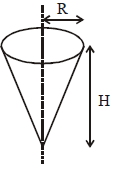
Shown in the figure is a hollow icecream cone (it is open at the top). If its mass is \(M,\) radius of its top, \(R\) and height, \(H\), then its moment of inertia about its axis is
Pick an option to check your answer.
Answer & Solution
Correct Answer
(A) \(\frac{ MR ^{2}}{2}\)
Step-by-step Solution
Detailed explanation
Explanation:
Let us derive the moment of inertia of a hollow cone step-by-step using calculus based on the System of Particles and Rotational Motion chapter of the NCERT Class 11 Physics textbook:
Step 1: Understand the Geometry of the Cone
Let the apex (vertex) of the cone be at the origin, pointing downwards. - Slant height of the cone, \(l = \sqrt{R^2 + H^2}\)
- If \(\theta\) is the semi-vertical angle of the cone, then:
\(\tan\theta = \frac{R}{H}\) and \(\cos\theta = \frac{H}{l} = \frac{H}{\sqrt{R^2+H^2}}\)
The total curved surface area of this hollow cone is \(A = \pi R l = \pi R \sqrt{R^2 + H^2}\).
Therefore, the mass per unit area (\(\sigma\)) of the uniform hollow cone is:
\(\sigma = \frac{M}{\pi R \sqrt{R^2 + H^2}}\)
Step 2: Choose a Circular Element
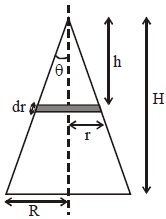
Consider an elemental circular ring of radius \(r\) at a vertical distance \(h\) from the vertex along the axis. The slant width of this element is \(dl\).
From the geometry of the triangle:
\(r = h \tan\theta\)
\(dl = \frac{dh}{\cos\theta}\)
The area of this elemental ring is given by:
\(dA = 2\pi r \cdot dl = 2\pi (h \tan\theta) \frac{dh}{\cos\theta}\)
Step 3: Calculate the Mass of the Element (\(dm\))
Multiply the area of the element by the surface mass density (\(\sigma\)):
\(dm = \sigma \cdot dA = \left(\frac{M}{\pi R \sqrt{R^2 + H^2}}\right) \cdot \left(2\pi h \frac{\tan\theta}{\cos\theta} dh\right)\)
\(dm = \frac{2M \tan\theta}{R \sqrt{R^2 + H^2} \cos\theta} h dh\)
Step 4: Integrate to Find the Total Moment of Inertia (\(I\))
The moment of inertia of a thin ring of radius \(r\) and mass \(dm\) about its central axis is \(dI = (dm)r^2\).
Substituting \(r = h \tan\theta\):
\(dI = (dm)(h \tan\theta)^2 = \left(\frac{2M \tan\theta}{R \sqrt{R^2 + H^2} \cos\theta} h dh\right) \cdot h^2 \tan^2\theta\)
\(dI = \frac{2M \tan^3\theta}{R \sqrt{R^2 + H^2} \cos\theta} h^3 dh\)
Integrating from \(h = 0\) to \(h = H\):
\(I = \int_0^H \frac{2M \tan^3\theta}{R \sqrt{R^2 + H^2} \cos\theta} h^3 dh = \frac{2M \tan^3\theta}{R \sqrt{R^2 + H^2} \cos\theta} \left[ \frac{h^4}{4} \right]_0^H\)
\(I = \frac{2M \tan^3\theta}{R \sqrt{R^2 + H^2} \cos\theta} \cdot \frac{H^4}{4}\)
Step 5: Substitute Trigonometric Values for Simplification
Substitute \(\tan\theta = \frac{R}{H}\) and \(\cos\theta = \frac{H}{\sqrt{R^2+H^2}}\) back into the equation:
\(I = \frac{2M \left(\frac{R^3}{H^3}\right)}{R \sqrt{R^2 + H^2} \left(\frac{H}{\sqrt{R^2 + H^2}}\right)} \cdot \frac{H^4}{4}\)
\(I = \frac{2M R^2}{H^4} \cdot \frac{H^4}{4} = \frac{MR^2}{2}\)
Hence, Option A is the correct choice.
Let us derive the moment of inertia of a hollow cone step-by-step using calculus based on the System of Particles and Rotational Motion chapter of the NCERT Class 11 Physics textbook:
Step 1: Understand the Geometry of the Cone
Let the apex (vertex) of the cone be at the origin, pointing downwards. - Slant height of the cone, \(l = \sqrt{R^2 + H^2}\)
- If \(\theta\) is the semi-vertical angle of the cone, then:
\(\tan\theta = \frac{R}{H}\) and \(\cos\theta = \frac{H}{l} = \frac{H}{\sqrt{R^2+H^2}}\)
The total curved surface area of this hollow cone is \(A = \pi R l = \pi R \sqrt{R^2 + H^2}\).
Therefore, the mass per unit area (\(\sigma\)) of the uniform hollow cone is:
\(\sigma = \frac{M}{\pi R \sqrt{R^2 + H^2}}\)
Step 2: Choose a Circular Element
Consider an elemental circular ring of radius \(r\) at a vertical distance \(h\) from the vertex along the axis. The slant width of this element is \(dl\).
From the geometry of the triangle:
\(r = h \tan\theta\)
\(dl = \frac{dh}{\cos\theta}\)
The area of this elemental ring is given by:
\(dA = 2\pi r \cdot dl = 2\pi (h \tan\theta) \frac{dh}{\cos\theta}\)
Step 3: Calculate the Mass of the Element (\(dm\))
Multiply the area of the element by the surface mass density (\(\sigma\)):
\(dm = \sigma \cdot dA = \left(\frac{M}{\pi R \sqrt{R^2 + H^2}}\right) \cdot \left(2\pi h \frac{\tan\theta}{\cos\theta} dh\right)\)
\(dm = \frac{2M \tan\theta}{R \sqrt{R^2 + H^2} \cos\theta} h dh\)
Step 4: Integrate to Find the Total Moment of Inertia (\(I\))
The moment of inertia of a thin ring of radius \(r\) and mass \(dm\) about its central axis is \(dI = (dm)r^2\).
Substituting \(r = h \tan\theta\):
\(dI = (dm)(h \tan\theta)^2 = \left(\frac{2M \tan\theta}{R \sqrt{R^2 + H^2} \cos\theta} h dh\right) \cdot h^2 \tan^2\theta\)
\(dI = \frac{2M \tan^3\theta}{R \sqrt{R^2 + H^2} \cos\theta} h^3 dh\)
Integrating from \(h = 0\) to \(h = H\):
\(I = \int_0^H \frac{2M \tan^3\theta}{R \sqrt{R^2 + H^2} \cos\theta} h^3 dh = \frac{2M \tan^3\theta}{R \sqrt{R^2 + H^2} \cos\theta} \left[ \frac{h^4}{4} \right]_0^H\)
\(I = \frac{2M \tan^3\theta}{R \sqrt{R^2 + H^2} \cos\theta} \cdot \frac{H^4}{4}\)
Step 5: Substitute Trigonometric Values for Simplification
Substitute \(\tan\theta = \frac{R}{H}\) and \(\cos\theta = \frac{H}{\sqrt{R^2+H^2}}\) back into the equation:
\(I = \frac{2M \left(\frac{R^3}{H^3}\right)}{R \sqrt{R^2 + H^2} \left(\frac{H}{\sqrt{R^2 + H^2}}\right)} \cdot \frac{H^4}{4}\)
\(I = \frac{2M R^2}{H^4} \cdot \frac{H^4}{4} = \frac{MR^2}{2}\)
Hence, Option A is the correct choice.
More questions from Physics
- The equation of motion of a particle is given by \(x = a \sin\left(50t + \dfrac{\pi}{3}\right)\) cm. The particle will come to rest at time \(t_1\) and it will have zero acceleration at time \(t_2\). The \(t_1\) and \(t_2\) respectively are _______.JEE Mains 2026 Medium
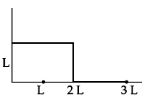
- The position vector of the centre of mass \(\vec r\, cm\) of an asymmetric uniform bar of negligible area of cross-section as shown in figure is
 JEE Mains 2019 Medium
- The current \(I\) flowing through the given circuit will be \(.....A\).
 JEE Mains 2022 Medium
- A ball is spun with angular acceleration \(\alpha=6 t ^{2}-2 t\) where \(t\) is in second and \(\alpha\) is in \(rads\) \(^{-2}\). At \(t=0\), the ball has angular velocity of \(10\,rads\) \(^{-1}\) and angular position of \(4\,rad\). The most appropriate expression for the angular position of the ball isJEE Mains 2022 Medium
- One main scale division of a vernier caliper is equal to \(m\) units. If \(n^{\text {th }}\) division of main scale coincides with \((n+1)^{\mathrm{th}}\) division of vernier scale, the least count of the vernier caliper is _______.JEE Mains 2024 Hard
- A body of mass \((5 \pm 0.5) kg\) is moving with a velocity of \((20 \pm 0.4) m / s\). Its kinetic energy will beJEE Mains 2023 Medium
More PYQs from JEE Mains
- An ideal gas initially at \(0^{\circ} \mathrm{C}\) temperature, is compressed suddenly to one fourth of its volume. If the ratio of specific heat at constant pressure to that at constant volume is \(3 / 2\), the change in temperature due to the thermodynamic process is _____ K.JEE Mains 2025 Medium
- A ray of light \(AO\) in vacuum is incident on a glass slab at angle \(60^o\) and refracted at angle \(30^o\) along \(OB\) as shown in the figure. The optical path length of light ray from \(A\) to \(B\) is
 JEE Mains 2019 Hard