


JEE Mains · Physics · STD 12 - 4. Moving charges and magnetism
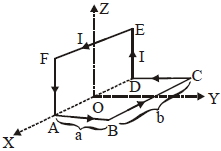
A wire carrying current \(I\) is bent in the shape \(A\,B\,C\,D\,E\,F\,A\) as shown, where rectangle \(A\,B\,C\,D\,A\) and \(A\,D\,E\,F\,A\) are perpendicular to each other. If the sides of the rectangles are of lengths \(a\) and \(b,\) then the magnitude and direction of magnetic moment of the loop \(A\,B\,C\,D\,E\,F\,A\,\) is
- A \(\sqrt{2}\) \(abI\), along \(\left(\frac{\hat{j}}{\sqrt{2}}+\frac{\hat{ k }}{\sqrt{2}}\right)\)
- B \(\sqrt{2}\) \(abI,\) along \(\left(\frac{\hat{j}}{\sqrt{5}}+\frac{2 \hat{k}}{\sqrt{5}}\right)\)
- C \(abI,\) along \(\left(\frac{\hat{j}}{\sqrt{2}}+\frac{\hat{k}}{\sqrt{2}}\right)\)
- D \(abI,\) along \(\left(\frac{\hat{j}}{\sqrt{5}}+\frac{2 \hat{ k }}{\sqrt{5}}\right)\)
Answer & Solution
Correct Answer
(A) \(\sqrt{2}\) \(abI\), along \(\left(\frac{\hat{j}}{\sqrt{2}}+\frac{\hat{ k }}{\sqrt{2}}\right)\)
Step-by-step Solution
Detailed explanation
Sol. \(\quad M=N I A\) \(N =1\) For \(ABCD\) \(\overrightarrow{ M }_{1}= abI \hat{ K }\) For \(DEFA\) \(\overrightarrow{ M }_{2}= abI \hat{ j }\) \(\overrightarrow{ M }=\overrightarrow{ M }_{1}+\overrightarrow{ M }_{2}\) \(=\operatorname{ab} I (\hat{ k }+\hat{j})\)…
See the Complete Solution
Get step-by-step explanations for this and 2.5 Lakh+ more JEE, NEET & CET questions.
- Unlock all solutions
- Practice the full chapter
- Track accuracy across PYQs
4.8 rated on Google Play · 14,000+ reviews
More questions from Physics
- A big drop is formed by coalescing \(1000\) small identical drops of water. If \(E_1\) be the total surface energy of \(1000\) small drops of water and \(E_2\) be the surface energy of single big drop of water, the \(E_1\) : \(\mathrm{E}_2\) is \(\mathrm{x}: 1\) where \(x\) = _____.JEE Mains 2024 Hard
- The fractional compression \(\left(\frac{\Delta \mathrm{V}}{\mathrm{V}}\right)\) of water at the depth of 2.5 km below the sea level is ______ \(\%\). Given, the Bulk modulus of water \(=2 \times 10^9 \mathrm{~N} \mathrm{~m}^{-2}\), density of water \(=10^3\) \(\mathrm{kg} \mathrm{m}^{-3}\), acceleration due to gravity \(=\mathrm{g}=10 \mathrm{~m} \mathrm{~s}^{-2}\).JEE Mains 2025 Medium
- Consider a uniform rod of mass \(\mathrm{M}=4 \mathrm{m}\) and length \(\ell\) pivoted about its centre. A mass \(m\) moving with velocity \(v\) making angle \(\theta=\frac{\pi}{4}\) to the rod's long axis collides with one end of the rod and sticks to it. The angular speed of the rod-mass system just after the collision isJEE Mains 2020 Hard
- The binding energy for the following nuclear reactions are expressed in MeV .
\({ }_2 He ^3+{ }_0 n ^1 \rightarrow{ }_2 He ^4+20 MeV\)
\({ }_2 He ^4+{ }_0 n ^1 \rightarrow{ }_2 He ^5-0.9 MeV\)
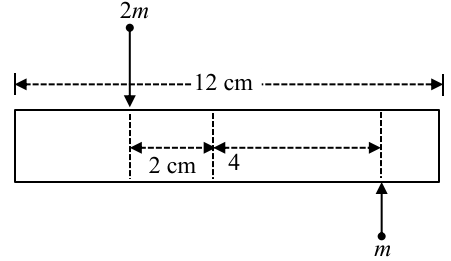
If \(X _3, X _4, X _5\) denote the stability of \({ }_2 He ^3,{ }_2 He ^4\) and \({ }_2 He ^5\), respectively, then the correct order is :JEE Mains 2026 Medium - A uniform bar of length 12 cm and mass 20 m lies on a smooth horizontal table. Two point masses m and 2 m are moving in opposite directions with same speed of v and in the same plane as the bar. These masses strike the bar simultaneously and get stuck to it. After collision the entire system is rotating with angular frequency \( \omega \). The ratio of v and \( \omega \) is:
 JEE Mains 2026 Medium
 - Match the LIST-I with LIST-II
LIST-I LIST-II (A) Boltzmann constant I. \(\mathrm{ML}^2 \mathrm{~T}^{-1}\) (B) Coefficient of viscosity II. \(\mathrm{MLT}^{-3} \mathrm{~K}^{-1}\) (C) Planck's constant III. \(\mathrm{ML}^2 \mathrm{~T}^{-2} \mathrm{~K}^{-1}\) (D) Thermal conductivity IV. \(\mathrm{ML}^{-1} \mathrm{~T}^{-1}\)
Choose the correct answer from the options given below :JEE Mains 2025 Medium
More PYQs from JEE Mains
- A cylindrical wire of mass \((0.4 \pm 0.01)\,g\) has length \((8 \pm 0.04)\,cm\) and radius \((6 \pm 0.03)\,mm\).The maximum error in its density will be \(......\,\%\)JEE Mains 2023 Medium
- Let \(\mathrm{y}=\mathrm{y}(\mathrm{x})\) be the solution curve of the differential equation, \(\quad\left(y^{2}-x\right) \frac{d y}{d x}=1\) satisfying \(\mathrm{y}(0)=1 .\) This curve intersects the \(\mathrm{x}\) -axis at a point whose abscissa isJEE Mains 2020 Hard
- If the magnetic field of a plane electromagnetic wave is given by (The speed of light \( = 3 \times {10^8}\,m/s\) ) \(B = 100 \times {10^{ - 6}}\,\sin \,\left[ {2\pi \times 2 \times {{10}^{15}}\,\left( {t - \frac{x}{c}} \right)} \right]\) then the maximum electric field associated with it isJEE Mains 2019 Easy
- If the integral \(525 \int_0^{\frac{\pi}{2}} \sin 2 x \cos ^{\frac{11}{2}} x\left(1+\cos ^{\frac{5}{2}} x\right)^{\frac{1}{2}} d x\) is equal to \((n \sqrt{2}-64)\), then \(n\) is equal toJEE Mains 2024 Hard
- Let \(J_{n, m}=\int_{0}^{\frac{1}{2}} \frac{x^{n}}{x^{m}-1} d x, \quad \forall n>m\) and \(n, m \in N\) Consider a matrix \(A=\left[a_{i j}\right]_{3 \times 3}\) where \(a_{i j}=J_{6+i, 3}-J_{i+3,3}, \quad i \leq j\) \(\quad\quad\quad\quad\quad\quad0 , \quad\quad\quad i>j\). Then \(\left|\operatorname{adj} A^{-1}\right|\) is :JEE Mains 2021 Hard
- If a point \(P (\alpha, \beta, \gamma)\) satisfying \((\alpha \ \beta \ \gamma)\left(\begin{array}{ccc}2 & 10 & 8 \\ 9 & 3 & 8 \\ 8 & 4 & 8\end{array}\right)=\left(\begin{array}{llll}0 & 0 & 0\end{array}\right)\) lies on the plane \(2 x+4 y+3 z=5\), then \(6 \alpha+9 \beta+7 \gamma\) is equal to:JEE Mains 2023 Medium