


JEE Mains · Physics · STD 11 - 6. system of particles and rotational motion
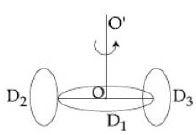
A circular disc \(D_1\) of mass \(M\) and radius \(R\) has two identical discs \(D_2\) and \(D_3\) of the same mass \(M\) and radius \(R\) attached rigidly as its opposite ends (see figure). The moment of inertia of the system about the axis \(OO\)’, passing through the centre of \(D_1\) as shown in the figure, will
- A \(MR^2\)
- B \(3MR^2\)
- C \(\frac{4}{5}\,M{R^2}\)
- D \(\frac{2}{3}\,M{R^2}\)
Answer & Solution
Correct Answer
(B) \(3MR^2\)
Step-by-step Solution
Detailed explanation
\(I = \frac{{M{R^2}}}{2} + 2\left( {\frac{{M{R^2}}}{4} + M{R^2}} \right)\) \( = \frac{{M{R^2}}}{2} + \frac{{M{R^2}}}{2} + 2M{R^2} = 3\,M{R^2}\)
See the Complete Solution
Get step-by-step explanations for this and 2.5 Lakh+ more JEE, NEET & CET questions.
- Unlock all solutions
- Practice the full chapter
- Track accuracy across PYQs
4.8 rated on Google Play · 14,000+ reviews
More questions from Physics
- A thin convex lens of focal length 5 cm and a thin concave lens of focal length 4 cm are combined together (without any gap) and this combination has magnification \( m_{1} \), when an object is placed 10 cm before the convex lens. Keeping the positions of convex lens and object undisturbed a gap of 1 cm is introduced between the lenses by moving the concave lens away, which lead to a change in magnification of total lens system to \( m_{2} \).
The value of \(\left|\frac{m_1}{m_2}\right|\) is __________ .JEE Mains 2026 Medium - A heat engine is involved with exchange of heat of \(1915\, J,\) \(-40\, J ,+125\, J\) and \(-Q\,J\), during one cycle achieving an efficiency of \(50.0 \%\). The value of \(Q\) is.......\(J\)JEE Mains 2020 Medium
- An alpha-particle of mass \(m\) suffers \(1-\) dimensional elastic collision with a nucleus at rest of unknown mass. It is scattered directly backwards losing, \(64\%\) of its initial kinetic energy. The mass of the nucleus is .......... \(\mathrm{m}\)JEE Mains 2019 Hard
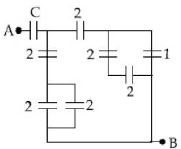
- In the circuit shown, find \(C\) if the effective capacitance of the whole circuit is to be \(0.5\,\mu F.\) All values in the circuit are in \(\mu F.\)
 JEE Mains 2019 Hard
 - From a solid sphere of mass \(M\) and radius \(R\), a spherical portion of radius \(R/2\) is removed, as shown in the figure. Taking gravitational potential \(V = 0\) at \(r = \infty\), the potential at the centre of the cavity thus formed is
( \(G =\) gravitational constant)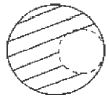 JEE Mains 2015 Hard
 - A parallel plate capacitor has plate area \(40\,cm ^2\) and plates separation \(2\,mm\). The space between the plates is filled with a dielectric medium of a thickness \(1\,mm\) and dielectric constant \(5\) . The capacitance of the system is :JEE Mains 2023 Medium
More PYQs from JEE Mains
- Given below are two statements: Statement \(I:\) Out of microwaves, infrared rays and ultraviolet rays, ultraviolet rays are the most effective for the emission of electrons from a metallic surface. Statement \(II:\) Above the threshold frequency, the maximum kinetic energy of photoelectrons is inversely proportional to the frequency of the incident light. In the light of above statements, choose the correct answer from the options given below:JEE Mains 2023 Medium
- If the curve \(y = f(x)\) passes through the point \((1, e)\) and satisfies the differential equation \(dy = y(2 + \log_e x)\,dx\), \(x > 0\), then \(f(e)\) is equal to :JEE Mains 2026 Medium
- Steel ruptures when a shear of \(3 .5 \times 10^8\,\,N\,m^{-2}\) is applied. The force needed to punch a \(1\,cm\) diameter hole in a steel sheet \(0.3\,cm\) thick is nearlyJEE Mains 2014 Medium
- The dimensions of \(\left(\frac{ B ^{2}}{\mu_{0}}\right)\) will be. (if \(\mu_{0}\) : permeability of free space and \(B\) : magnetic field)JEE Mains 2022 Medium
- Suppose \(f ( x )\) is a polynomial of degree four, having critical points at \(-1,0,1\) . If \(T =\{ x \in R \mid f ( x )= f (0)\},\) then the sum of squares of all the elements of \(T\) isJEE Mains 2020 Hard
- A particle moves from the point \(\left( {2.0\hat i + 4.0\hat j} \right)\,m\), at \(t = 0\) with an initial velocity \(\left( {5.0\hat i + 4.0\hat j} \right)\,m{s^{ - 1 }}\). It is acted upon by a constant force which produces a constant acceleration \(\left( {4.0\hat i + 4.0\hat j} \right)\,m{s^{ - 2}}\). What is the distance of the particle from the origin at time \(2\,s\)JEE Mains 2019 Medium