


Questions
18 questionsShowing 1–18 of 18 questions
-
- (A) \(400\)
- (B) \(600\)
- (C) \(500\)
- (D) \(700\)
Show answer and solution
Correct Answer: (B)
\(\beta=\frac{\lambda D }{ d }\)\(\lambda=\frac{\beta d }{ D }\)
\(\lambda=\frac{6 \times 10^{-3} \times 10^{-3}}{10}\)
\(\lambda=6 \times 10^{-7} m =600 \times 10^{-9} m\)
\(\lambda=600 nm\)
-
- (A) \(2\)
- (B) \(3\)
- (C) \(9\)
- (D) \(6\)
Show answer and solution
Correct Answer: (D)
\(\frac{\Delta \lambda}{\lambda} c=v\)\(\Delta \lambda=\frac{v}{c} \times \lambda=\frac{286}{3 \times 10^{5}} \times 630 \times 10^{-9}=6 \times 10^{-10}\)
-
- (A) \(60\)
- (B) \(30\)
- (C) \(45\)
- (D) \(90\)
Show answer and solution
Correct Answer: (B)
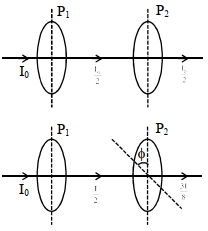
\(I=\frac{I_{0}}{2} \cos ^{2} \phi\)\(\frac{I}{2} \cos ^{2} \phi=\frac{3 I}{8}\)
\(\cos ^{2} \phi=\frac{3}{4}\)
\(\cos ^{2} \phi=\frac{\sqrt{3}}{2}\)
\(\Rightarrow \phi=30\)
-
- (A) \(150\)
- (B) \(50\)
- (C) \(75\)
- (D) \(100\)
Show answer and solution
Correct Answer: (C)
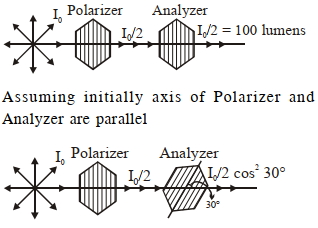
Now emerging intensity \(=\frac{ I _{0}}{2} \cos ^{2} 30^{\circ}\)\(=100\left(\frac{\sqrt{3}}{2}\right)^{2}=100 \times \frac{3}{4}=75\)
-
- (A) its size decreases, and intensity decreases
- (B) its size increases, and intensity increases
- (C) its size increases, but intensity decreases
- (D) its size decreases, but intensity increases
Show answer and solution
Correct Answer: (D)
\(\sin \theta=\frac{ m \lambda}{ a }\)when \(a\) increases, \(\theta\) decreases,
width decreases
width decreases so intensity will increases
-
- (A) \(A\) is true but \(R\) is false.
- (B) Both \(A\) and \(R\) are true and \(R\) is the correct explanation of \(A\).
- (C) Both \(A\) and \(R\) are true but \(R\) is \(N O T\) the correct explanation of \(A\).
- (D) \(A\) is false but \(R\) is true.
Show answer and solution
Correct Answer: (B)
Resolving power \(\propto \frac{1}{\lambda}\)Since wavelength of electron is much less than visible light, its resolving power will be much more.
-
- (A) \(0.5\)
- (B) \(5.5\)
- (C) \(50\)
- (D) \(5\)
Show answer and solution
Correct Answer: (D)
\(8 \beta=2.4 \,{cm}\)\(\frac{8 \lambda \Delta}{{d}}=2.4\, {cm}\)
\(\frac{8 \times 1.5 \times {c}}{0.3 \times 10^{-5} \times {f}}=2.4 \times 10^{-2}\)
\({f}=5 \times 10^{14}\, {Hz}\)
-
- (A) \(1: 4\)
- (B) \(3: 1\)
- (C) \(4: 1\)
- (D) \(2: 1\)
Show answer and solution
Correct Answer: (C)
Amplitude \(\propto\) Width of slit \(\Rightarrow A _{2}=3 A _{1}\)\(\frac{ I _{\max }}{ I _{\min }}=\left(\frac{\sqrt{ I _{1}}+\sqrt{ I _{2}}}{\left|\sqrt{ I _{1}}-\sqrt{ I _{2}}\right|}\right)^{2}\)
\(\because\) Intensity \(I \propto A ^{2}\)
\(\Rightarrow \frac{I_{\max }}{I_{\min }}=\left(\frac{A_{1}+A_{2}}{\left|A_{1}-A_{2}\right|}\right)^{2}\)
\(=\left(\frac{ A _{1}+3 A _{1}}{\left| A _{1}-3 A _{1}\right|}\right)^{2}\)
\(=\left(\frac{4 A _{1}}{2 A _{1}}\right)^{2}=4: 1\)
-
- (A) \(0.25\)
- (B) \(0.50\)
- (C) \(0.75\)
- (D) \(1\)
Show answer and solution
Correct Answer: (A)
\(\beta=\frac{\lambda D }{ d }=\frac{500 \times 10^{-9} \times 1}{2 \times 10^{-3}}\)\(\beta=\frac{5}{2} \times 10^{-4} m =2.5 \times 10^{-1} mm\)
\(b =0.25 mm\)
-
- (A) \(\frac{\lambda D}{d_{0}+a_{0}}\)
- (B) \(\frac{2 \lambda \cdot D a_{0}}{\left(d_{0}^{2}-a_{0}^{2}\right)}\)
- (C) \(\frac{2 \lambda {D}\left({d}_{0}\right)}{\left({d}_{0}^{2}-{a}_{0}^{2}\right)}\)
- (D) \(\frac{\lambda D}{d_{0}^{2}} a_{0}\)
Show answer and solution
Correct Answer: (B)
Fringe Width, \(\beta=\frac{\lambda D }{ d }\)\(\beta_{\max } \Rightarrow d _{\min } \text { and } \beta_{\min } \Rightarrow d _{\max }\)
\(d = d _{0}+ a _{0} \sin \omega t\)
\(d _{\max }= d _{0}+ a _{0} \text { and } d _{\min }= d _{0}- a _{0}\)
\(\therefore \beta_{\min }=\frac{\lambda D }{ d _{0}+ a _{0}}\) and
\(\therefore \beta_{\max }=\frac{\lambda D }{ d _{0}- a _{0}}\)
\(\beta_{\max }-\beta_{\min }=\frac{\lambda D }{ d _{0}- a _{0}}-\frac{\lambda D }{ d _{0}+ a _{0}}=\frac{2 \lambda Da _{0}}{ d _{0}^{2}- a _{0}^{2}}\)
-
- (A) \(1178 \times 10^{-9} \,m\)
- (B) \(1178 \times 10^{-6}\,m\)
- (C) \(1178 \times 10^{-12} \,m\)
- (D) \(5890 \times 10^{-7} \,m\)
Show answer and solution
Correct Answer: (B)
\(\beta=\frac{\lambda D}{d}=\frac{5890 \times 10^{-10} \times 0.5}{0.5 \times 10^{-3}}\)\(=589 \times 10^{-6} m\)
Distance between first and third bright fringe is \(2 \beta=2 \times 589 \times 10^{-6} m\)
\(=1178 \times 10^{-6} m\)
- 12. In Young's double slit experiment, if the source of light changes from orange to blue then 2021 Medium
- (A) the central bright fringe will become a dark fringe.
- (B) the distance between consecutive fringes will decrease.
- (C) the distance between consecutive fringes will increase.
- (D) the intensity of the minima will increase.
Show answer and solution
Correct Answer: (B)
Fringe width \(\beta=\frac{\lambda D}{d}\)as \(\lambda\) decreases, \(\beta\) also decreases
-
- (A) \(2\)
- (B) \(4\)
- (C) \(6\)
- (D) \(8\)
Show answer and solution
Correct Answer: (A)
We knowThickness \({t}={n} \lambda\)
\({So}, {n} \lambda_{{vac}}=({n}+1) \lambda_{{air}}\)
\({n} \lambda=({n}+1) \frac{\lambda}{\mu_{{air}}}\)
\(n=\frac{1}{\mu_{\text {air }}-1}=\frac{10^{4}}{3}\)
\({t}={n} \lambda\)
\(=\frac{10^{4}}{3} \times 6000\, \stackrel{\circ}{{A}}\)
\(=2\, {mm}\)
-
- (A) \({I}_{0}\)
- (B) \(2 {I}_{0}\)
- (C) \(5 {I}_{0}\)
- (D) \(4 {I}_{0}\)
Show answer and solution
Correct Answer: (D)
\({I}_{\max }=\left(\sqrt{{I}_{1}}+\sqrt{{I}_{2}}\right)^{2}\)\(=4 \,{I}_{0}\)
-
- (A) \(1837\)
- (B) \(\frac{1}{1837}\)
- (C) \(\sqrt{1837}\)
- (D) \(\frac{1}{\sqrt{1837}}\)
Show answer and solution
Correct Answer: (A)
Resolving power \(( RP ) \propto \frac{1}{\lambda}\)\(\lambda=\frac{ h }{ P }=\frac{ h }{ mv }\)
So (RP) \(\propto \frac{ mv }{ h }\)
\(RP \propto P\)
\(RP \propto mv\)
\(RP \propto m\)
-
- (A) \(1\)
- (B) \(1.4\)
- (C) \(14\)
- (D) \(10\)
Show answer and solution
Correct Answer: (A)
Given amplitude \(\propto\) slit widthAlso intensity \(\propto(\text { Amplitude })^{2} \propto\) (Slit width \()^{2}\)
\(\frac{{I}_{1}}{{I}_{2}}=\left(\frac{3}{1}\right)^{2}=9 \Rightarrow {I}_{1}=9 {I}_{2}\)
\(\frac{{I}_{\min }}{{I}_{\max }}=\left(\frac{\sqrt{{I}_{1}}-\sqrt{{I}_{2}}}{\sqrt{{I}_{1}}+\sqrt{{I}_{2}}}\right)^{2}=\left(\frac{3-1}{3+1}\right)^{2}=\frac{1}{4}=\frac{{x}}{4}\)
\(\Rightarrow {x}=1.00\)
-
- (A) \(150\)
- (B) \(1300\)
- (C) \(300\)
- (D) \(600\)
Show answer and solution
Correct Answer: (C)
Position of bright fringe \({y}={n} \frac{{D} \lambda}{{d}}\)\({y}_{1} \text { of red }=\frac{{D} \lambda_{{r}}}{{d}}=3.5\, {mm}\)
\(\lambda_{{T}}=3.5 \times 10^{-3} \frac{{d}}{{D}}\)
Similarly \(\lambda_{{v}}=2 \times 10^{-3} \frac{{d}}{{D}}\)
\(\lambda_{{r}}-\lambda_{{v}}=\left(1.5 \times 10^{-3}\right)\left(\frac{0.3 \times 10^{-3}}{1.5}\right)\)
\(=3 \times 10^{-1}=300\, {nm}\)
-
- (A) \(336\)
- (B) \(296\)
- (C) \(306\)
- (D) \(322\)
Show answer and solution
Correct Answer: (C)
\(\frac{\Delta \lambda }{\lambda }=\frac{v}{c}\)\(v=6 \times \frac{3\times 10^8}{5890}=305.06\, {km} / {s}\)
No questions on this page match these filters.