


JEE Mains · Chemistry · STD 12 - Haloalkanes and Haloarenes
- JEE Mains 2025
- Medium
- MCQ
Given below are two statements :
Statement I : \(\mathrm{CH}_3-\mathrm{O}-\mathrm{CH}_2-\mathrm{Cl}\) will undergo \(\mathrm{S}_{\mathrm{N}} 1\) reaction though it is a primary halide.
Statement II :
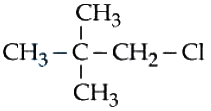
will not undergo \(S_N 2\) reaction very easily though it is a primary halide.
In the light of the above statements, choose the most appropriate answer from the options given below :
Pick an option to check your answer.
Answer & Solution
Correct Answer
(B) Both Statement I and Statement II are correct
Step-by-step Solution
Detailed explanation
1. Analysis of Statement I (True):
- Generally, primary alkyl halides do not undergo \( \text{S}_\text{N}1 \) reactions because primary carbocations are highly unstable.
- However, for \( \text{CH}_3-\text{O}-\text{CH}_2-\text{Cl} \), the loss of the chloride ion forms the carbocation \( \text{CH}_3-\ddot{\text{O}}-\overset{+}{\text{C}}\text{H}_2 \).
- This specific carbocation is exceptionally stabilized by resonance due to the lone pair of electrons on the adjacent oxygen atom:
\( \text{CH}_3-\ddot{\text{O}}-\overset{+}{\text{C}}\text{H}_2 \longleftrightarrow \text{CH}_3-\overset{+}{\text{O}}=\text{CH}_2 \)
- In the canonical structure on the right, every single atom (including both carbon and oxygen) satisfies the octet rule. This high resonance stabilization lowers the activation energy barrier for the \( \text{S}_\text{N}1 \) pathway remarkably, allowing it to proceed rapidly despite being a primary halide.
2. Analysis of Statement II (True):
- Neopentyl chloride is a primary alkyl halide. For an \( \text{S}_\text{N}2 \) reaction to occur, a nucleophile must perform a backside attack on the electrophilic carbon carrying the leaving group.
- In neopentyl chloride, the \( \alpha \)-carbon bonded to chlorine is directly attached to a highly bulky tert-butyl group (\( -\text{C(CH}_3)_3 \)).
- This extreme steric hindrance completely shields the backside approach of the nucleophile. Consequently, neopentyl chloride is practically inert to \( \text{S}_\text{N}2 \) substitution reactions under standard laboratory conditions.
Since both Statement I and Statement II are factually correct, Option B is definitively the correct choice.
More questions from Chemistry
- Decomposition of A is a first order reaction at T(K) and is given by \(A(g) \rightarrow B(g) + C(g)\). In a closed 1 L vessel, 1 bar A(g) is allowed to decompose at T(K). After 100 minutes, the total pressure was 1.5 bar. What is the rate constant (in \(min^{-1}\)) of the reaction? (\(log 2 = 0.3\))JEE Mains 2026 Easy
- Which of the following is not a correct statement for primary aliphatic amines?JEE Mains 2021 Easy
- A solution of \(Fe _{2}\left( SO _{4}\right)_{3}\) is electrolyzed for \('x'\) min with a current of \(1.5\, A\) to deposit \(0.3482\, g\) of \(Fe\). The value of \(x\) is \(.......\). [nearest integer] Given : \(1 \,F =96500\, C \,mol ^{-1}\) Atomic mass of \(Fe =56\, g \,mol ^{-1}\)JEE Mains 2022 Easy
- Match List\(-I\) with List\(-II\).
Choose the correct answer from the options given below:List\(-I\) List\(-II\) \(A\) \(16\,g \text { of } CH _{4( g )}\) \(I\) Weighs \(28\,g\) \(B\) \(1\,g \text { of } H _{2( g )}\) \(II\) \(60.2 \times 10^{23}\) electrons \(C\) \(1\,mole \text { of } N _{2( g )}\) \(III\) Weighs \(32\,g\) \(D\) \(0.5\,mol\) of \(SO _{2( g )}\) \(IV\) Occupies \(11.4\,L\) volume at STP JEE Mains 2023 Hard - Which molecule/ion among the following cannot act as a ligand in complex compounds ?JEE Mains 2015 Hard
- \(4.0\, L\) of an ideal gas is allowed to expand isothermally into vacuum until the total volume is \(20\, L.\) The amount of heat absorbed in this expansion is \(.....\,L\,atm\)JEE Mains 2022 Medium
More PYQs from JEE Mains
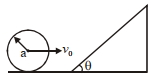
- A sphere of radius \('a'\) and mass \('m'\) rolls along a horizontal plane with constant speed \(v_{0}\). It encounters an inclined plane at angle \(\theta\) and climbs upward. Assuming that it rolls without slipping, how far up the sphere will travel?
 JEE Mains 2021 Hard
- The total number of intensive properties from the following is \(........\). Volume, Molar heat capacity, Molarity, \(E ^\theta\) cell, Gibbs free energy change, Molar mass, MoleJEE Mains 2023 Medium
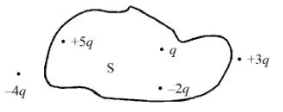
- Five charges \(+q,+5 q,-2 q,+3 q\) and \(-4 q\) are situated as shown in the figure. The electric flux due to this configuration through the surface \(S\) is _______.
 JEE Mains 2024 Hard
- A stationary observer receives sound from two identical tuning forks, one of which approaches and the other one recedes with the same speed (much less than the speed of sound). The observer hears \(2\; beats/sec\). The oscillation frequency of each tuning fork is \(v_{0}=1400 \;\mathrm{Hz}\) and the velocity of sound in air is \(350\; \mathrm{m} / \mathrm{s}\). The speed of each tuning fork is close toJEE Mains 2020 Hard
- \(2\,L\) of \(0.2\,M H _{2} SO _{4}\) is reacted with \(2\,L\) of \(0.1\,M\) \(NaOH\) solution, the molarity of the resulting product \(Na _{2} SO _{4}\) in the solution is millimolar. (Nearest integer).JEE Mains 2022 Hard
- Natural glucose is termed \(D-\) glucose becauseJEE Mains 2013 Medium