


JEE Mains · Chemistry · STD 12 - Haloalkanes and Haloarenes
- JEE Mains 2025
- Easy
- MCQ
Match the LIST-I with LIST-II
| LIST-I (Name reaction) | LIST-II (Product obtainable) |
| (A) Swarts reaction | (I) Ethyl benzene |
| (B) Sandmeyer's reaction | (II) Ethyl iodide |
| (C) Wurtz Fittig reaction | (III) Cyanobenzene |
| (D) Finkelstein reaction | (IV) Ethyl fluoride |
Choose the correct answer from the options given below:
Pick an option to check your answer.
Answer & Solution
Correct Answer
(D) A-IV, B-III, C-I, D-II
Step-by-step Solution
Detailed explanation
| LIST-I Name reaction | LIST-II Product obtainable |
| (A) Swarts reaction | (I) \(Et-I \xrightarrow{KF/DF} Et-F\) |
| (B) Sandmeyer's reaction | (II) \(\mathrm{PhN}_2^{\oplus} \mathrm{Cl}^{-} \xrightarrow[\mathrm{CuCN} / \mathrm{KCN}]{\mathrm{PhCN}+\mathrm{N}_2}\) |
| (C) Wurtz Fittig reaction | (III) \(Ph-Cl + EtCl \xrightarrow{Na/ether} Ph-Et + Ph-Ph + Et-Et\) |
| (D) Finkelstein reaction | (IV) \(Et-Cl \xrightarrow[acetone]{NaI} Et-I + NaCl\) |
Explanation:
Let us evaluate each named organic reaction to determine its correct product:
1. Swarts reaction (A): This reaction involves the synthesis of alkyl fluorides by heating alkyl chlorides or bromides in the presence of metallic fluorides such as \( \text{AgF} \). For example, heating ethyl chloride with \( \text{AgF} \) gives Ethyl fluoride (IV).
2. Sandmeyer's reaction (B): This reaction is used to synthesize aryl nitriles or aryl halides from diazonium salts. Treating a benzene diazonium salt with \( \text{CuCN} \) yields Cyanobenzene (III).
3. Wurtz Fittig reaction (C): This reaction involves the coupling of an aryl halide and an alkyl halide when treated with sodium metal in the presence of dry ether to form an alkylbenzene. Reacting chlorobenzene and ethyl chloride with sodium yields Ethyl benzene (I).
4. Finkelstein reaction (D): This is a halogen exchange reaction where alkyl iodides are prepared by reacting alkyl chlorides or bromides with \( \text{NaI} \) in the presence of dry acetone. This gives Ethyl iodide (II).
Matching these correctly gives: A-IV, B-III, C-I, D-II.
Hence, Option D is the correct choice.
More questions from Chemistry
- Consider the following sequence of reactions:
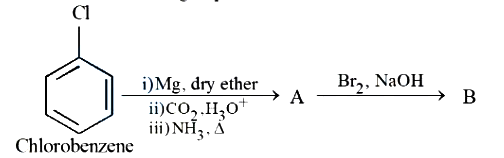
11.25 mg of chlorobenzene will produce __________ \(\times 10^{-1} \mathrm{mg}\) of product B .
(Consider the reactions result in complete conversion.)
[Given molar mass of \(\mathrm{C}, \mathrm{H}, \mathrm{O}, \mathrm{N}\) and Cl as \(12,1,16,14\) and \(35.5 \mathrm{~g} \mathrm{~mol}^{-1}\) respectively]JEE Mains 2025 Medium - \(2-\) hexene \(\xrightarrow[(ii)H_2O]{(i) O_3}\) Products The two products formed in above reaction are -JEE Mains 2023 Medium
- The standard reduction potentials at \(298 \mathrm{~K}\) for the following half cells are given below : \(\mathrm{Cr}_2 \mathrm{O}_7{ }^{2-}+14 \mathrm{H}^{+}+6 \mathrm{e}^{-} \rightarrow 2 \mathrm{Cr}^{3+}+7 \mathrm{H}_2 \mathrm{O}, \mathrm{E}^{\circ}=1.33 \mathrm{~V}\) \(\mathrm{Fe}^{3+}(\mathrm{aq})+3 \mathrm{e}^{-} \rightarrow \mathrm{Fe} \mathrm{E}^{\circ}=-0.04 \mathrm{~V}\) \(\mathrm{Ni}^{2+}(\mathrm{aq})+2 \mathrm{e}^{-} \rightarrow \mathrm{Ni} \mathrm{E}^{\circ}=-0.25 \mathrm{~V}\) \(\mathrm{Ag}^{+}(\mathrm{aq})+\mathrm{e}^{-} \rightarrow \mathrm{Ag} \mathrm{E}^{\circ}=0.80 \mathrm{~V}\) \(\mathrm{Au}^{3+}(\mathrm{aq})+3 \mathrm{e}^{-} \rightarrow \mathrm{Au} \mathrm{E}^{\circ}=1.40 \mathrm{~V}\) Consider the given electrochemical reactions, The number of metal\((s)\) which will be oxidized be \(\mathrm{Cr}_2 \mathrm{O}_7{ }^{2-}\), in aqueous solution is _______.JEE Mains 2024 Medium
- The volume \((\text { in } \mathrm{mL})\) of \(0.125\; \mathrm{M}\; \mathrm{AgNO}_{3}\) required to quantitatively precipitate chloride ions in \(0.3\; \mathrm{g}\) of \(\left[\mathrm{Co}\left(\mathrm{NH}_{3}\right)_{6}\right] \mathrm{Cl}_{3}\) is \(^{\mathrm{M}}\left[\mathrm{Co}\left(\mathrm{NH}_{3}\right)_{6}\right] \mathrm{Cl}_{3}=267.46 \;\mathrm{g} / \mathrm{mol}\) \(\mathrm{M}_{\mathrm{AgNO}_{3}}=169.87 \;\mathrm{g} / \mathrm{mol}\)JEE Mains 2020 Hard
- For a first order reaction, the time required for completion of \(90\, \%\) reaction is \('x'\) times the half life of the reaction. The value of \('x'\) is \(........\,.\) (Given: \(\ln 10=2.303\) and \(\log 2=0.3010\) )JEE Mains 2022 Medium
- The major product obtained in the photo catalysed bromination of \(2-\) methylbutane isJEE Mains 2014 Hard
More PYQs from JEE Mains
- The reaction \(2 NO + Br _2 \rightarrow 2 NOBr\) takes places through the mechanism given below : \(NO + Br _2 \Leftrightarrow NOBr _2 \text { (fast) }\) \(NOBr _2+ NO \rightarrow 2 NOBr \text { (slow) }\) The overall order of the reaction is \(.....\).JEE Mains 2023 Medium
- A mixture of hydrogen and oxygen has volume \(2000 \; cm ^{3}\), temperature \(300 \; K\), pressure \(100 \; kPa\) and mass \(0.76 \; g\) The ratio of number of moles of hydrogen to number of moles of oxygen in the mixture will beJEE Mains 2022 Medium
- The addition of \(HI\) in the presence of peroxide catalyst does not follow anti-Markovnikov's rule becauseJEE Mains 2013 Hard
- A source and a detector move away from each other in absence of wind with a speed of \(20\, {m} / {s}\) with respect to the ground. If the detector detects a frequency of \(1800\, {Hz}\) of the sound coming from the source, then the original frequency of source considering speed of sound in air \(340\, {m} / {s}\) will be \({Hz}\)JEE Mains 2021 Easy
- A student determined Young's Modulus of elasticity using the formula \(Y=\frac{M g L^{3}}{4 b d^{3} \delta} .\) The value of \(g\) is taken to be \(9.8 \,{m} / {s}^{2}\), without any significant error, his observation are as following.
Then the fractional error in the measurement of \({Y}\) isPhysical Quantity Least count of the Equipment used for measurement Observed value Mass \(({M})\) \(1\; {g}\) \(2\; {kg}\) Length of bar \((L)\) \(1\; {mm}\) \(1 \;{m}\) Breadth of bar \((b)\) \(0.1\; {mm}\) \(4\; {cm}\) Thickness of bar \((d)\) \(0.01\; {mm}\) \(0.4 \;{cm}\) Depression \((\delta)\) \(0.01\; {mm}\) \(5 \;{mm}\) JEE Mains 2021 Hard - The correct increasing order of C-H(A), C-O(B), C=O(C) and \(C \equiv N(D)\) bonds in terms of covalent bond length is:JEE Mains 2026 Easy