


JEE Mains · Chemistry · STD 11 - 7. Redox reactions
The species which does not undergo disproportionation reaction is _______.
- A \(\mathrm{ClO}_3^{-}\)
- B \(\mathrm{ClO}^{-}\)
- C \(\mathrm{ClO}_2^{-}\)
- D \(\mathrm{ClO}_4^{-}\)
Answer & Solution
Correct Answer
(D) \(\mathrm{ClO}_4^{-}\)
Step-by-step Solution
Detailed explanation
\(\mathrm{ClO}_4^{-} \rightarrow x+\{(-2) \times 4\}=-1 \Rightarrow x=+7\) Chlorine is in its maximum oxidation state, so disproportionation not possible in \(\mathrm{ClO}_4^{-}\).
See the Complete Solution
Get step-by-step explanations for this and 2.5 Lakh+ more JEE, NEET & CET questions.
- Unlock all solutions
- Practice the full chapter
- Track accuracy across PYQs
4.8 rated on Google Play · 14,000+ reviews
More questions from Chemistry
- In reaction \(A + 2B\) \( \rightleftharpoons \) \(2C + D\), initial concentration of \(B\) was \(1.5\, times\) of \([A]\) , but at equilibrium the concentrations of \(A\) and \(B\) became equal. The equilibrium constant for the reaction isJEE Mains 2019 Hard
- The correct decreasing order of priority of functional groups in naming an organic compound as per \(IUPAC\) system of nomenclature is.JEE Mains 2022 Easy
- Which of the following pair is not isoelectronic species? (At. no. \(Sm , 62 ; Er , 68: Yb , 70: Lu , 71 ; Eu , 63: Tb\), \(65\); \(\operatorname{Tm}, 69)\)JEE Mains 2022 Hard
- The ammonia \((NH_{3} )\) released on quantitative reaction of \(0.6\; \mathrm{g}\) urea \(\left(\mathrm{NH}_{2} \mathrm{CONH}_{2}\right)\) with sodium hydroxide (\(NaOH\)) can be neutralized byJEE Mains 2020 Hard
- The energy required by electrons, present in the first Bohr orbit of hydrogen atom to be excited to second Bohr orbit is ___________ \(J~mol^{-1}\).
Given: \(R_{H}=2.18\times10^{-11}\) ergsJEE Mains 2026 Medium - \(\mathrm{A}(\mathrm{g}) \rightarrow \mathrm{B}(\mathrm{g})+\mathrm{C}(\mathrm{g})\) is a first order reaction.
\(\begin{array}{|l|l|l|}\hline \text{Time} & T & \infty \\\hline \mathbf{P}_{\text {system }} & \mathrm{P}_{\mathrm{t}} & \mathrm{P}_{\infty} \\\hline\end{array}\)
The reaction was started with reactant A only. Which of the following expression is correct for rate constant k ?JEE Mains 2025 Medium
More PYQs from JEE Mains
- Within a spherical charge distribution of charge density \(\rho \left( r \right)\), \(N\) equipotential surfaces of potential \({V_0},{V_0} + \Delta V,{V_0} + 2\Delta V,\)\(.....{V_0} + N\Delta V\left( {\Delta V > 0} \right),\) are drawn and have increasing radii \(r_0, r_1, r_2,......r_N\), respectively. If the difference in the radii of the surfaces is constant for all values of \(V_0\) and \(\Delta V\) thenJEE Mains 2016 Hard
- The molarity of the solution prepared by dissolving \(6.3\, \mathrm{~g}\) of oxalic acid \(\left(\mathrm{H}_{2} \mathrm{C}_{2} \mathrm{O}_{4} \cdot 2 \mathrm{H}_{2} \mathrm{O}\right)\) in \(250\, \mathrm{~mL}\) of water in \(\operatorname{mol} \mathrm{L}^{-1}\) is \(\mathrm{x} \times 10^{-2} .\) The value of \(\mathrm{x}\) is ..... . (Nearest integer) [Atomic mass : \(\mathrm{H}: 1.0, \mathrm{C}: 12.0, \mathrm{O}: 16.0]\)JEE Mains 2021 Hard
- For the given cell ; \(Cu ( s )\left| Cu ^{2+}\left( C _{1} M \right) \| Cu ^{2+}\left( C _{2} M \right)\right| Cu ( s )\) change in Gibbs energy \((\Delta G )\) is negative, if :JEE Mains 2020 Medium
- n-Butane on monochlorination under photochemical condition gives an optically active compound "P". "P" on further chlorination gives dichloro compounds. The number of dichloro compounds obtained (ignore stereoisomers) is:JEE Mains 2026 Hard
- Given below are two statements. One is labelled as Assertion (A) and the other is labelled as Reason (R).
Assertion (A) :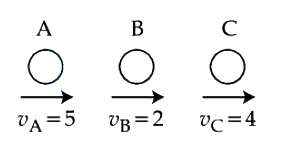
Three identical spheres of same mass undergo one dimensional motion as shown in figure with initial velocities \(v_{\mathrm{A}}=5 \mathrm{~m} / \mathrm{s}, v_{\mathrm{B}}=2 \mathrm{~m} / \mathrm{s}, v_{\mathrm{C}}=4 \mathrm{~m} / \mathrm{s}\). If we wait sufficiently long for elastic collision to happen, then \(v_{\mathrm{A}}=4 \mathrm{~m} / \mathrm{s}, v_{\mathrm{B}}=2 \mathrm{~m} / \mathrm{s}\), \(v_{\mathrm{C}}=5 \mathrm{~m} / \mathrm{s}\) will be the final velocities.
Reason (R): In an elastic collision between identical masses, two objects exchange their velocities.
In the light of the above statements, choose the correct answer from the options given below :JEE Mains 2025 Easy - The distance of the Sun from earth is \(1.5 \times 10^{11} \,m\) and its angular diameter is \((2000) \,s\) when observed from the earth. The diameter of the Sun will be ...........JEE Mains 2022 Medium