


JEE Mains · Chemistry · STD 12 - 3. Chemical kinetics
Iron (III) catalyses the reaction between iodide and persulphate ions, in which
A. \(Fe ^{3+}\) oxidises the iodide ion
B. \(Fe ^{3+}\) oxidises the persulphate ion
C. \(Fe ^{2+}\) reduces the iodide ion
D. \(Fe ^{2+}\) reduces the persulphate ion
Choose the most appropriate answer from the options given below:
- A B only
- B A only
- C B and C only
- D A and D only
Answer & Solution
Correct Answer
(D) A and D only
Step-by-step Solution
Detailed explanation
\(2 Fe ^{3+}+2 I ^{-} \rightarrow 2 Fe ^{2+}+ I _2\) \(2 Fe ^{2+}+ S _2 O _8^{2-} \rightarrow 2 Fe ^{3+}+2 SO _4^{2-}\) \(Fe ^{+3}\) oxidises \(I ^{-}\)to \(I _2\) and convert itself into \(Fe ^{+2}\). This \(Fe ^{+2}\) reduces \(S _2 O _8{ }^{2-}\) to \(SO _4{ }^{2-}\) and…
See the Complete Solution
Get step-by-step explanations for this and 2.5 Lakh+ more JEE, NEET & CET questions.
- Unlock all solutions
- Practice the full chapter
- Track accuracy across PYQs
4.8 rated on Google Play · 14,000+ reviews
More questions from Chemistry
- Which among the following has highest boiling point?JEE Mains 2024 Hard
- The conversion of propan\(-1-\)ol to \(n-\)butylamine involves the sequential addition of reagents. The correct sequential order of reagents is.JEE Mains 2022 Medium
- Consider the following \(Zn^{2+} + 2e^-\) \(\longrightarrow\) \(Zn (s) ; E^o = -0.76\,V\) \(Ca^{2+} + 2e^-\) \(\longrightarrow\) \(Ca (s) ; E^o = -2.87\,V\) \(Mg^{2+} + 2e^-\) \(\longrightarrow\) \(Mg (s) ; E^o = -2.36\,V\) \(Ni^{2+} + 2e^-\) \(\longrightarrow\) \(Ni (s) ; E^o = -0.25\,V\) The reducing power of the metals increases in the orderJEE Mains 2019 Hard
- Following four solutions are prepared by mixing different volumes of \(NaOH\) and \(HCl\) of different concentrations, \(pH\) of which one of them will be equal to \(1\)?JEE Mains 2018 Medium
- The increasing order of the following compounds towards \(HCN\) addition is
 JEE Mains 2020 Medium
 - In which one of the following pairs the central atoms exhibit \(\mathrm{sp}^2\) hybridization ?JEE Mains 2024 Medium
More PYQs from JEE Mains
- A coil of negligible resistance is connected in series with \(90 \Omega\) resistor across \(120 \mathrm{~V}, 60 \mathrm{~Hz}\) supply. A voltmeter reads \(36 \mathrm{~V}\) across resistance. Inductance of the coil is _______.JEE Mains 2024 Hard
- Given : \(f(x)=\left\{\begin{array}{ccc}{x} & {,} & {0 \leq x < \frac{1}{2}} \\ {\frac{1}{2}} & {,} & {x=\frac{1}{2}} \\ {1-x} & {,} & {\frac{1}{2} < x \leq 1}\end{array}\right.\) and \(g(x)=\left(x-\frac{1}{2}\right)^{2}, x \in R .\) Then the area (in sq. units) of the region bounded by the curves, \(y=f(x)\) and \(y=g(x)\) between the lines, \(2 \mathrm{x}=1\) and \(2 \mathrm{x}=\sqrt{3},\) isJEE Mains 2020 Hard
- Let for any three distinct consecutive terms \(a, b, c\) of an \(A.P,\) the lines \(a x+b y+c=0\) be concurrent at the point \(\mathrm{P}\) and \(\mathrm{Q}(\alpha, \beta)\) be a point such that the system of equations \( x+y+z=6, \) \( 2 x+5 y+\alpha z=\beta\) and \(x+2 y+3 z=4\), has infinitely many solutions. Then \((P Q)^2\) is equal to ...........JEE Mains 2024 Hard
- The compound \(A\) in the following reaction is : \(A\xrightarrow[{(ii)\,\,Conc.\,{H_2}S{O_4}/\Delta }]{{{\text{(i)}}\,{\text{C}}{{\text{H}}_3}MgBr/{H_2}O}}\) \(B\xrightarrow[{(ii)\,Zn/{H_2}O}]{{(i)\,{O_3}}}C + D\) \(D\xrightarrow[\Delta ]{{Ba\left( {OH} \right)}}\begin{array}{*{20}{c}} {\,\,\,\,\,\,\,\,\,\,\,\,\,\,\,\,\,\,\,\,\,\,\,\,C{H_3}} \\ {\,\,\,\,\,\,\,\,\,\,\,\,\,\,\,\,|} \\ {{H_3}C - C} \end{array}\)\(\begin{array}{*{20}{c}} {\,\,\,\,\,\,\,O} \\ {\,\,\,\,\,||} \\ { = CH - C - C{H_3}} \end{array}\)
 JEE Mains 2020 Medium
 - In a compound microscope the focal length of objective lens is \(1.2\, cm\) and focal length of eye piece is \(3.0\, cm\). When object is kept at \(1.25\, cm\) in front of objective, final image is formed at infinity. Magnifying power of the compound microscope should beJEE Mains 2014 Hard
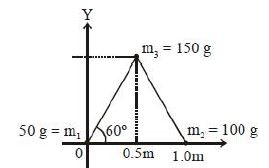
- Three particles of masses \(50\, g\), \(100\, g\) and \(150\, g\) are placed at the vertices of an equilateral triangle of side \(1\, m\) (as shown in the figure). The \((x, y)\) coordinates of the centre of mass will be
 JEE Mains 2019 Hard