


JEE Mains · Chemistry · STD 12 - 2. Electrochemistry
In a cell, the following reactions take place \(Fe ^{2+} \rightarrow Fe ^{3+} + e ^{-} \quad E _{ Fe ^{3+} / Fe ^{2+}}=0.77 \,V\) \(2 I ^{-} \rightarrow I _{2}+2 e ^{-} \quad E _{ I _{2} / I ^{-}}^{0}=0.54 \,V\) The standard electrode potential for the spontaneous reaction in the cell is \(x \times 10^{-2} \,V 298\) \(K\). The value of \(x\) is .... (Nearest Integer)
- A \(95\)
- B \(202\)
- C \(23\)
- D \(4\)
Answer & Solution
Correct Answer
(C) \(23\)
Step-by-step Solution
Detailed explanation
\(Fe _{\text {Cathode }}^{+3}+ I _{\text {anode }}^{-} \longrightarrow I _{2}+ Fe ^{+2}\) \(E _{\text {Cell }}^{0}= E _{\text {cathode }}^{0}- E _{\text {anode }}^{0}\) \(=0.77-0.54\) \(=0.23\) \(=23 \times 10^{-2}\, V\)
See the Complete Solution
Get step-by-step explanations for this and 2.5 Lakh+ more JEE, NEET & CET questions.
- Unlock all solutions
- Practice the full chapter
- Track accuracy across PYQs
4.8 rated on Google Play · 14,000+ reviews
More questions from Chemistry
- Given below are two statements :
Statement (I) : Nitrogen, sulphur, halogen and phosphorus present in an organic compound are detected by Lassaigne's Test.
Statement (II) : The elements present in the compound are converted from covalent form into ionic form by fusing the compound with Magnesium in Lassaigne's test.
In the light of the above statements, choose the correct anower from the options given below :JEE Mains 2025 Medium - From \(6.55 \mathrm{~g}\) of aniline, the maximum amount of acetanilide that can be prepared will be _______ \(\times 10^{-1} \mathrm{~g}\).JEE Mains 2024 Medium
- The crystal field stabilization energy \((CFSE)\) of \([Fe(H_2O)_6]Cl_2\) and \(K_2[NiCl_4],\) respectively, areJEE Mains 2019 Hard
- For the electro chemical cell \(\mathrm{M}\left|\mathrm{M}^{2+}\right||\mathrm{X}| \mathrm{X}^{2-}\) If \(\mathrm{E}_{\left(\mathrm{M}^{2+} / \mathrm{M}\right)}^0=0.46 \mathrm{~V}\) and \(\mathrm{E}_{\left(\mathrm{x} / \mathrm{X}^{2-}\right)}^0=0.34 \mathrm{~V}\). Which of the following is correct?JEE Mains 2024 Medium
- Given below are two statements:
Statement I: When an electric discharge is passed through gaseous hydrogen, the hydrogen molecules dissociate and the energetically excited hydrogen atoms produce electromagnetic radiation of discrete frequencies.
Statement II: The frequency of second line of Balmer series obtained from \( He^{+} \) is equal to that of first line of Lyman series obtained from hydrogen atom.
In the light of the above statements, choose the correct answer from the options given below:JEE Mains 2026 Easy - Which of the following reagent is used for the following reaction ? \(CH _{3} CH _{2} CH _{3} \stackrel{?}{\longrightarrow} CH _{3} CH _{2} CHO\)JEE Mains 2021 Medium
More PYQs from JEE Mains
- When photon of energy \(4.0\; eV\) strikes the surface of a metal \(\mathrm{A}\), the ejected photoelectrons have maximum kinetic energy \(\mathrm{T}_{\mathrm{A}}\; eV\) end de-Broglie wavelength \(\lambda_{\mathrm{A}} .\) The maximum kinetic energy of photoelectrons liberated from another metal \(\mathrm{B}\) by photon of energy \(4.50 \;eV\) is \(\mathrm{T}_{\mathrm{B}}=\left(\mathrm{T}_{\mathrm{A}}-1.5\right)\;eV\). If the de-Broglie wavelength of these photoelectrons \(\lambda_{B}=2 \lambda_{A}\) then the work function of metal \(\mathrm{B}\) is ............. \(eV\)JEE Mains 2020 Medium
- Which of the following is correct order of ligand field strength?JEE Mains 2023 Medium
- A convergent doublet of separated lenses, corrected for spherical aberration, has resultant focal length of \(10\,cm\). The separation between the two lenses is \(2\,cm\). The focal lengths of the component lensesJEE Mains 2018 Hard
- The solution of the differential equation \(\left(x^2+y^2\right) d x-5 x y d y=0, y(1)=0\), is :JEE Mains 2024 Hard
- The structure of \(PCl _{5}\) in the solid state isJEE Mains 2020 Hard
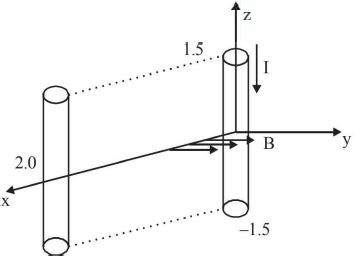
- A conductor lies along the \(z-\)axis \(a\) \(-1.5\)\( \le Z < 1.5\,m\) carries a fixed current of \(10.0\ A\) in \( - {\hat a_z}\) direction (see figure). For a field \(\vec B\) \(=\) \(3.0 \times 10^{-4}\) \(e^{-0.2x}\) \({\hat a_y}\,T\) find the power required to move the conductor at constant speed to \(x = 2.0\ m, y = 0\ m\) in \(5 \times 10^{-3}\ s\). Assume parallel motion along the \(x-\)axis........\( W\)
 JEE Mains 2014 Hard