


JEE Mains · Chemistry · STD 12 - Electrochemistry
- JEE Mains 2022
- Medium
- Numerical
The cell potential for the given cell at \(298\text{ K}\):
\(Pt \mid H_2(g, 1\text{ bar}) \mid H^+(aq) \parallel Cu^{2+}(aq) \mid Cu(s)\)
is \(0.31\text{ V}\). The \(\text{pH}\) of the acidic solution is found to be 3, whereas the concentration of \(Cu^{2+}\) is \(10^{-x}\text{ M}\). The value of \(x\) is:
(Given: \(E^\circ_{Cu^{2+}/Cu} = 0.34\text{ V}\) and \(\frac{2.303RT}{F} = 0.06\text{ V}\))
Pick an option to check your answer.
Answer & Solution
Correct Answer
(B) \(7\)
Step-by-step Solution
Detailed explanation
Explanation:
Let us solve this problem step-by-step using the Nernst equation from the Electrochemistry chapter of the NCERT Class 12 Chemistry textbook:
Step 1: Write the half-cell reactions and overall cell reaction
- Anode (Oxidation): \(H_2(g) \rightarrow 2H^+(aq) + 2e^-\)
- Cathode (Reduction): \(Cu^{2+}(aq) + 2e^- \rightarrow Cu(s)\)
- Overall Reaction: \(H_2(g) + Cu^{2+}(aq) \rightarrow 2H^+(aq) + Cu(s)\)
Here, the number of moles of electrons transferred is \(n = 2\).
The standard cell potential is: \(E^\circ_{\text{cell}} = E^\circ_{Cu^{2+}/Cu} - E^\circ_{H^+/H_2} = 0.34\text{ V} - 0\text{ V} = 0.34\text{ V}\).
Step 2: Determine concentration from \(\text{pH}\)
By definition, \(\text{pH} = -\log[H^+]\). Given that the \(\text{pH}\) of the solution is 3:
\([H^+] = 10^{-\text{pH}} = 10^{-3}\text{ M}\)
The concentration of copper ions is given as \([Cu^{2+}] = 10^{-x}\text{ M}\).
Step 3: Set up the Nernst Equation
The Nernst equation at \(298\text{ K}\) for this cell is:
\(E_{\text{cell}} = E^\circ_{\text{cell}} - \frac{0.06}{n} \log \frac{[H^+]^2}{[Cu^{2+}] \cdot P_{H_2}}\)
Substituting the given values (\(E_{\text{cell}} = 0.31\text{ V}\), \(E^\circ_{\text{cell}} = 0.34\text{ V}\), \(n = 2\), and \(P_{H_2} = 1\text{ bar}\)):
\(0.31 = 0.34 - \frac{0.06}{2} \log \frac{(10^{-3})^2}{10^{-x}}\)
Step 4: Solve for \(x\)
Subtract \(0.34\) from both sides:
\(0.31 - 0.34 = -0.03 \log \frac{10^{-6}}{10^{-x}}\)
\(-0.03 = -0.03 \log(10^{-6 - (-x)})\)
Divide both sides by \(-0.03\):
\(1 = \log(10^{x - 6})\)
Using the logarithmic property \(\log(10^a) = a\):
\(1 = x - 6\)
\(x = 1 + 6 = 7\)
Hence, Option B is the correct choice.
More questions from Chemistry
- Which one of the following complexes will have \(\Delta_0=0\) and \(\mu=5.96\) B.M.?JEE Mains 2025 Easy
- Given below are two statements : Statement \(I:\) Upon heating a borax bead dipped in cupric sulphate in a luminous flame, the colour of the bead becomes green. Statement \(II:\) The green colour observed is due to the formation of copper(I) metaborate. In the light of the above statements, choose the most appropriate answer from the options given below :JEE Mains 2023 Medium
- The incorrect relationship in the following pairs in relation to ionisation enthalpies is _______.JEE Mains 2025 Medium
- An alkane \((Y)\) requires \(8\) moles of oxygen for complete combustion and on chlorination with Cl\(_2\)/h\(\nu\), \((Y)\) gives only one monochlorinated product \((Z)\). The total number of primary carbon atoms in \((Y)\) is __________.JEE Mains 2026 Medium
- A reaction at \(1\,bar\) is non-spontaneous at low temperature but becomes spontaneous at high temperature. Identify the correct statement about the reaction among the followingJEE Mains 2016 Hard
- The most stable trihalide of nitrogen is ..... .JEE Mains 2022 Medium
More PYQs from JEE Mains
- 0.5 g of an organic compound on combustion gave 1.46 g of \(\mathrm{CO}_2\) and 0.9 g of \(\mathrm{H}_2 \mathrm{O}\). The percentage of carbon in the compound is _______. (Nearest integer) [Given : Molar mass (in \(\mathrm{g} \mathrm{mol}^{-1}\)) \(\mathrm{C}: 12, \mathrm{H}: 1\), O: 16]JEE Mains 2025 Easy
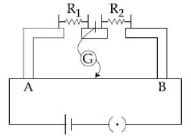
- In the experimental setup of meter bridge shown in the figure, the null point is obtained at a distance of \(40\,cm\) from \(A\). If a \(10\,\Omega \) resistor is connected in series with \(R_1\), the null point shifts by \(10\,cm\). The resistance that should be connected in parallel with \(\left( {{R_1} + 10} \right)\,\Omega \) such that the null point shifts back to its initial position is .............. \(\Omega\)
 JEE Mains 2019 Hard
- A nucleus at rest disintegrates into two smaller nuclei with their masses in the ratio of \(2: 1\). After disintegration they will move :-JEE Mains 2024 Hard
- The electric field component of a monochromatic radiation is given by \(\vec E = 2{E_0}\,\hat i\,\cos\, kz\,\cos\, \omega t\) Its magnetic field \(\vec B\) is then given byJEE Mains 2017 Hard
- The one division of main scale of vernier callipers reads \(1\,mm\) and \(10\) divisions of Vernier scale is equal to the \(9\) divisions on main scale. When the two jaws of the instrument touch each other the \(zero\) of the Vernier lies to the right of \(zero\) of the main scale and its fourth division coincides with a main scale division. When a spherical bob is tightly placed between the two jaws, the \(zero\) of the Vernier scale lies in between \(4.1\,cm\) and \(4.2\,cm\) and \(6^{\text {th }}\) Vernier division coincides with a main scale division. The diameter of the bob will be \(.............10^{-2}\,cm\)JEE Mains 2022 Hard
- Acidified potassium permanganate solution oxidises oxalic acid. The spin-only magnetic moment of the manganese product formed from the above reaction is \(....\,B.M.\) (Nearest Integer)JEE Mains 2022 Medium