


JEE Mains · Chemistry · STD 12 - p -Block elements - ll
The number of non-ionisable protons present in the product \(B\) obtained from the following reaction is \(\text { . } C _{2} H _{5} OH + PCl _{3} \rightarrow C _{2} H _{5} Cl + A\) \(A + PCl _{3} \rightarrow B\)
- A \(9\)
- B \(2\)
- C \(4\)
- D \(3\)
Answer & Solution
Correct Answer
(B) \(2\)
Step-by-step Solution
Detailed explanation
\(C _{2} H _{5} OH + PCl _{3} \longrightarrow C _{2} H _{5} Cl + H _{3} PO _{3}\) \(H _{3} PO _{3}+ PCl _{3} \longrightarrow H _{4} P _{2} O _{5}+ HCl\)
See the Complete Solution
Get step-by-step explanations for this and 2.5 Lakh+ more JEE, NEET & CET questions.
- Unlock all solutions
- Practice the full chapter
- Track accuracy across PYQs
4.8 rated on Google Play · 14,000+ reviews
More questions from Chemistry
- Match List-I with List-II.
Choose the correct answer from the options given below:List-I
ReagentsList-II
Reaction Name
(Involving aldehydes)A. \(H _2, Pd - BaSO _4\) I. Etard Reaction B. \(SnCl _2, HCl\) II. Rosenmund Reduction C. \(CrO _2 Cl _2, CS _2\) III. Gatterman-Koch Reaction D. \( CO , HCl , \) \( \text { Anhyd. } AlCl _3\) IV. Stephen Reaction JEE Mains 2026 Hard - The maximum prescribed concentration of copper in drinking water is ........ \(ppm\)JEE Mains 2019 Easy
- \(83\, \mathrm{~g}\) of ethylene glycol dissolved in \(625\, \mathrm{~g}\) of water.The freezing point of the solution is \(......\mathrm{K} .\) (Nearest integer) [Use : Molal Freezing point depression constant of water \(\left.=1.86 \,\mathrm{~K} \,\mathrm{~kg} \,\mathrm{~mol}^{-1}\right]\) Freezing Point of water \(=273\, \mathrm{~K}\) Atomic masses : \(\mathrm{C}: 12.0\, \mathrm{u}, \mathrm{O}: 16.0\, \mathrm{u}, \mathrm{H}: 1.0\, \mathrm{u}]\)JEE Mains 2021 Medium
- Which one of the following compounds does not exhibit resonance ?JEE Mains 2021 Hard
- Benzyl isocyanide can be obtained from
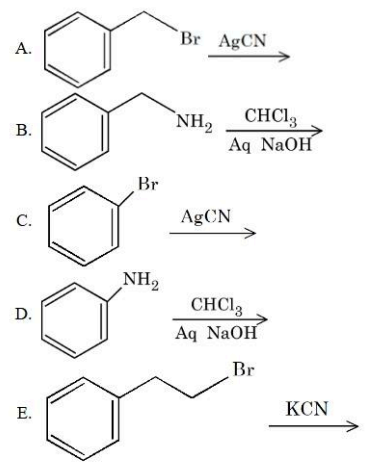
Choose the correct answer from the options given below:JEE Mains 2026 Medium - Electrode potentials \((E^o)\) are given below \(Cu^+ /Cu = + 0.52\, V\), \(Fe^{3+} /Fe^{2+} = +0.7 7\, V\), \(\frac{1}{2}{I_2}\left( s \right)/{I^ - }\, = + 0.54\,V,\) \(Ag^+ /Ag = + 0.88\,V\). Based on the above potentials, strongest oxidizing agent will beJEE Mains 2013 Hard
More PYQs from JEE Mains
- Ice at \(-20\,^oC\) is added to \(50\,g\) of water at \(40\,^oC.\) When the temperature of the mixture reaches \(0\,^oC,\) it is found that \(20\,g\) of ice is still unmelted. The amount of ice added to the water was close to ........\(g\) (Specific heat of water \(= 4.2\,J/g/^oC)\) Heat of fusion of water at \(0^oC = 334\,J/g\) )JEE Mains 2019 Medium
- \(\mathop {{\rm{lim}}}\limits_{x \to 0} \frac{{{\rm{sin}}\left( {\pi {{\cos }^2}x} \right)}}{{{x^2}}} = \)JEE Mains 2014 Medium
- An equilateral triangle OAB is inscribed in the parabola \( y^{2}=4x \) with the vertex O at the vertex of the parabola. Then the minimum distance of the circle having AB as a diameter from the origin is:JEE Mains 2026 Hard
- Given below are two statements: Statement \(I\) : In hydrogen atom, the frequency of radiation emitted when an electron jumps from lower energy orbit \(\left( E _{1}\right)\) to higher energy orbit \(\left( E _{2}\right)\), is given as \(hf = E _{1}- E _{2}\). Statement \(II\) : The jumping of electron from higher energy orbit \(\left(E_{2}\right)\) to lower energy orbit \(\left(E_{1}\right)\) is associated with frequency of radiation given as \(f\) \(=\left( E _{2}- E _{1}\right) / h\) This condition is Bohr's frequency condition. In the light of the above statements, choose the correct answer from the options given belowJEE Mains 2022 Medium
- Given \(\frac{{b + c}}{{11}} = \frac{{c + a}}{{12}} = \frac{{a + b}}{{13}}\) for a \(\Delta ABC\) with usual nation. If \(\frac{{\cos \,A}}{\alpha } = \frac{{\cos \,\beta }}{\beta } = \,\frac{{\cos \,C}}{\gamma }\), then the ordered tried \(\left( {\alpha ,\beta ,\gamma } \right)\) has a valueJEE Mains 2019 Hard
- A particle of mass \(m\) and charge \(q\) is in an electric and magnetic field given by \(\vec E = 2\hat i + 3\hat j ;\, B = 4\hat j + 6\hat k\) The charged particle is shifted from the origin to the point \(P(x = 1 ;\, y = 1)\) along a straight path. The magnitude of the total work done isJEE Mains 2019 Medium