


JEE Mains · Chemistry · STD 12 - P -Block elements - ll
- JEE Mains 2022
- Easy
- MCQ
Given below are two statements: one is labelled as Assertion \(A\) and the other is labelled as Reason \(R\). Assertion \(A :\) Flourine forms one oxoacid. Reason \(R\) : Flourine has smallest size amongst all halogens and is highly electronegative In the light of the above statements, choose the most appropriate answer from the options given below.
Pick an option to check your answer.
Answer & Solution
Correct Answer
(A) Both \(A\) and \(R\) are correct and \(R\) is the correct explanation of \(A\).
Step-by-step Solution
Detailed explanation
Both \(A\) and \(R\) are correct and \(R\) is the correct explanation of \(A\).
More questions from Chemistry
- The limiting molar conductivities of \(NaI , NaNO _{3}\) and \(AgNO _{3}\) are \(12.7,12.0\) and \(13.3 \,m\,S m ^{2} \,mol ^{-1}\), respectively (all at \(25^{\circ} C\) ). The limiting molar conductivity of \(AgI\) at this temperature is \(....\,m\,S m ^{2}\, mol ^{-1}\)JEE Mains 2022 Medium
- Which of the following is correct set of \(4\) quantum numbers of \(19^{th}\) electron in Chromium (Atomic number \(= 24\)) in accordance with Aufbau principle?JEE Mains 2026 Medium
- An aqueous solution of volume \(300\,cm ^3\) contains \(0.63\,g\) of protein. The osmotic pressure of the solution at \(300\,K\) is \(1.29\,mbar\). The molar mass of the protein is \(.........\,g\,mol ^{-1}\) Given : \(R =0.083\,L\,bar\,K ^{-1} mol ^{-1}\)JEE Mains 2023 Medium
- Choose the correct tests with respective observations.
(A) \(\mathrm{CuSO}_4\) (acidified with acetic acid) \(+ \mathrm{K}_4\left[\mathrm{Fe}(\mathrm{CN})_6\right] \rightarrow\) Chocolate brown precipitate.
(B) \(\mathrm{FeCl}_3+\mathrm{K}_4\left[\mathrm{Fe}(\mathrm{CN})_6\right] \rightarrow\) Prussian blue precipitate.
(C) \(\mathrm{ZnCl}_2+\mathrm{K}_4\left[\mathrm{Fe}(\mathrm{CN})_6\right]\), neutralised with \(\mathrm{NH}_4 \mathrm{OH}\) \(\rightarrow\) White or bluish white precipitate.
(D) \(\mathrm{MgCl}_2+\mathrm{K}_4\left[\mathrm{Fe}(\mathrm{CN})_6\right] \rightarrow\) Blue precipitate.
(E) \(\mathrm{BaCl}_2+\mathrm{K}_4\left[\mathrm{Fe}(\mathrm{CN})_6\right]\), neutralised with NaOH \(\rightarrow\) White precipitate.
Choose the correct answer from the options given below :JEE Mains 2025 Hard - At \(300\, K\) and \(1\, atm,\, 15\, mL\) of a gaseous hydrocarbon requires \(375\, mL\) air containing \(20\%\,\, O_2\) by volume for complete combustion. After combustion the gases occupy \(330\, mL.\) Assuming that the water formed is in liquid form and the volumes were measured at the same temperature and pressure, the formula of the hydrocarbon is :JEE Mains 2016 Hard
- For the given compounds, the correct order of increasing \(\mathrm{pK}_{\mathrm{a}}\) value:
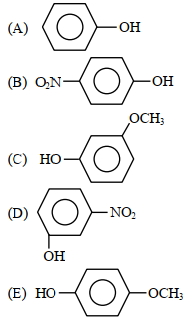 JEE Mains 2024 Medium
More PYQs from JEE Mains
- A particle moving with kinetic energy \(E\) has de Broglie wavelength \(\lambda\). If energy \(\Delta \mathrm{E}\) is added to its energy, the wavelength become \(\frac {\lambda}{2} .\) Value of \(\Delta \mathrm{E},\) isJEE Mains 2020 Medium
- According to Lewis theory, the total number of \(\sigma\) bond-pairs and lone pair of electrons around the central atom of \(XeO_6^{4-}\) ion is _____.JEE Mains 2026 Medium
- Match the LIST-I with LIST-II
List-I
OrbitalList-II
Radial nodes and nodal planeA. \(2s\) I. \(1\) Radial node + two nodal planes B. \(3s\) II. \(1\) Radial node + one nodal plane C. \(3p\) III. \(2\) Radial nodes + No nodal plane D. \(4d\) IV. \(1\) Radial node + No nodal plane
Choose the correct answer from the options given below:JEE Mains 2026 Medium - The electric field of light wave is given as \(\vec E\, = \,{10^{ - 3}}\,\cos \,\,\left( {\frac{{2\pi x}}{{5 \times {{10}^{ - 7}}}} - 2\pi \times 6 \times {{10}^{14}}t} \right)\hat x\frac{N}{C}\). This light falls on a metal plate of work function \(2\,eV.\) The stopping potential of the photoelectrons is ................ \(V\)JEE Mains 2019 Hard
- Consider the following chemical equilibrium of the gas phase reaction at a constant temperature :
\(\mathrm{A}(\mathrm{~g}) \rightleftharpoons \mathrm{B}(\mathrm{~g})+\mathrm{C}(\mathrm{~g})\)
If \(p\) being the total pressure, \(K_p\) is the pressure equilibrium constant and \(\alpha\) is the degree of dissociation, then which of the following is true at equilibrium?JEE Mains 2025 Hard - Which one of the following acids does not exhibit optical isomerism?JEE Mains 2014 Hard