


JEE Mains · Chemistry · STD 11 - 6.2. Equilibrium - II (icon Equilibrium)
A solution is \(0.1\, \mathrm{M}\) in \(\mathrm{Cl}^{-}\)and \(0.001\, \mathrm{M}\) in \(\mathrm{CrO}_{4}{ }^{2-}\). Solid \(\mathrm{AgNO}_{3}\) is gradually added to it. Assuming that the addition does not change in volume and \(\mathrm{K}_{\mathrm{sp}}(\mathrm{AgCl})=1.7 \times 10^{-10} \,\mathrm{M}^{2}\) and \(\mathrm{K}_{\mathrm{sp}}\left(\mathrm{Ag}_{2} \mathrm{CrO}_{4}\right)=1.9 \,\times 10^{-12} \mathrm{M}^{3}\) Select correct statement from the following :
- A \(\mathrm{AgCl}\) will precipitate first as the amount of \(\mathrm{Ag}^{+}\)needed to precipitate is low.
- B \(\mathrm{AgCl}\) precipitates first because its \(\mathrm{K}_{\mathrm{sp}}\) is high.
- C \(\mathrm{Ag}_{2} \mathrm{CrO}_{4}\) precipitates first because the amount of \(\mathrm{Ag}^{+}\)needed is low.
- D \(\mathrm{Ag}_{2} \mathrm{CrO}_{4}\) precipitates first as its \(\mathrm{K}_{\mathrm{sp}}\) is low.
Answer & Solution
Correct Answer
(A) \(\mathrm{AgCl}\) will precipitate first as the amount of \(\mathrm{Ag}^{+}\)needed to precipitate is low.
Step-by-step Solution
Detailed explanation
\((i)\) \(\left[\mathrm{Ag}^{+}\right]\)required to \(\mathrm{ppt} \mathrm{AgCl}(\mathrm{s})\) \(\mathrm{Ksp}=\mathrm{IP}=\left[\mathrm{Ag}^{+}\right]\left[\mathrm{Cl}^{-}\right]=1.7 \times 10^{-10}\) \(\left[\mathrm{Ag}^{+}\right]=1.7 \times 10^{-9}\) \((ii)\)…
See the Complete Solution
Get step-by-step explanations for this and 2.5 Lakh+ more JEE, NEET & CET questions.
- Unlock all solutions
- Practice the full chapter
- Track accuracy across PYQs
4.8 rated on Google Play · 14,000+ reviews
More questions from Chemistry
- Phthalimide is made to undergo following sequence of reactions. (Image) Total number of \(\pi\) bonds present in product ' \(P\) ' is _______.
 JEE Mains 2024 Medium
 - Which of the following statement(s) is/are true ?
A. If two orbitals have the same value of \((n + l)\), the orbital with lower value of \(n\) will have lower energy.
B. Energies of the orbitals in the same subshell increase with increase in atomic number.
C. The size of \(2p_x\) orbital is less than the size of \(3p_x\) orbital.
D. Among \(5f\), \(6s\), \(4d\), \(5p\) and \(5d\) orbitals, none of the orbitals have \(2\) radial nodes.
Choose the correct answer from the options given below :JEE Mains 2026 Medium - Molality (m) of \(3 \mathrm{M}\) aqueous solution of \(\mathrm{NaCl}\) is _______. (Given : Density of solution \(=1.25 \mathrm{~g} \mathrm{~mL}^{-1}\), Molar mass in \(\left.\mathrm{g} \mathrm{mol}^{-1}: \mathrm{Na}-23, \mathrm{Cl}-35.5\right)\)JEE Mains 2024 Medium
- \(A _2+ B _2 \rightarrow 2 AB \cdot \Delta H _{ l }^0=-200\,kJmol ^{-1}\) \(AB , A _2\) and \(B _2\) are diatomic molecule. If the bond enthalpies of \(A _2, B _2\) and \(AB\) are in the ratio \(1: 0.5: 1\), then the bond enthalpy of \(A_2\) is \(......\,kJ\,mol ^{-1}\) (Nearest integer)JEE Mains 2023 Hard
- When light of wavelength \(248\, nm\) falls on a metal of threshold energy \(3.0 \,eV\), the de-Broglie wavelength of emitted electrons is ............. \(\mathring A\) (Round off to the Nearest Integer). [Use : \(\sqrt{3}=1.73, h =6.63 \times 10^{-34} Js\) \(m _{ e }=9.1 \times 10^{-31} kg ; c =3.0 \times 10^{8} ms ^{-1}\) \(\left.1 eV =1.6 \times 10^{-19} J \right]\)JEE Mains 2021 Hard
- Match the LIST-I with LIST-II
No. LIST-I No. LIST-II A. Carbocation I. Species that can supply a pair of electrons. B. C-Free radical II. Species that can receive a pair of electrons. C. Nucleophile III. sp2 hybridized carbon with empty p-orbital. D. Electrophile IV. sp2 / sp3 hybridized carbon with one unpaired electron.
Choose the correct answer from the options given below :JEE Mains 2025 Hard
More PYQs from JEE Mains
- If the shortest distance between the lines \(\frac{\mathrm{x}-\lambda}{2}=\frac{\mathrm{y}-4}{3}=\frac{\mathrm{z}-3}{4}\) and \(\frac{x-2}{4}=\frac{y-4}{6}=\frac{z-7}{8}\) is \(\frac{13}{\sqrt{29}}\), then a value of \(\lambda\) is :JEE Mains 2024 Hard
- Let the locus of the mid-point of the chord through the origin O of the parabola \( y^{2}=4x \) be the curve S. Let P be any point on S. Then the locus of the point, which internally divides OP in the ratio 3:1, is:JEE Mains 2026 Hard
- Consider the following electrochemical cell at 298 K
\(Pt \left| HSnO _2^{-}( aq )\right| Sn ( OH )_6{ }^{2-}( aq )\left| Bi _2 O _3(s)\right| Bi ( s )\).
If the reaction quotient at a given time is \(10^6\), then the cell EMF ( \(E _{\text {cell }}\) ) is _______ \(\times 10^{-1} V\) (Nearest integer).
Given the standard half-cell reduction potential as
\(E _{ Bi _2 O _3 /{ Bi , OH ^{-}}^0}^0=-0.44 V\) and
\(E _{ Sn ( OH )_6^{2-} / HSnO _2^{-}, OH }^0=-0.90 V\)JEE Mains 2026 Medium - A ball of mass \(0.5 \; kg\) is dropped from the height of \(10 \; m\). The height, at which the magnitude of velocity becomes equal to the magnitude of acceleration due to gravity, is \(\dots \; m\). (Use \(g =10 \; m / s ^{2}\)).JEE Mains 2022 Medium
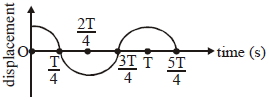
- The displacement time graph of a particle executing \(S.H.M.\) is given in figure: (sketch is schematic and not to scale) Which of the following statements is are true for this motion? \((A)\) The force is zero \(t=\frac{3 T}{4}\) \((B)\) The acceleration is maximum at \(t=T\) \((C)\) The speed is maximum at \(t =\frac{ T }{4}\) \((D)\) The \(P.E.\) is equal to \(K.E.\) of the oscillation at \(t=\frac{T}{2}\)
 JEE Mains 2020 Hard
 - Let \(S=\left\{\theta \in(0,2 \pi): 7 \cos ^{2} \theta-3 \sin ^{2} \theta-2\right.\) \(\left.\cos ^{2} 2 \theta=2\right\}\). Then, the sum of roots of all the equations \(x ^{2}-2\left(\tan ^{2} \theta+\cot ^{2} \theta\right) x +6 \sin ^{2} \theta=0\) \(\theta \in S\), is\(...\)JEE Mains 2022 Hard