


JEE Mains · Chemistry · STD 11 - Classification of elements and periodicity in properties
- JEE Mains 2020
- Easy
- Numerical
The atomic number of Unnilunium is...........
Pick an option to check your answer.
Answer & Solution
Correct Answer
(A) \(101\)
Step-by-step Solution
Detailed explanation
Explanation:
According to the IUPAC systematic nomenclature rules for elements with atomic numbers greater than 100, the name is derived directly from the numerical roots of the digits composing the atomic number:
1. Numerical Roots for Digits:
- 1 = un
- 0 = nil
- 1 = un
2. Assembling the Name:
The systematic name is formed by combining these roots in sequence and appending the suffix "-ium" at the end:
\( \text{un} + \text{nil} + \text{un} + \text{ium} = \text{Unnilunium} \)
3. Identification:
The digits 1, 0, and 1 construct the atomic number 101 (Mendelevium). Note that atomic number 100 uses the digits 1, 0, 0 and is systematically named Unnilnilium (\( \text{un} + \text{nil} + \text{nil} + \text{ium} \)). Therefore, the question and the original answer key are completely correct.
Hence, Option A is the correct choice.
More questions from Chemistry
- Consider the following sequence of reactions to give the major product \((X)\)
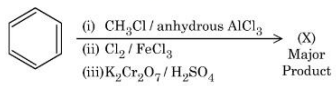
\(P\) g of the major product \((X)\) formed is reacted with \(NaHCO_3\) solution to liberate a gas which occupied \(11.2\) dm\(^3\) at STP. \(P = \) _____ g. (Given molar mass in g mol\(^{-1}\) H:\(1\), C:\(12\), O:\(16\), Cl:\(35.5\))JEE Mains 2026 Hard - The correct order of the rate of the reaction for the following reaction with respect to nucleophiles is: \(CH_{3}Br + Nu^{\ominus} \longrightarrow CH_{3}Nu + Br^{\ominus}\)JEE Mains 2026 Medium
- Which one of the following complexes will have \(\Delta_0=0\) and \(\mu=5.96\) B.M.?JEE Mains 2025 Easy
- Number of atoms in the following samples of substances is largest inJEE Mains 2013 Hard
- Which of the following statements are correct? \((A)\) The \(M ^{3+} / M ^{2+}\) reduction potential for iron is greater than manganese \((B)\) The higher oxidation states of first row \(d\) block elements get stabilized by oxide ion. \((C)\) Aqueous solution of \(Cr ^{2+}\) can liberate hydrogen from dilute acid. \((D)\) Magnetic moment of \(V ^{2+}\) is observed between \(4.4-5.2\,BM\) Choose the correct answer from the options given below:JEE Mains 2023 Hard
- Arrange in the correct order of stability (decreasing order) for the following molecules
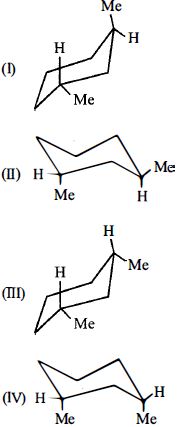 JEE Mains 2013 Hard
More PYQs from JEE Mains
- At \(320\,K,\) a gas \(A_2\) is \(20\%\) dissociated to \(A(g).\) The standard free energy change at \(320\,K\) and \(1\,atm\) in \(J\,mo1^{-1}\) is approximately \((R= 8.314\,\,JK^{-1}\,\,mol^{-1};\,\,ln\,2 = 0.693;\,\,ln\,3 = 1.098)\)JEE Mains 2018 Hard
- \(3-Methylhex-2-\)ene on reaction with \(\mathrm{HBr}\) in presence of peroxide forms an addition product \((A).\) The number of possible stereoisomers for ' \(\mathrm{A}\) ' is___________.JEE Mains 2024 Hard
- Number of ambidentate ligands among the following is _______.
\(NO _2^{-}, SCN ^{-}, C _2 O _4^{2-}, NH _3, CN ^{-}, SO _4^{2-}, H _2 O\).JEE Mains 2024 Medium - Two infinite planes each with uniform surface charge density \(+\sigma\) are kept in such a way that the angle between them is \(30^{\circ} .\) The electric field in the region shown between them is given by
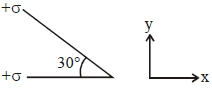 JEE Mains 2020 Medium
- Take the mean distance of the moon and the sun from the earth to be \(0.4 \times 10^6\,km\) and \(150 \times 10^6\,km\) respectively. Their masses are \(8 \times 10^{22}\, kg\) and \(2 \times 10^{30}\, kg\) respectively. The radius of the earth is \(6400\, km\). Let \(\Delta {F_1}\) be the difference in the forces exerted by the moon at the nearest and farthest points on the earth and \(\Delta {F_2}\) be the difference in the force exerted by the sun at the nearest and farthest points on the earth. Then, the number closest to \(\frac{{\Delta {F_1}}}{{\Delta {F_2}}}\) isJEE Mains 2018 Hard
- Select the compound from the following that will show intramolecular hydrogen bonding.JEE Mains 2024 Hard