


JEE Mains · Chemistry · STD 11 - Organic chemistry Nomenclature of organic compounds
- JEE Mains 2020
- Medium
- MCQ
Which of the following has the shortest \(C-Cl\) bond?
Pick an option to check your answer.
Answer & Solution
Correct Answer
(D) \(Cl-CH=CH-NO_2\)
Step-by-step Solution
Detailed explanation
Explanation:
Let us analyze the bond length of the given vinyl chloride derivatives step-by-step using electronic effects in organic chemistry:
1. Resonance in Vinylic Halides:
In all the given options, the chlorine atom is directly attached to an \(sp^2\) hybridized carbon atom belonging to a carbon-carbon double bond (\(C=C\)). The lone pairs of electrons on the chlorine atom can undergo delocalization with the adjacent pi-bond through resonance (mesomeric effect). This resonance introduces a partial double bond character into the \(C-Cl\) bond, making it shorter and stronger than a standard single bond.
2. Role of the Substituent Group:
The degree of partial double bond character depends heavily on the nature of the substituent group attached at the opposite end of the conjugated system.
Effect in Option D:
The nitro group (\(-NO_2\)) is a very strong electron-withdrawing group via the resonance (\(-M\)) effect. It pulls electron density away from the double bond, which strongly facilitates the push of electrons from the chlorine lone pair into the conjugated system.
Impact of Delocalization:
This extensive delocalization significantly enhances the stability and contribution of the resonating structure containing the \(C=Cl^+\) double bond.
3. Comparison:
Because the \(-M\) effect of the \(-NO_2\) group maximizes the double-bond character of the \(C-Cl\) linkage, it results in the greatest contraction of bond distance. In contrast, groups like \(-OCH_3\) (Option A) and \(-CH_3\) (Option B) are electron-donating and oppose this delocalization.
Therefore, \(Cl-CH=CH-NO_2\) has the shortest \(C-Cl\) bond length.
Hence, Option D is the correct choice.
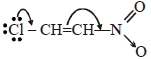
Let us analyze the bond length of the given vinyl chloride derivatives step-by-step using electronic effects in organic chemistry:
1. Resonance in Vinylic Halides:
In all the given options, the chlorine atom is directly attached to an \(sp^2\) hybridized carbon atom belonging to a carbon-carbon double bond (\(C=C\)). The lone pairs of electrons on the chlorine atom can undergo delocalization with the adjacent pi-bond through resonance (mesomeric effect). This resonance introduces a partial double bond character into the \(C-Cl\) bond, making it shorter and stronger than a standard single bond.
2. Role of the Substituent Group:
The degree of partial double bond character depends heavily on the nature of the substituent group attached at the opposite end of the conjugated system.
Effect in Option D:
The nitro group (\(-NO_2\)) is a very strong electron-withdrawing group via the resonance (\(-M\)) effect. It pulls electron density away from the double bond, which strongly facilitates the push of electrons from the chlorine lone pair into the conjugated system.
Impact of Delocalization:
This extensive delocalization significantly enhances the stability and contribution of the resonating structure containing the \(C=Cl^+\) double bond.
3. Comparison:
Because the \(-M\) effect of the \(-NO_2\) group maximizes the double-bond character of the \(C-Cl\) linkage, it results in the greatest contraction of bond distance. In contrast, groups like \(-OCH_3\) (Option A) and \(-CH_3\) (Option B) are electron-donating and oppose this delocalization.
Therefore, \(Cl-CH=CH-NO_2\) has the shortest \(C-Cl\) bond length.
Hence, Option D is the correct choice.
More questions from Chemistry
- Which of the following cannot be explained by crystal field theory?JEE Mains 2023 Hard
- The correct order of electron gain enthalpy isJEE Mains 2021 Easy
- The osmotic pressure exerted by a solution prepared by dissolving \(2.0\, g\) of protein of molar mass \(60\, kg\, mol ^{-1}\) in \(200\, mL\) of water at \(27^{\circ} C\) is \(.....Pa\). [integer value] (use \(R =0.083 L\,bar\,mol ^{-1}\, K ^{-1}\) )JEE Mains 2022 Easy
- \(A\) and \(B\) decompose via first order kinetics with half-lives \(54.0\, min\) and \(18.0\, min\) respectively. Starting from an equimolar non reactive mixture of \(A\) and \(B\), the time taken for the concentration of \(A\) to become \(16\) times that of \(B\) is ...... \(min.\) (Round off to the Nearest Integer).JEE Mains 2021 Medium
- Consider the following reactions : \((i)\) Glucose \(+ ROH \quad \stackrel{\text { dry } HCl }{\longrightarrow}\) Acetal \(\xrightarrow[{{{\left( {C{H_3}CO} \right)}_2}O}]{{x\,eq.of}}\) acetyl derivative \((ii)\) Glucose \(\xrightarrow{{Ni/{H_2}}}A\xrightarrow[{{{\left( {C{H_3}CO} \right)}_2}O}]{{y\,\,eq.\,of}}\) acetyl derivative. \((iii)\) Glucose \(\xrightarrow[{{{\left( {C{H_3}CO} \right)}_2}O}]{{z\,ed.\,of}}\) acetyl derivative. \(' x ^{\prime},{ }^{\prime} y ^{\prime}\) and \({ }^{\prime} z^{\prime}\) in these reactions are respectively.JEE Mains 2020 Hard
- Higher order \(( > 3)\) reactions are rare due to :JEE Mains 2015 Hard
More PYQs from JEE Mains
- The stopping potential \(V_0\) (in \(volt\)) as a function of frequency \((v)\) for a sodium emitter, is shown in the figure. The work function of sodium, from the data plotted in the figure, will be : ................. \(eV\) (Given : Planck's constant \((h) = 6.63 \times 10^{-34}\, Js\), electron charge \(e = 1.6 \times 10^{-19}\, C\))
 JEE Mains 2019 Medium
- Identify the correct statement among the following:JEE Mains 2025 Easy
- Given below are two statements :
Statement I: Aluminium upon reaction with NaOH forms \([Al(OH)_6]^{3-}\) ion.
Statement II: The geometry of \(ICl_4^-\), \(ClO_3^-\) and \(IBr_2^-\) is square planar, pyramidal and linear respectively.
In the light of the above statements, choose the correct answer from the options given below :JEE Mains 2026 Medium - In Carius method of estimation of halogen. \(0.45\,g\) of an organic compound gave \(0.36\,g\) of \(AgBr\). Find out the percentage of bromine in the compound.Molar masses : \(AgBr =188 g mol ^{-1}: Br =80 g mol ^{-1}\) )JEE Mains 2022 Medium
- The reaction \(2 NO + Br _2 \rightarrow 2 NOBr\) takes places through the mechanism given below : \(NO + Br _2 \Leftrightarrow NOBr _2 \text { (fast) }\) \(NOBr _2+ NO \rightarrow 2 NOBr \text { (slow) }\) The overall order of the reaction is \(.....\).JEE Mains 2023 Medium
- The sum of oxidation state of the metals in \(Fe ( CO )_5, VO ^{2+}\) and \(WO _3\) is \(.........\).JEE Mains 2023 Medium