


JEE Mains · Chemistry · STD 12 - Haloalkanes and Haloarenes
- JEE Mains 2026
- Medium
- MCQ
Given below are two statements :
Statement (I) : Benzyl chloride reacts faster in \(S_N1\) mechanism than ethyl chloride.
Statement (II) : Ethyl carbocation intermediate is less stabilized by hyperconjugation than benzyl carbocation by resonance.
In the light of the above statements, choose the correct answer from the options given below :
Pick an option to check your answer.
Answer & Solution
Correct Answer
(A) Both Statement I and Statement II are true
Step-by-step Solution
Detailed explanation
The rate of \(S_N1\) reaction depends on the stability of the carbocation intermediate formed during the rate-determining step.
Benzyl chloride undergoes ionization to form a benzyl carbocation (\(C_6H_5CH_2^+\)), whereas ethyl chloride forms an ethyl carbocation (\(CH_3CH_2^+\)). The benzyl carbocation is highly stabilized by the delocalization of the positive charge over the benzene ring through resonance. On the other hand, the ethyl carbocation is stabilized only by hyperconjugation involving three \(\alpha\)-hydrogens.
Since resonance provides significantly greater stabilization than hyperconjugation, the benzyl carbocation is much more stable than the ethyl carbocation. Consequently, benzyl chloride reacts faster in the \(S_N1\) mechanism than ethyl chloride. Thus, Statement I is true.
Statement II correctly explains that the ethyl carbocation intermediate is less stabilized by hyperconjugation compared to the resonance stabilization of the benzyl carbocation. Thus, Statement II is also true.
Both Statement I and Statement II are true.
Answer: Both Statement I and Statement II are true
More questions from Chemistry
- \(2\,L\) of \(0.2\,M H _{2} SO _{4}\) is reacted with \(2\,L\) of \(0.1\,M\) \(NaOH\) solution, the molarity of the resulting product \(Na _{2} SO _{4}\) in the solution is millimolar. (Nearest integer).JEE Mains 2022 Hard
- The increasing order of the boiling points for the following compounds is \(\mathop {{C_2}{H_5}OH}\limits_{\left( I \right)} \) \(\mathop {{C_2}{H_5}Cl}\limits_{\left( {II} \right)} \) \(\mathop {{C_2}{H_5}C{H_3}}\limits_{\left( {III} \right)} \) \(\mathop {{C_2}{H_5}OC{H_3}}\limits_{\left( {IV} \right)} \)JEE Mains 2017 Hard
- Which one of the following does not have a pyramidal shape?JEE Mains 2014 Hard
- Given below are two statements.
Statement I : The dipole moment of \(\stackrel{4}{\mathrm{CH}_3}-\stackrel{3~~~~}{\mathrm{CH}}=\stackrel{3~~~~}{\mathrm{CH}}-\stackrel{1~~~~}{\mathrm{CH}}=\mathrm{O}\) is greater than \(\stackrel{4}{\mathrm{CH}_3}-\stackrel{3}{\mathrm{CH}_2}-\stackrel{2}{\mathrm{CH}_2}-\stackrel{1}{\mathrm{CH}}=\mathrm{O}\)
Statement II : \(\mathbf{C}_1-\mathbf{C}_2\) bond length of \(\underset{4}{\mathrm{CH}_3-\mathrm{}} \underset{3}{\mathrm{CH=}} \underset{2}{\mathrm{CH}}-\mathrm{CH}=\mathrm{O}\) is greater than \(\mathrm{C}_1-\mathrm{C}_2\) bond length of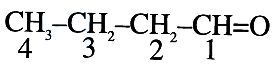
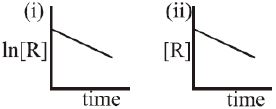
In the light of the above statements, choose the correct answer from the options given below:JEE Mains 2025 Medium - The given plots represent the variation of the concentration of a reactant \(R\) with time for two different reactions \((i)\) and \((ii).\) The respective orders of the reactions are
 JEE Mains 2019 Hard
- Number of ambidentate ligands among the following is _______.
\(NO _2^{-}, SCN ^{-}, C _2 O _4^{2-}, NH _3, CN ^{-}, SO _4^{2-}, H _2 O\).JEE Mains 2024 Medium
More PYQs from JEE Mains
- In a large building, there are \(15\) bulbs of \(40\ W\), \(5\) bulbs of \(100\ W, 5\) fans of \(80\ W\) and \(1\) heater of \(1\ kW\). The voltage of electric mains is \(220\ V\). The minimum capacity of the main fuse of the building will be ................ \(A\)JEE Mains 2014 Medium
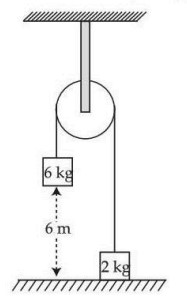
- The velocity at which \(6\) kg mass (shown in figure) strikes the ground when it is released from a height of \(6\) m above the ground is __________ m/s. Assume pulley is massless and string is light and inextensible. (Take g \(= 10\) m/s\(^2\))
 JEE Mains 2026 Medium
- Match List \(I\) with List \(II\)
Choose the correct answer from the options given below:List \(I\) Name of reaction List \(II\) Reagent used \(A\) Hell-Volhard-Zelinsky reaction \(I\) \(NaOH + I _2\) \(B\) Iodoform reaction \(II\) (i) \(CrO _2 Cl _2, CS _2\) (ii)\(H _2 O\) \(C\) Etard reaction \(III\) (i) \(Br _2 /\) red phosphorus (ii) \(H _2 O\) \(D\) Gatterman-Koch reaction \(IV\) \(CO , HCl\), anhyd.\(AlCl_3\) JEE Mains 2023 Medium -
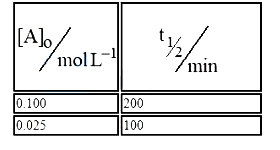
For a given reaction \(\mathrm{R} \rightarrow \mathrm{P}, \mathrm{t}_{1 / 2}\) is related to \([\mathrm{A}]_0\) as given in table.
Given: \(\log 2=0.30\)
Which of the following is true?
A. The order of the reaction is \(1 / 2\).
B. If \([\mathrm{A}]_0\) is 1 M , then \(\mathrm{t}_{1 / 2}\) is \(200 \sqrt{10} \mathrm{~min}\)
C. The order of the reaction changes to 1 if the concentration of reactant changes from 0.100 M to 0.500 M .
D. \(\mathrm{t}_{1 / 2}\) is 800 min for \([\mathrm{A}]_0=1.6 \mathrm{M}\)
Choose the correct answer from the options given below:JEE Mains 2025 Medium - Given below are two statements:
Statement (I) : for \(\mathrm{ClF}_3\), all three possible structures may be drawn as follows.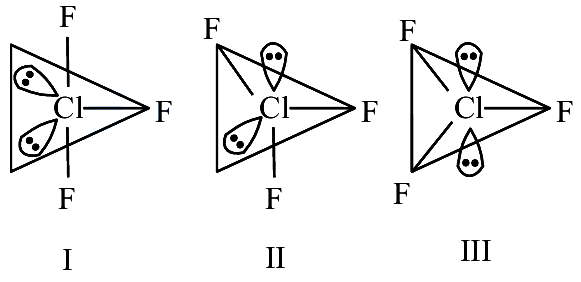
Statement (II) : Structure III is most stable, as the orbitals having the lone pairs are axial, where the \(\ell \mathrm{p}-\mathrm{bp}\) repulsion is minimum.
In the light of the above statements, choose the most appropriate answer from the options given below:JEE Mains 2025 Easy - A freshly prepared radioactive source of half life \(2\) hours \(30\) minutes emits radiation which is \(64\) times the permissible safe level. The minimum time, after which it would be possible to work safely with source, will be hours.JEE Mains 2022 Medium