


JEE Mains · Chemistry · STD 12 - 6. Haloalkanes and Haloarenes
An optically active alkyl bromide C\(_4\)H\(_9\)Br, reacts with ethanolic KOH to form major compound [A] which reacts with bromine to give compound [B]. Compound [B] reacts with ethanolic KOH and sodamide to give compound [C]. One molecule of water adds to compound [C] on warming with mercuric sulphate and dilute sulphuric acid at \(333\) K to form compound [D]. The functional group in compound D will be confirmed by :
- A Haloform test
- B Lucas test
- C Silver mirror test
- D Benedict test
Answer & Solution
Correct Answer
(A) Haloform test
Step-by-step Solution
Detailed explanation
The optically active alkyl bromide \(\text{C}_4\text{H}_9\text{Br}\) is \(2\)-bromobutane, \(\text{CH}_3\text{CH}(\text{Br})\text{CH}_2\text{CH}_3\). Reaction with ethanolic \(\text{KOH}\) undergoes dehydrohalogenation to form but-\(2\)-ene as the major product [A] (Zaitsev's…
See the Complete Solution
Get step-by-step explanations for this and 2.5 Lakh+ more JEE, NEET & CET questions.
- Unlock all solutions
- Practice the full chapter
- Track accuracy across PYQs
4.8 rated on Google Play · 14,000+ reviews
More questions from Chemistry
- Consider the following reaction \(N _{2} O _{4}( g ) \rightleftharpoons 2 NO _{2}( g ) ; \Delta H ^{0}=+58 kJ\) For each of the following cases \((a, b),\) the direction in which the equilibrium shifts is: \((a)\) Temperature is decreased \((b)\) Pressure is increased by adding \(N _{2}\) at constant \(T\)JEE Mains 2020 Medium
- Consider the following molecules :
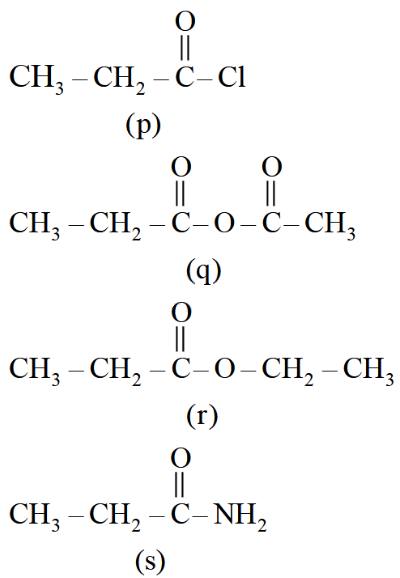
The correct order of rate of hydrolysis is _______.JEE Mains 2025 Medium - \(100\, \mathrm{~mL}\) of \(\mathrm{Na}_{3} \mathrm{PO}_{4}\) solution contains \(3.45\, \mathrm{~g}\) of sodium. The molarity of the solution is \(.....\times 10^{-2}\) \(\operatorname{mol} \,\mathrm{L}^{-1} \cdot(\) Nearest integer \()\) [Atomic Masses - \(\mathrm{Na}: 23.0\, \mathrm{u}, \mathrm{O}: 16.0\, \mathrm{u}, \mathrm{P}: 31.0 \,\mathrm{u}]\)JEE Mains 2021 Medium
- The elements with atomic numbers \(101\) and \(104\) belong to, respectivelyJEE Mains 2020 Medium
- Amongst the following statements, that which was not proposed by Dalton wasJEE Mains 2020 Medium
- For the given cell
\(\mathrm{Fe}^{2+}{ }_{(\mathrm{aq})}+\mathrm{Ag}^{+}{ }_{(\mathrm{aq})} \rightarrow \mathrm{Fe}_{(\mathrm{aq})}^{3+}+\mathrm{Ag}_{(\mathrm{s})}\)
The standard cell potential of the above reaction is Given:
\(\begin{array}{lr}
\mathrm{Ag}^{+}+\mathrm{e}^{-} \rightarrow \mathrm{Ag} & \mathrm{E}^\theta=\mathrm{xV} \\
\mathrm{Fe}^{2+}+2 \mathrm{e}^{-} \rightarrow \mathrm{Fe} & \mathrm{E}^\theta=\mathrm{yV} \\
\mathrm{Fe}^{3+}+3 \mathrm{e}^{-} \rightarrow \mathrm{Fe} & \mathrm{E}^\theta=\mathrm{zV}
\end{array}\)JEE Mains 2025 Medium
More PYQs from JEE Mains
- Let \((\alpha, \beta, \gamma)\) be the point \((8,5,7)\) in the line \(\frac{x-1}{2}=\frac{y+1}{3}=\frac{z-2}{5}\). Then \(\alpha+\beta+\gamma\) is equal toJEE Mains 2024 Hard
- \(250\, \mathrm{~mL}\) of \(0.5\, \mathrm{M}\, \mathrm{NaOH}\) was added to \(500\, \mathrm{~mL}\) of \(1\, \mathrm{M}\, \mathrm{HCl}\) The number of unreacted \(\mathrm{HCl}\) molecules in the solution after complete reaction is \(......\,\times 10^{21}\). (Nearest integer) \(\left(\mathrm{N}_{\mathrm{A}}=6.022 \times 10^{23}\right)\)JEE Mains 2021 Hard
- For the given reaction:
\(CaCO_{3} + 2HCl \to CaCl_{2} + H_{2}O + CO_{2}\)
If 90 g \(CaCO_{3}\) is added to 300 mL of HCl which contains 38.55% HCl by mass and has density \(1.13 g mL^{-1}\) then which of the following option is correct?
[Given molar mass of H, Cl, Ca and O are 1, 35.5, 40 and \(16 g mol^{-1}\) respectively]JEE Mains 2026 Easy - Two point charges \(8 \, \mu C\) and \(-2 \, \mu C\) are located at \(x = 2\) cm and \(x = 4\) cm, respectively on the \(x\)-axis. The ratio of electric flux due to these charges through two spheres of radii \(3\) cm and \(5\) cm with their centers at the origin is _______.JEE Mains 2026 Medium
- If \(\left[ Cu \left( H _{2} O \right)_{4}\right]^{2+}\) absorbs a light of wavelength \(600\) \(nm\) for \(d - d\) transition, then the value of octahedral crystal field splitting energy for \(\left[ Cu \left( H _{2} O \right)_{6}\right]^{2+}\) will be \(.....\,\times 10^{-21}\, J\). (Nearest Integer) (Given : \(h =6.63 \times 10^{-34} \,Js\) and \(c =3.08 \times 10^{8} \,ms ^{-1}\) )JEE Mains 2022 Hard
- Given \(C_{(graphite)} +O_2(g) \rightarrow CO_2(g)\,;\) \(\Delta _rH^o=-395.5 \, kJ\,mol^{-1}\) \(H_2 (g) + \frac{1}{2} O_2 (g) \rightarrow H_2O(l)\,;\) \(\Delta _rH^o =-285.8\, kJ\, mol^{-1}\) \(CO_2(g) + 2H_2O(l) \rightarrow CH_4(g) + 2O_2(g)\,;\) \(\Delta _rH^o = + 890.3\, kJ\, mol^{-1}\) Based on the above thermochemical equations, the value of, \(\Delta _rH^o \) at \(298\, K\) for the reaction \(C_{(graphite)} + 2H_2(g) \rightarrow CH_4(g) \) will be for \(\Delta_{r} H^{\circ}\) ........... \(kJ \,mol^{-1}\)JEE Mains 2017 Hard