


JEE Mains · Chemistry · STD 12 - Haloalkanes and Haloarenes
- JEE Mains 2026
- Hard
- MCQ
Given below are two statements:
Statement I: \(3\)-phenylpropene reacts with HBr and gives secondary alkyl bromide having a chiral carbon atom as the major product.
Statement II: Aryl chlorides and aryl cyanides can be prepared by Sandmeyer reaction as well as Gattermann reaction.
In the light of the above statements, choose the correct answer from the options given below
Pick an option to check your answer.
Answer & Solution
Correct Answer
(C) Statement I is true but Statement II is false
Step-by-step Solution
Detailed explanation
Statement I:
When \(3\)-phenylpropene reacts with \(HBr\), protonation of the alkene occurs to form a secondary carbocation.
\(C_6H_5-CH_2-CH=CH_2 + H^+ \rightarrow C_6H_5-CH_2-CH^+-CH_3\)
This secondary carbocation undergoes a \(1,2\)-hydride shift to form a more stable, resonance-stabilized benzylic carbocation.
\(C_6H_5-CH_2-CH^+-CH_3 \rightarrow C_6H_5-CH^+-CH_2-CH_3\)
The bromide ion then attacks this benzylic carbocation to form the major product, \(1\)-bromo-\(1\)-phenylpropane.
\(C_6H_5-CH^+-CH_2-CH_3 + Br^- \rightarrow C_6H_5-CH(Br)-CH_2-CH_3\)
The carbon atom bonded to the bromine is attached to four different groups: a phenyl group (\(-C_6H_5\)), an ethyl group (\(-CH_2CH_3\)), a hydrogen atom (\(-H\)), and a bromine atom (\(-Br\)). Thus, it is a chiral carbon. The product is a secondary alkyl bromide. Therefore, Statement I is true.
Statement II:
The Sandmeyer reaction involves treating a diazonium salt with \(Cu(I)\) salts (\(CuCl\), \(CuBr\), \(CuCN\)) to prepare aryl chlorides, aryl bromides, and aryl cyanides, respectively.
The Gattermann reaction involves treating a diazonium salt with copper powder (\(Cu\)) and halogen acids (\(HCl\), \(HBr\)) to prepare aryl chlorides and aryl bromides. Aryl cyanides are not prepared using the Gattermann reaction. Therefore, Statement II is false.
Conclusion: Statement I is true but Statement II is false.
Answer: Statement I is true but Statement II is false
More questions from Chemistry
- Calculate the standard cell potential (in \(V\)) of the cell in which following reaction takes place \(F{e^2}+ \left( {aq} \right) + A{g^ + }\left( {aq} \right) \to F{e^{3 + }}\left( {aq} \right) + Ag\left( s \right)\) Given that:
\(E_{Ag^+/Ag}^o = xV\)
\(E_{F{e^{2 + }}/Fe}^o = yV\)
\(E_{F{e^{3 + }}/Fe}^o = zV\)JEE Mains 2019 Hard - Williamson synthesis of ether is an example ofJEE Mains 2014 Hard
- The major product of the following reaction is \(\,\begin{array}{*{20}{c}}
{C{H_3} - CH - C{H_2} - CH - C{H_2} - C{H_3}}\\
{\,\,\,\,\,\,\,\,\,\,\,\,\,\,\,\,\,\,\,\,\,\,\,\,\,\,\,\,\,\,|\,\,\,\,\,\,\,\,\,\,\,\,\,\,\,\,\,\,\,\,\,\,\,\,\,\,\,\,\,\,\,\,\,\,\,|\,\,\,\,\,\,\,\,\,\,\,\,\,\,\,\,\,\,\,\,\,\,\,\,\,\,\,\,\,\,\,\,\,\,\,\,\,\,\,\,\,\,\,\,\,\,\,\,\,\,\,\,}\\
{\,\,\,\,\,\,\,\,\,Br\,\,\,\,\,\,\,\,\,\,\,\,\,\,\,\,\,\,\,\,\,\,\,\,\,\,\,\,\,\,\,Br\,\,\,\,\,\,\,\,\,\,\,\,\,\,\,\,\,\,\,\,\,\,\,\,\,\,\,\,\,\,}
\end{array}\) \(\xrightarrow[{heat}]{{KOH,\,C{H_3}OH}}\)JEE Mains 2017 Hard - Number of \(\mathrm{Cl}=\mathrm{O}\) bonds in chlorous acid, chloric acid and perchloric acid respectively are :JEE Mains 2021 Medium
-
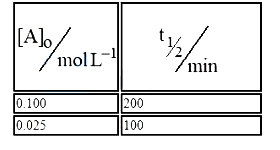
For a given reaction \(\mathrm{R} \rightarrow \mathrm{P}, \mathrm{t}_{1 / 2}\) is related to \([\mathrm{A}]_0\) as given in table.
Given: \(\log 2=0.30\)
Which of the following is true?
A. The order of the reaction is \(1 / 2\).
B. If \([\mathrm{A}]_0\) is 1 M , then \(\mathrm{t}_{1 / 2}\) is \(200 \sqrt{10} \mathrm{~min}\)
C. The order of the reaction changes to 1 if the concentration of reactant changes from 0.100 M to 0.500 M .
D. \(\mathrm{t}_{1 / 2}\) is 800 min for \([\mathrm{A}]_0=1.6 \mathrm{M}\)
Choose the correct answer from the options given below:JEE Mains 2025 Medium - \(0.01\, M\, KMnO _{4}\) solution was added to \(20.0\, mL\) of \(0.05\, M\) Mohr's salt solution through a burette. The initial reading of \(50\, mL\) burette is zero. The volume of \(KMnO _{4}\) solution left in the burette after the end point is \(.....\,mL\). (nearest integer)JEE Mains 2022 Medium
More PYQs from JEE Mains
- In a plane \(EM\) wave, the electric field oscillates sinusoidally at a frequency of \(5 \times 10^{10} \mathrm{~Hz}\) and an amplitude of \(50 \mathrm{Vm}^{-1}\). The total average energy density of the electromagnetic field of the wave is _______. [Use \(\varepsilon_0=8.85 \times 10^{-12} \mathrm{C}^2 / \mathrm{Nm}^2\) ]JEE Mains 2024 Hard
- If a copper wire is stretched to increase its length by \(20 \% \). The percentage increase in resistance of the wire is \(..........\%\)JEE Mains 2023 Medium
- A simple pendulum oscillating in air has period \(T.\) The bob of the pendulum is completely immersed in a non-viscous liquid. The density of the liquid is \(\frac {1}{16}\) of the material of the bob. If the bob is inside liquid all the time, its period of oscillation in this liquid isJEE Mains 2019 Hard
- A car is moving on a horizontal curved road with radius \(50\,m\). The approximate maximum speed of car will be \(............\,ms^{-1}\), if friction between tyres and road is \(0.34.\left[\right.\) Take \(\left.g =10 ms ^{-2}\right]\)JEE Mains 2023 Medium
- The functional groups that are responsible for the ion-exchange property of cation and anion exchange resins, respectively, are :JEE Mains 2021 Medium
- The highest industrial consumption of molecular hydrogen is to produce compounds of element ...... .JEE Mains 2022 Easy