


JEE Mains · Chemistry · STD 12 - Haloalkanes and Haloarenes
- JEE Mains 2023
- Hard
- Numerical
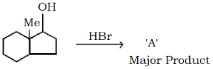
The number of hyperconjugation structures involved to stabilize carbocation formed in the above reaction is \(.............\).
Pick an option to check your answer.
Answer & Solution
Correct Answer
(A) \(6\)
Step-by-step Solution
Detailed explanation
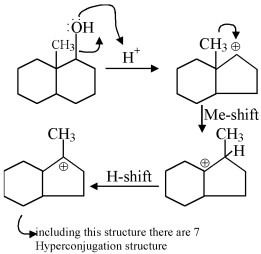
Let's analyze the step-by-step carbocation rearrangement mechanism for the given reaction:
1. Initial Carbocation Formation: Protonation of the alcohol (\( -\text{OH} \)) group followed by the loss of a water molecule (\( \text{H}_2\text{O} \)) forms a secondary (\( 2^\circ \)) carbocation on the 5-membered ring.
2. 1,2-Methyl Shift: To increase stability, the methyl group (\( -\text{CH}_3 \)) on the bridgehead carbon undergoes a 1,2-shift to the adjacent positive carbon. This creates a highly stable tertiary (\( 3^\circ \)) carbocation at the bridgehead position.
Counting Alpha-Hydrogens (\( \alpha \)-H):
For this stable tertiary carbocation, the adjacent (\( \alpha \)) positions relative to the positive charge are:
- The neighboring \( \text{-CH}_2- \) group in the 5-membered ring: contains 2 \( \alpha \)-hydrogens.
- The neighboring \( \text{-CH}_2- \) group in the 6-membered ring: contains 2 \( \alpha \)-hydrogens.
- The adjacent bridgehead \( \text{-CH}- \) carbon: contains 1 \( \alpha \)-hydrogen.
Total number of \( \alpha \)-hydrogens = \( 2 + 2 + 1 = 5 \).
Total Hyperconjugation Structures:
The total number of hyperconjugation structures is given by the formula:
Total structures = \( \text{Number of } \alpha\text{-hydrogens} + 1 \) (including the parent contributing structure).
Total structures = \( 5 + 1 = 6 \).
Therefore, Option A is the correct answer.
More questions from Chemistry
- The correct combination isJEE Mains 2018 Hard
- Match List - I with List - II.
Choose the correct answer from the options given\(\text{ }\)below\(\text{ }\):List - I (Carbohydrate) List - II (Linkage Source) (A) Amylose (I) \(\beta-C_1-C_4 \text {, plant }\) (B) Cellulose (II) \(\alpha-C_1-C_4, \text { animal }\) (C) Glycogen (III) \(\alpha-C_1-C_4, \alpha-C_1-C_6, \text { plant }\) (D) Amylopectin (IV) \(\alpha-C_1-C_4, \text { plant }\) JEE Mains 2025 Medium - \(20\text{ g}\) hemoglobin in a \(1\text{ L}\) aqueous solution (A) at \(300\text{ K}\) is separated from pure water by semi permeable membrane. At equilibrium the height of solution in a tube dipped in a solution (A) is found to be \(80.0\text{ mm}\) higher than the tube dipped in water. The molar mass of hemoglobin is _______ \(\text{kg mol}^{-1}\). (Nearest integer)
(Given : \(g = 10\text{ m s}^{-2}\), \(R = 8.3\text{ kPa dm}^3\text{ K}^{-1}\text{mol}^{-1}\), density of solution \(= 1000\text{ kg m}^{-3}\))JEE Mains 2026 Hard - Number of elements from the following that \(CANNOT\) form compounds with valencies which match with their respective group valencies is _______. \(B, C, N, S, O, F, P, Al, Si\)JEE Mains 2024 Medium
- \(2 \mathrm{SO}_{2}(\mathrm{~g})+\mathrm{O}_{2}(\mathrm{~g}) \rightleftharpoons 2 \mathrm{SO}_{3}(\mathrm{~g})\) In an equilibrium mixture, the partial pressures are \(P_{S O_{3}}=43\,\mathrm{kPa} ; \quad P_{O_{2}}=530 \,\mathrm{~Pa}\) and \(\mathrm{P}_{\mathrm{SO}_{2}}=45\, \mathrm{kPa}\) The equilibrium constant \(\mathrm{K}_{\mathrm{p}}=......\times 10^{-2} .\) (Nearest integer)JEE Mains 2021 Medium
- \(20 \%\) of acetic acid is dissociated when its \(5\,g\) is added to \(500\,mL\) of water. The depression in freezing point of such water is \(.....\times 10^{-3} \;{ }^{\circ} C\). Atomic mass of \(C , H\) and \(O\) are \(12,1\) and \(16\,a.m.u.\) respectively. [Given : Molal depression constant and density of water are \(1.86\, K\, kg\, mol^{-1}\) and \(1\, g\, cm^{-3}\) respectively.]JEE Mains 2023 Medium
More PYQs from JEE Mains
- The density of \(\mathrm{NaOH}\) solution is \(1.2 \mathrm{gcm}^{-3} .\) The molality of this solution is \(....\,m\) (Round off to the NearestInteger) [Use:Atomicmasses:\(Na:23.0\,u \mathrm{O}: 16.0 \,\mathrm{u} \quad \mathrm{H}: 1.0 \,\mathrm{u}\), Density of \(\mathrm{H}_{2} \mathrm{O}: 1.0 \,\mathrm{~g} \,\mathrm{~cm}^{-3}\) ]JEE Mains 2021 Medium
- One mole of an ideal monoatomic gas is compressed isothermally in a rigid vessel to double its pressure at room temperature, \(27\,^oC\).The work done on the gas will beJEE Mains 2018 Medium
- Given below are two statements: one is labelled as Assertion \((A)\) and the other is labelled as Reason \((R)\). Assertion \((A)\): Cis form of alkene is found to be more polar than the trans form Reason \((R)\): Dipole moment of trans isomer of \(2\)-butene is zero. In the light of the above statements, choose the correct answer from the options given below :JEE Mains 2024 Medium
- At \(298\, K\), the standard reduction potentials are \(1.51\, V\) for \(MnO_4^ - \,|\,M{n^{2 + }}\), \(1.36\, V\) for \(C{l_2}\,|\,C{l^ - }\), \(1.07\, V\) for \(B{r_2}\,|\,B{r^ - }\) and \(0.54\, V\) for \({I_2}\,|\,{I^ - }\). At \(pH\, = 3\) , permanganate is expected to oxidize \(\left( {\frac{{RT}}{F} = 0.059\,V} \right)\)JEE Mains 2015 Hard
- At an angle of \(30^{\circ}\) to the magnetic meridian, the apparent dip is \(45^{\circ} .\) Find the true dip :JEE Mains 2021 Medium
- A particular hydrogen like ion emits radiation of frequency \(2.92 \times 10^{15}\, {Hz}\) when it makes transition from \({n}=3\) to \({n}=1 .\) The frequency in \({Hz}\) of radiation emitted in transition from \({n}=2\) to \({n}=1\) will be : (in \(\,\times 10^{15}\))JEE Mains 2021 Medium