


JEE Mains · Chemistry · STD 12 - 6. Haloalkanes and Haloarenes
Decreasing order towards \(S_N 1\) reaction for the following compounds is:
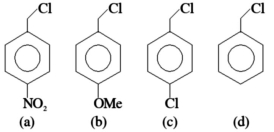
- A \(a > c > d > b\)
- B \(a > b > c > d\)
- C \(b > d > c > a\)
- D \(d > b > c > a\)
Answer & Solution
Correct Answer
(C) \(b > d > c > a\)
Step-by-step Solution
Detailed explanation
The rate of \(S_N 1\) reaction depends upon stability of carbocation which follows the order \(\therefore\) Reactivity order \((b) > (d) > (c) > (a)\)
See the Complete Solution
Get step-by-step explanations for this and 2.5 Lakh+ more JEE, NEET & CET questions.
- Unlock all solutions
- Practice the full chapter
- Track accuracy across PYQs
4.8 rated on Google Play · 14,000+ reviews
More questions from Chemistry
- The correct order in aqueous medium of basic strength in case of methyl substituted amines is :JEE Mains 2023 Medium
- For water \(\Delta_{\text {vap }} \mathrm{H}=41 \mathrm{~kJ} \mathrm{~mol}^{-1}\) at \(373 \mathrm{~K}\) and 1 bar pressure. Assuming that water vapour is an ideal gas that occupies a much larger volume than liquid water, the internal energy change during evaporation of water is \(...... \mathrm{kJ}\, \mathrm{mol}^{-1}\) [Use: \(\left.\mathrm{R}=8.3 \,\mathrm{~J} \,\mathrm{~mol}^{-1}\, \mathrm{~K}^{-1}\right]\)JEE Mains 2021 Medium
- The compounds that produce \(CO _2\) with aqueous \(NaHCO _3\) solution are _______.
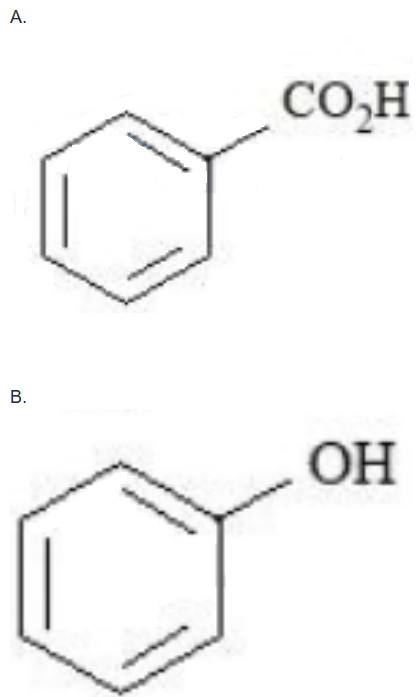 \(\qquad\)\(\qquad\)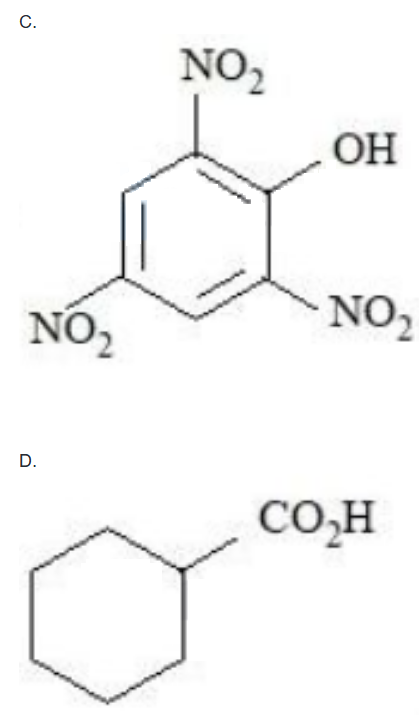
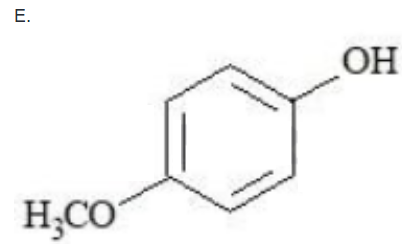
Choose the correct answer from the options given below:JEE Mains 2025 Medium - Given below are two statements: Statement \(I:\) \(\left[\mathrm{Mn}(\mathrm{CN})_{6}\right]^{3-},\left[\mathrm{Fe}(\mathrm{CN})_{6}\right]^{3-}\) and \(\left[\mathrm{Co}\left(\mathrm{C}_{2} \mathrm{O}_{4}\right)_{3}\right]^{3-}\) are \(d^{2} \mathrm{sp}^{3}\) hybridised. Statement \(II:\) \(\left[\mathrm{MnCl}_{6}\right]^{3-}\) and \(\left[\mathrm{FeF}_{6}\right]^{3-}\) are paramagnetic and have \(4\) and \(5\) unpaired electrons, respectively. In the light of the above statements, choose the coorrect answer from the options given below :JEE Mains 2021 Hard
- The overall stability constant of the complex ion \(\left[\mathrm{Cu}\left(\mathrm{NH}_{3}\right)_{4}\right]^{2+}\) is \(2.1 \times 10^{13} . \quad\) The overall dissociations constant is \(\mathrm{y} \times 10^{-14}\). Then y is ....... .(Nearest integer)JEE Mains 2021 Easy
- In an acid -base titration, \(0.1\, M\, HCl\) solution was added to the \(NaOH\) solution of unknown strength. Which of the following correctly shows the change of \(pH\) of the titration mixture in this experiment?
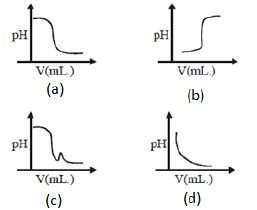 JEE Mains 2019 Medium
More PYQs from JEE Mains
- The greatest value of \(c \in R\) for which the system of linear equations \(x - cy - cz = 0 \,\,;\,\, cx - y + cz = 0 \,\,;\,\, cx + cy - z = 0 \) has a non -trivial solution, isJEE Mains 2019 Hard
- The magnetic field of an electromagnetic wave is given by \(\vec B = 1.6 \times {10^{ - 6}}\,\cos \,\left( {2 \times {{10}^7}z + 6 \times {{10}^{15}}t} \right)\left( {2\hat i + \hat j} \right)\frac{{Wb}}{{{m^2}}}\) The associated electric field will beJEE Mains 2019 Medium
- Glycosidic linkage between \(C _{1}\) of \(\alpha\)-glucose and \(C _{2}\) of \(\beta\)-fructose is found in.JEE Mains 2022 Medium
- Consider the following equilibrium, \(\mathrm{CO}(\mathrm{g})+2 \mathrm{H}_2(\mathrm{g}) \rightleftharpoons \mathrm{CH}_3 \mathrm{OH}(\mathrm{g})\) 0.1 mol of CO along with a catalyst is present in a \(2 \mathrm{dm}^3\) flask maintained at 500 K. Hydrogen is introduced into the flask until the pressure is 5 bar and 0.04 mol of \(\mathrm{CH}_3 \mathrm{OH}\) is formed. The \(\mathrm{K}_{\mathrm{p}}^0\) is ______ \(\times 10^{-3}\) (nearest integer).
Given : \(\mathrm{R}=0.08 \mathrm{dm}^3\) bar \(\mathrm{K}^{-1} \mathrm{~mol}^{-1}\)
Assume only methanol is formed as the product and the system follows ideal gas behaviour.JEE Mains 2025 Medium - Which statement is not true with respect to nitrate ion test ?JEE Mains 2022 Easy
- Let two straight lines drawn from the origin \(O\) intersect the line \(3 x+4 y=12\) at the points \(P\) and \(\mathrm{Q}\) such that \(\triangle \mathrm{OPQ}\) is an isosceles triangle and \(\angle \mathrm{POQ}=90^{\circ}\). If \(l=\mathrm{OP}^2+\mathrm{PQ}^2+\mathrm{QO}^2\), then the greatest integer less than or equal to \(l\) is :JEE Mains 2024 Hard