


JEE Mains · Chemistry · STD 12 - Electrochemistry
- JEE Mains 2021
- Hard
- Numerical
A \(5.0\, m mol dm ^{-3}\) aqueous solution of \(KCl\) has a conductance of \(0.55\, mS\) when measured in a cell constant \(1.3 \,cm ^{-1}\). The molar conductivity of this solution is ....... \(mSm ^{2}\, mol ^{-1}\). (Round off to the Nearest Integer)
Pick an option to check your answer.
Answer & Solution
Correct Answer
(C) \(143\)
Step-by-step Solution
Detailed explanation
Given conc \(^{\text {n }}\) of \(KCl =\frac{ m . mol }{ L }\)
: Conductance \(( G )=0.55 mS\)
: Cell constant \(\left(\frac{\ell}{ A }\right)=1.3 cm ^{-1}\)
To Calculate : Molar conductivity \(\left(\lambda_{ m }\right)\) of sol.
\(\rightarrow\) Since \(\lambda_{ m }=\frac{1}{1000} \times \frac{ k }{ m }\)
\(\rightarrow\) Molarity \(=5 \times 10^{-3} \frac{ mol }{ L }\)
\(\rightarrow\) Conductivity \(= G \times\left(\frac{\ell}{ A }\right)=0.55 \,mS \times \frac{1.3}{\frac{1}{100}} \,m ^{-1}\)
\(=55 \times 1.3 \, mSm ^{-1}\)
eq \(^{ n }(1) \,{\lambda_{ m }}=\frac{1}{1000} \times \frac{55 \times 1.3}{\left(\frac{5}{1000}\right)} \frac{ mSm ^{2}}{ mol }\)
\(\Rightarrow \lambda_{ m }=14.3 \, \frac{ mSm ^{2}}{ mol }\)
More questions from Chemistry
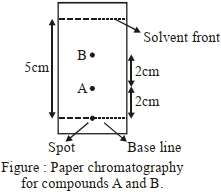
- Using the provided information in the following paper chromatogram the calculate \(R _{ f }\) value of \(A\) .......... \(\times 10^{-1}\)
 JEE Mains 2021 Medium
- Given \(XNa_2HAsO_3 + YNaBrO_3 + ZHCl \longrightarrow\) \(NaBr + H_3AsO_4 + NaCl\) The values of \(X, Y\) and \(Z\) in the above redox reaction are respectivelyJEE Mains 2013 Medium
- The metal that shows highest and maximum number of oxidation state is _______.JEE Mains 2024 Medium
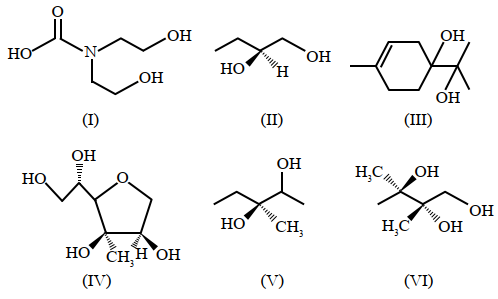
- From the following, how many compounds contain at least one secondary alcohol ?
Choose the correct answer from the options given below :JEE Mains 2026 Easy - The correct order of increasing intermolecular hydrogen bond strength is .... .JEE Mains 2022 Easy
- Reagent, \(1 -\)naphthylamine and sulphanilic acid in acetic acid is used for the detection ofJEE Mains 2021 Medium
More PYQs from JEE Mains
- The wavelength of the radiation emitted is \(\lambda_0\) when an electron jumps from the second excited state to the first excited state of hydrogen atom. If the electron jumps from the third excited state to the second orbit of the hydrogen atom, the wavelength of the radiation emitted will be \(\frac{20}{x} \lambda_0\). The value of \(x\) is \(........\)JEE Mains 2023 Medium
- The density and breaking stress of a wire are \(6 \times\) \(10^4 \mathrm{~kg} / \mathrm{m}^3\) and \(1.2 \times 10^8 \mathrm{~N} / \mathrm{m}^2\) respectively. The wire is suspended from a rigid support on a planet where acceleration due to gravity is \(\frac{1^{\text {rd }}}{3}\) of the value on the surface of earth. The maximum length of the wire with breaking is _______ \(\mathrm{m}\) (take, \(\mathrm{g}=\) \(\left.10 \mathrm{~m} / \mathrm{s}^2\right)\)JEE Mains 2024 Hard
- The magnetic field of a plane electromagnetic wave is given by \(\overrightarrow{ B }=2 \times 10^{-8} \sin \left(0.5 \times 10^{3} x +1.5 \times 10^{11} t \right) \hat{ j } T\) The amplitude of the electric field would be.JEE Mains 2022 Medium
- Consider the reaction \(aX \rightarrow bY\), for which the rate constant at \(30°C\) is \(1 \times 10^{-3}\) mol\(^{-1}\) L s\(^{-1}\). Which of the following statements are true?
A. When concentration of 'X' is increased to four times, the rate of reaction becomes \(16\) times.
B. The reaction is a second order reaction.
C. The half-life period is independent of the concentration of X.
D. Decomposition of \(N_2 O_5\) is an example of the above reaction.
E. \(\ln\dfrac{[R_o]}{[R]}\) vs time is valid for the above reaction.
Choose the correct answer from the options given below:JEE Mains 2026 Medium - An aluminium rod with Young's modulus \(Y =7.0\) \(\times 10^{10} N / m ^2\) undergoes elastic strain of \(0.04 \%\). The energy per unit volume stored in the rod in SI unit is:JEE Mains 2023 Easy
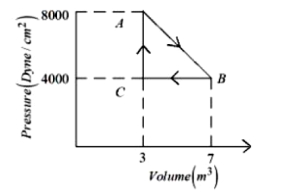
- A thermodynamic system is taken from an original state \(A\) to an intermediate state \(B\) by a linear process as shown in the figure. It's volume is then reduced to the original value from \(B\) to \(C\) by an isobaric process. The total work done by the gas from \(A\) to \(B\) and \(B\) to \(C\) would be :
 JEE Mains 2024 Hard