


JEE Mains · Chemistry · STD 12 - Electrochemistry
- JEE Mains 2021
- Hard
- Numerical
Copper reduces \(NO _{3}^{-}\) into \(NO\) and \(NO _{2}\) depending uponthe concentration of \(HNO _{3}\) insolution. (Assuming fixed \(\left[ Cu ^{2+}\right]\) and \(\left. P _{ NO }= P _{ NO _{2}}\right),\) the \(HNO _{3}\) concentration at which the thermodynamic tendency for reduction of \(NO _{3}^{-}\) into \(NO\) and \(NO _{2}\) by copper is same is \(10^{ x }\, M\). The value of \(2 x\) is ...... . \(\left[\right.\) Given \(, E_{C u^{2+} / C u}^{o}=0.34\, V , E _{ NO _{3}^{-} / NO_2 }^{\circ}=0.96\, V\) (Rounded-off to the nearest integer) \(E _{ NO _{3} / NO _{2}}^{\circ}=0.79 \,V\) and at \(298 \,K\) \(\left.\frac{ RT }{ F }(2.303)=0.059\right]\)
Pick an option to check your answer.
Answer & Solution
Correct Answer
(D) \(4\)
Step-by-step Solution
Detailed explanation
Explanation:
Let us determine the value of \(2x\) step-by-step using the Nernst equation from the Electrochemistry chapter of the NCERT Class 12 Chemistry textbook:
Step 1: Write down the half-cell reduction reactions
The two reduction processes taking place at the cathode are:
Reaction 1: Reduction of \(\text{NO}_3^-\) to \(\text{NO}\)
\(\text{NO}_3^- + 4\text{H}^+ + 3\text{e}^- \rightarrow \text{NO} + 2\text{H}_2\text{O}\), \(E^\circ_1 = 0.96\text{ V}\)
Reaction 2: Reduction of \(\text{NO}_3^-\) to \(\text{NO}_2\)
\(\text{NO}_3^- + 2\text{H}^+ + \text{e}^- \rightarrow \text{NO}_2 + \text{H}_2\text{O}\), \(E^\circ_2 = 0.79\text{ V}\)
Step 2: Relate thermodynamic tendency to reduction potentials
The thermodynamic tendency for reduction by copper is identical when the cell EMF values (\(E_{\text{cell}}\)) for both processes are equal. Since the oxidation half-cell (copper anode) is fixed and identical for both reactions, their reduction potentials at the cathode must be equal:
\(E_1 = E_2\)
Step 3: Define concentration terms for \(\text{HNO}_3\)
Since \(\text{HNO}_3\) is a strong acid, it dissociates completely in solution:
\(\text{HNO}_3 \rightarrow \text{H}^+ + \text{NO}_3^-\)
Let the molar concentration of \(\text{HNO}_3\) be \(C\). Thus:
\([\text{H}^+] = C\) and \([\text{NO}_3^-] = C\)
Step 4: Apply Nernst Equation
Using Nernst equation at \(298\text{ K}\) with \(\frac{2.303RT}{F} = 0.059\text{ V}\), and assuming \(P_{\text{NO}} = P_{\text{NO}_2} = 1\text{ bar}\):
For Reaction 1:
\(E_1 = E^\circ_1 - \frac{0.059}{3} \log \left(\frac{1}{[\text{NO}_3^-][\text{H}^+]^4}\right) = 0.96 + \frac{0.059}{3} \log \left([\text{NO}_3^-][\text{H}^+]^4\right)\)
\(E_1 = 0.96 + \frac{0.059}{3} \log (C \cdot C^4) = 0.96 + \frac{0.295}{3} \log C\)
For Reaction 2:
\(E_2 = E^\circ_2 - \frac{0.059}{1} \log \left(\frac{1}{[\text{NO}_3^-][\text{H}^+]^2}\right) = 0.79 + \frac{0.059}{1} \log \left([\text{NO}_3^-][\text{H}^+]^2\right)\)
\(E_2 = 0.79 + \frac{0.059}{1} \log (C \cdot C^2) = 0.79 + 0.177 \log C\)
Step 5: Equate \(E_1\) and \(E_2\) to find \(x\)
\(0.96 + \frac{0.295}{3} \log C = 0.79 + 0.177 \log C\)
\(0.96 - 0.79 = 0.177 \log C - 0.0983 \log C\)
\(0.17 = 0.0787 \log C\)
\(\log C = \frac{0.17}{0.0787} \approx 2.16\)
Since the concentration is given in the form \(10^x\text{ M}\):
\(C = 10^{2.16} = 10^x \implies x = 2.16\)
Therefore, the value of \(2x\) is:
\(2x = 2 \times 2.16 = 4.32\)
Rounding off to the nearest integer gives 4.
Hence, Option D is the correct choice.
More questions from Chemistry
- At \(25^{\circ} C\) and 1 atm pressure, the enthalpies of combustion are as given below:
The enthalpy of formation of ethane is ........ .Substance \(H _{2}\) \(C (\) graphite \()\) \(C _{2} H _{6}( g )\) \(\frac{\Delta_{ C } H ^{\Theta}}{ kJmol ^{-1}}\) \(-286.0\) \(-394.0\) \(-1560.0\) JEE Mains 2022 Medium - Given below are two statements:
\(IUPAC\) name of Compound \(A\) is \(4-\) chloro-\(1\), \(3\)-dinitrobenzene.
\(IUPAC\) name of Compound \(B\) is \(4\)-ethyl-\(2\)-methylaniline.
In the light of the above statements, choose the most appropriate answer from the options given below: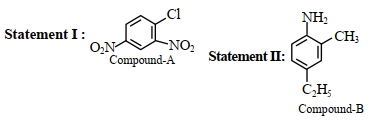 JEE Mains 2024 Medium
- The total number of 'sigma' (σ) and 'Pi' (π) bonds in 2-oxohex-4-ionic acid is ______.JEE Mains 2024 Medium
- One mole of an ideal gas expands isothermally and reversibly from \(10 \mathrm{dm}^3\) to \(20 \mathrm{dm}^3\) at \(300 \mathrm{~K}. \Delta \mathrm{U}\), q and work done in the process respectively are :
Given : \(\mathrm{R}=8.3 \mathrm{JK}^{-1}\) and \(\mathrm{mol}^{-1}\)
\(\begin{aligned}
& \text { In } 10=2.3 \\
& \log 2=0.30 \\
& \log 3=0.48
\end{aligned}\)JEE Mains 2025 Medium - The observed and normal molar masses of compound \(\mathrm{MX}_2\) are 65.6 and 164 respectively. The percent degree of ionisation of \(\mathrm{MX}_2\) is _______ %. (Nearest integer)JEE Mains 2025 Medium
- Match List - I with List - II.
Choose the correct answer from the options given\(\text{ }\)below\(\text{ }\):List - I (Complex) List - II (Hybridisation Magnetic characters) (A) \(\left[\mathrm{MnBr}_4\right]^{2-}\) (I) \(d^2 s^3\) diamagnetic (B) \(\left[\mathrm{FeF}_6\right]^{3-}\) (II) \(\mathrm{sp}^3 \mathrm{~d}^2\) paramagnetic (C) \(\left[\mathrm{Co}\left(\mathrm{C}_2 \mathrm{O}_4\right)_3\right]^{3-}\) (III) \(\mathrm{sp}^3\) diamagnetic (D) \(\left[\mathrm{Ni}(\mathrm{CO})_4\right]\) (IV) \(\mathrm{sp}^3\) paramagnetic JEE Mains 2025 Medium
More PYQs from JEE Mains
- Which one of the following statements is not true about enzymes ?JEE Mains 2021 Medium
- Xg of benzoic acid on reaction with aq \(\mathrm{NaHCO}_3\) released \(\mathrm{CO}_2\) that occupied 11.2 L volume at STP.
X is _____ g.JEE Mains 2025 Easy - The average molar mass of chlorine is \(35.5\, g\) \(mol ^{-1}\). The ratio of \(35\, Cl\) to \(37 \,Cl\) in naturally occurring chlorine is close to :JEE Mains 2020 Hard
- Two isolated conducting spheres \(S_{1}\) and \(S_{2}\) of radius \(\frac{2}{3} R\) and \(\frac{1}{3} R\) have \(12\, \mu C\) and \(-3\, \mu C\) charges, respectively, and are at a large distance from each other. They are now onnected by a conducting wire. A long time after this is done the charges on \(S_{1}\) and \(S_{2}\) are respectivelyJEE Mains 2020 Hard
- 14.0 g of calcium metal is allowed to react with excess HCl at 1.0 atm pressure and 273 K. Which of the following statements is incorrect ? [Given: Molar mass in g mol of Ca-40, Cl-35.5, H-1]JEE Mains 2026 Hard
- In a physical balance working on the principle of moments, when \(5\, mg\) weight is placed on the left pan, the beam becomes horizontal. Both the empty pans of the balance are of equal mass. Which of the following statements is correct?JEE Mains 2017 Medium