


JEE Mains · Chemistry · STD 12 - Co-ordination chemistry
- JEE Mains 2026
- Hard
- MCQ
Given below are two statements:
Statement I: Among \(Zn, Mn, Sc\) and \(Cu\), the energy required to remove the third valence electron is highest for \(Zn\) and lowest for \(Sc\).
Statement II: The correct order of the following complexes in terms of CFSE is \([Co(H_2 O)_6]^{2+} < [Co(H_2 O)_6]^{3+} < [Co(en)_3]^{3+}\).
In the light of the above statements, choose the correct answer from the options given below:
Pick an option to check your answer.
Answer & Solution
Correct Answer
(A) Both Statement I and Statement II are true
Step-by-step Solution
Detailed explanation
Statement I:
The third ionization energy (\(IE_3\)) corresponds to the removal of the third valence electron. Let us look at the electronic configurations of the divalent cations for the given metals:
\(Sc^{2+}\): \([Ar] 3d^{1}\)
\(Mn^{2+}\): \([Ar] 3d^{5}\)
\(Cu^{2+}\): \([Ar] 3d^{9}\)
\(Zn^{2+}\): \([Ar] 3d^{10}\)
For \(Sc\), removing the third electron involves taking it from the \(3d^{1}\) state, which results in a highly stable noble gas core (\([Ar]\)). Hence, \(Sc\) has the lowest \(IE_3\).
For \(Zn\), the third electron must be removed from a completely filled, highly stable \(3d^{10}\) subshell. Combined with its high effective nuclear charge (\(Z_{eff}\)) across the 3d series, \(Zn\) requires the highest energy for the removal of the third electron.
Thus, Statement I is true.
Statement II:
The Crystal Field Stabilization Energy (CFSE) depends on the magnitude of the crystal field splitting energy (\(\Delta_o\)), which in turn depends on the oxidation state of the central metal ion and the strength of the ligand.
1. Oxidation state: A higher oxidation state on the central metal ion leads to a larger \(\Delta_o\). Therefore, the splitting for \(Co^{3+}\) complexes is significantly greater than for \(Co^{2+}\) complexes. This makes the CFSE of \([Co(H_2O)_6]^{3+}\) greater than that of \([Co(H_2O)_6]^{2+}\).
2. Nature of the ligand: Ethylenediamine (\(en\)) is a strong field bidentate ligand, whereas \(H_2O\) is a weak field ligand. According to the spectrochemical series, \(en\) causes a much larger splitting than \(H_2O\). Thus, the \(\Delta_o\) and CFSE for \([Co(en)_3]^{3+}\) are greater than those for \([Co(H_2O)_6]^{3+}\).
The overall order of CFSE is:
\([Co(H_2O)_6]^{2+} < [Co(H_2O)_6]^{3+} < [Co(en)_3]^{3+}\)
Thus, Statement II is true.
Since both statements are correct, the correct option is (1).
Answer: Both Statement I and Statement II are true
More questions from Chemistry
- 'W' g of a non-volatile electrolyte solid solute of molar mass 'M' g \( mol^{-1} \) when dissolved in 100 mL water, decreases vapour pressure of water from 640 mm Hg to 600 mm Hg. If aqueous solution of the electrolyte boils at 375 K and \( K_{b} \) for water is 0.52 K kg \( mol^{-1} \), then the mole fraction of the electrolyte solute \( (X_{2}) \) in the solution can be expressed as
(Given density of water = 1 g/mL and boiling point of water = 373 K)JEE Mains 2026 Hard - Boric acid in solid, whereas \(BF _3\) is gas at room temperature because ofJEE Mains 2023 Medium
- The compound A, \(C_{8}H_{8}O_{2}\) reacts with acetophenone to form a single product via cross-Aldol condensation. The compound A on reaction with conc. NaOH forms a substituted benzyl alcohol asJEE Mains 2026 Hard
- The oxidation state of chromium in the final product formed in the reaction between KI and acidified \( K_{2}Cr_{2}O_{7} \) solution is:JEE Mains 2026 Medium
- Identify the process in which change in the oxidation state is five :JEE Mains 2021 Easy
- If the CFSE of \(\left[ Ti \left( H _2 O \right)_6\right]^{3+}\) is \(-96.0\,kJ / mol\), this complex will absorb maximum at wavelength \(........nm\). (nearest integer) Assume Planck's constant \(( h )=6.4 \times 10^{-34}\,Js\) Speed of light \(( c )=3.0 \times 10^8\,m / s\) and Avogadro's constant \(\left( N _{ A }\right)=6 \times 10^{23} / mol\)JEE Mains 2023 Hard
More PYQs from JEE Mains
- The correct statement with respect to dinitrogen isJEE Mains 2020 Medium
- \(LCR\) circuit is at resonance for a capacitor \(C\), inductance \(L\) and resistance \(R\). Now the value of resistance is halved keeping all other parameters same. The current amplitude at resonance will be now what?JEE Mains 2024 Hard
- \(\mathrm{FeO}_4^{2-} \xrightarrow{+2.0 \mathrm{v}} \mathrm{Fe}^{3+} \xrightarrow{0.8 \mathrm{v}} \mathrm{Fe}^{2+} \xrightarrow{-0.5 \mathrm{v}} \mathrm{Fe}^0\)
In the above diagram, the standard electrode potentials are given in volts (over the arrow).
The value of \(\mathrm{E}_{\mathrm{FeO}_4^{2-} / \mathrm{Fe}^{2+}}^{\mathrm{O}}\) is _______.JEE Mains 2025 Medium - Two thermodynamical process are shown in the figure. The molar heat capacity for process \(A\) and \(B\) are \(C_A\) and \(C_B\). The molar heat capacity at constant pressure and constant volume are represented by \(C_P\) and \(C_V\), respectively. Choose the correct statement.
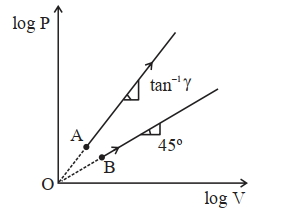 JEE Mains 2024 Hard
- What is the minimum energy required to launch a satellite of mass \(m\) from the surface of a planet of mass \(M\) and radius \(R\) in a circular orbit at an altitude of \(2R\)?JEE Mains 2013 Medium
- An object is thrown vertically upwards. At its maximum height, which of the following quantity becomes zero?JEE Mains 2022 Medium