


JEE Mains · Chemistry · STD 12 - Co-ordination chemistry
- JEE Mains 2026
- Hard
- MCQ
Match the LIST-I with LIST-II
| List-I Electronic configuration of tetrahedral metal ion | List-II Crystal Field Stabilization Energy (\(\Delta_t\)) |
|---|---|
| A. \(d^2\) | I. \(-0.6\) |
| B. \(d^4\) | II. \(-0.8\) |
| C. \(d^6\) | III. \(-1.2\) |
| D. \(d^8\) | IV. \(-0.4\) |
Choose the correct answer from the options given below:
Pick an option to check your answer.
Answer & Solution
Correct Answer
(C) A-III, B-IV, C-I, D-II
Step-by-step Solution
Detailed explanation
In a tetrahedral crystal field, the d-orbitals split into a lower energy \(e\) set and a higher energy \(t_2\) set. The energy of an electron in the \(e\) orbital is \(-0.6 \Delta_t\) and in the \(t_2\) orbital is \(+0.4 \Delta_t\). Since \(\Delta_t\) is generally small, tetrahedral complexes form high-spin configurations.
The Crystal Field Stabilization Energy (CFSE) is given by:
\(\text{CFSE} = (-0.6 n_e + 0.4 n_{t_2}) \Delta_t\)
For \(d^2\): The configuration is \(e^2 t_2^0\).
\(\text{CFSE} = 2 \times (-0.6) + 0 = -1.2 \Delta_t\) (A \(\rightarrow\) III)
For \(d^4\): The configuration is \(e^2 t_2^2\).
\(\text{CFSE} = 2 \times (-0.6) + 2 \times (0.4) = -1.2 + 0.8 = -0.4 \Delta_t\) (B \(\rightarrow\) IV)
For \(d^6\): The configuration is \(e^3 t_2^3\).
\(\text{CFSE} = 3 \times (-0.6) + 3 \times (0.4) = -1.8 + 1.2 = -0.6 \Delta_t\) (C \(\rightarrow\) I)
For \(d^8\): The configuration is \(e^4 t_2^4\).
\(\text{CFSE} = 4 \times (-0.6) + 4 \times (0.4) = -2.4 + 1.6 = -0.8 \Delta_t\) (D \(\rightarrow\) II)
Therefore, the correct match is A-III, B-IV, C-I, D-II.
Answer: A-III, B-IV, C-I, D-II
More questions from Chemistry
- A sample of \(NaClO_3\) is converted by heat to \(NaCl\) with a loss of \(0.16\, g\) of oxygen. The residue is dissolved in water and precipitated as \(AgCl\). The mass of \(AgCl\) (in \(g\)) obtained will be (Given: Molar mass of \(AgCl = 143.5\, g\,mol^{-1}\) )JEE Mains 2018 Hard
- \(2 \mathrm{SO}_{2}(\mathrm{~g})+\mathrm{O}_{2}(\mathrm{~g}) \rightarrow 2 \mathrm{SO}_{3}(\mathrm{~g})\) The above reaction is carried out in a vessel starting with partial pressure \(\mathrm{P}_{\mathrm{SO}_{2}}=250\, \mathrm{~m}\) \(bar,\) \(\mathrm{P}_{0_{2}}=750 \,\mathrm{~m}\) \(bar\) and \(\mathrm{P}_{\mathrm{SO}_{3}}=0 \,\mathrm{bar}\). When the reaction is complete, the total pressure in the reaction vessel is \(.....\mathrm{m}\) \(bar.\) (Round off to the Nearest Integer).JEE Mains 2021 Medium
- A reaction of cobalt \((III)\) chloride and ethylenediamine in a \(1 : 2\) mole ratio generates two isomeric products \(A\) (violet coloured) and \(B\) (green coloured). \(A\) can show optical activity, but, \(B\) is optically inactive. What type of isomers does \(A\) and \(B\) represent?JEE Mains 2019 Hard
- For the following Assertion and Reason, the correct option is Assertion \((A)\) \(:\) When Cu \((II)\) and sulphide ions are mixed, they react together extremely quickly to give a solid. Reason \((R)\) \(:\) The equilibrium constant of \(Cu ^{2+}( aq )+ S ^{2-}( aq ) \rightleftharpoons \operatorname{CuS}( s )\) is high because the solubility product is low.JEE Mains 2020 Medium
- The vapour pressures of two volatile liquids \(A\) and \(B\) at \(25^{\circ} C\) are \(50\, Torr\) and \(100\, Torr,\) respectively. If the liquid mixture contains \(0.3\) mole fraction of \(A\), then the mole fraction of liquid \(B\) in the vapour phase is \(\frac{x}{17}\). The value of \(x\) is \(...\)JEE Mains 2022 Medium
- For a certain reaction at \(300 \mathrm{~K}, \mathrm{~K}=10\), then \(\Delta \mathrm{G}^{\circ}\) for the same reaction is _______ \(\times 10^{-1} \mathrm{~kJ} \mathrm{~mol}^{-1}\). (Given \(\mathrm{R}=8.314 \mathrm{JK}^{-1} \mathrm{~mol}^{-1}\) )JEE Mains 2024 Hard
More PYQs from JEE Mains
- In thermodynamics, heat and work areJEE Mains 2021 Medium
- The light rays from an object have been reflected towards an observer from a standard flat mirror, the image observed by the observer are :- \(A.\) Real \(B.\) Erect \(C.\) Smaller in size then object \(D.\) Laterally inverted Choose the most appropriate answer from the options given below :JEE Mains 2023 Medium
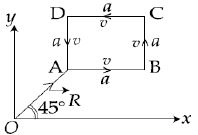
- A particle of mass \(m\) is moving along the side of a square of side '\(a\)', with a uniform speed \(v\) in the \(x-y\) plane as shown in the figure Which of the following statement is false for the angular momentum \(\vec L\) about the origin ?
 JEE Mains 2016 Hard
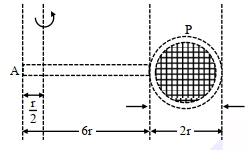
- Consider a badminton racket with length scales as shown in the figure.If the mass of the linear and circular portions of the badminton racket are same \((M)\) and the mass of the threads are negligible, the moment of inertia of the racket about an axis perpendicular to the handle and in the plane of the ring at, \(\frac{r}{2}\) distance from the end \(A\) of the handle will be ....... \(Mr^2\)?
 JEE Mains 2021 Hard
- For the compounds \(CH_3Cl, CH_3Br, CH_3I\) and \(CH_3F\), the correct order of increasing \(C-\) halogen bond length isJEE Mains 2014 Medium
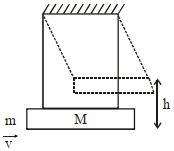
- A large block of wood of mass \(M =5.99\, kg\) is hanging from two long massless cords. A bullet of mass \(m =10\, g\) is fired into the block and gets embedded in it. The (block \(+\) bullet) then swing upwards, their centre of mass rising a vertical distance \(h =9.8\,cm\) before the (block \(+\) bullet) pendulum comes momentarily to rest at the end of its arc. The speed of the bullet just before collision is: (Take \(g =9.8\, ms ^{-2}\) ) (in \(m/s\))
 JEE Mains 2021 Hard